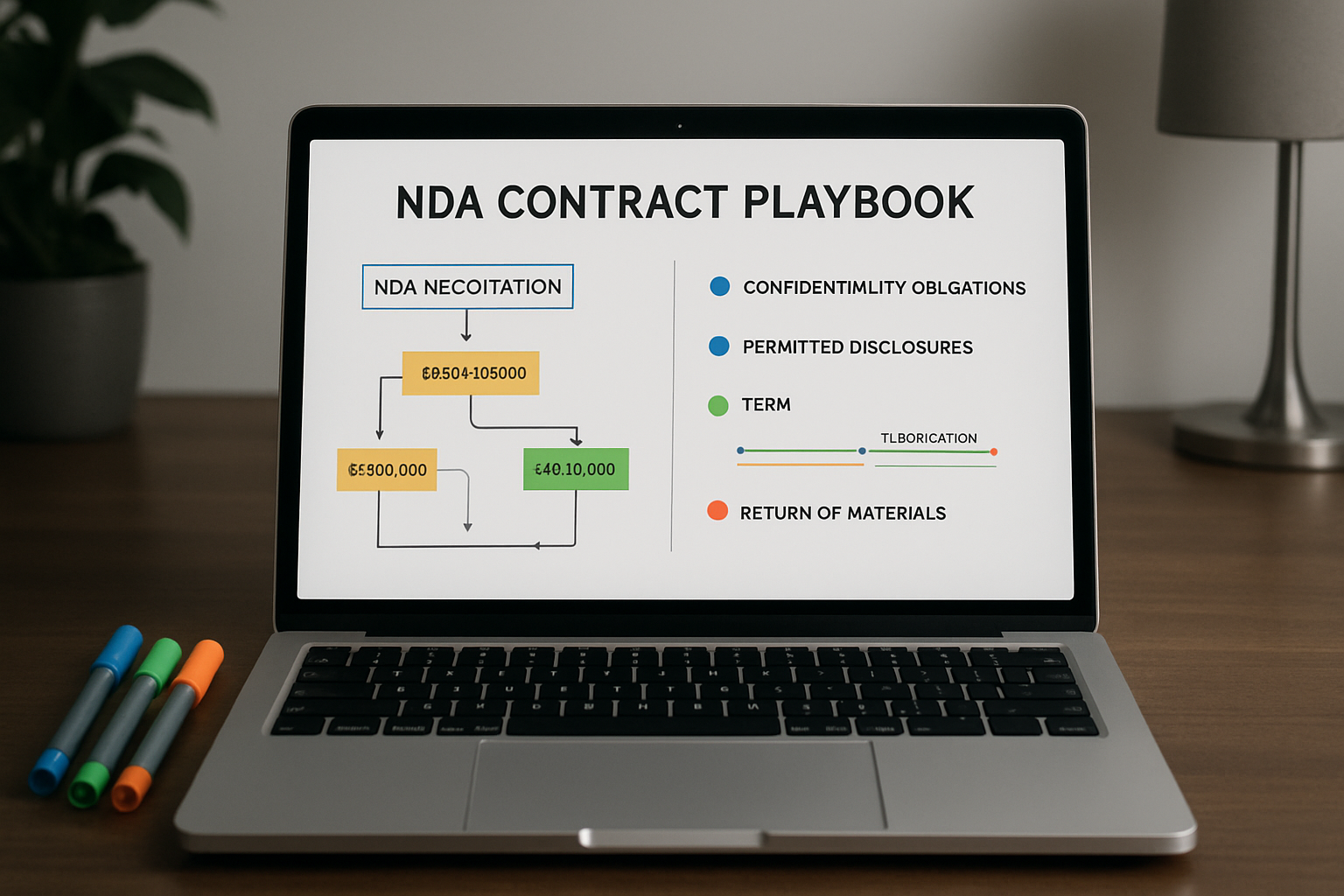
NDA contract playbook Guide
To explain an NDA contract playbook, you have to look at it as a “cheat sheet” for negotiations.
Most legal teams spend 50% to 70% of their time on NDAs—which are the most routine, high-volume documents in business. An NDA playbook is designed to get those off a lawyer’s desk and into the hands of Sales or Ops without increasing risk.
Here is the definitive guide to what an NDA contract playbook is, why it matters, and what actually goes inside one.
What is an NDA Contract Playbook?
An NDA contract playbook is a strategic “decision-making rubric” that tells a negotiator exactly how to handle a Non-Disclosure Agreement. Instead of a lawyer having to review every single redline manually, the playbook provides a pre-approved set of “guardrails.”
Think of it as institutional knowledge in a document.
It captures the company’s risk tolerance, preferred legal language, and the “lines in the sand” that cannot be crossed without executive approval.
Why bother building an NDA playbook?
- Speed (The “Deal Velocity” Factor): It allows Sales teams to negotiate their own NDAs. Deals that used to take 2 weeks for legal review can now be signed in 24 hours.
- Consistency: It ensures that every NDA the company signs has the same level of protection. You don’t want a junior lawyer in APAC signing off on something that a senior lawyer in the US would have rejected.
- Training: It acts as an “Onboarding Manual” for new hires. A new contract manager can be productive on Day 1 by simply following the playbook.
- AI Readiness: In 2026, most AI contract review tools (like Spellbook or Lexion) require a playbook to work. The AI “reads” your playbook and redlines the contract automatically based on your rules.
The “Big 3” Components of a NDA Contract Playbook
A high-quality NDA playbook isn’t just a list of rules; it’s a three-tier system for handling pushback from a counterparty:
1. The Gold Standard (Preferred Position)
This is your “starting line.” It’s the ideal version of the clause that is most protective of your company. In a playbook, this section includes the exact text to use and a “Rationale” explaining why we want it this way.
2. The Fallbacks (The “Plan B” and “Plan C”)
This is the heart of the playbook. If a counterparty says, “We can’t agree to a 5-year confidentiality term,” the playbook might say:
- Fallback 1: Offer 3 years.
- Fallback 2: Offer 2 years (minimum acceptable).
- Limit: If they ask for 1 year, do not sign—move to escalation.
3. The Escalation Path
The playbook clearly defines who the “Final Boss” is for specific issues.
- Example: “If the counterparty insists on a specific governing law (e.g., Singapore instead of New York), escalate to the General Counsel.”
What Clauses are Usually in an NDA Playbook?
Because NDA playbook clauses are relatively standard, the playbook usually focuses on these 5 “battleground” areas:
| Clause Type | What the NDA Playbook Defines |
|---|---|
| Definition of Confidential Info | Should it be “marked” as confidential, or is “orally disclosed” info covered too? |
| Duration of Obligations | How long must the secret stay secret? (2 years, 5 years, or Indefinite?) |
| Return/Destruction of Data | Do they have to send the data back, or can they just delete it and certify? |
| Exclusions | Standard “outs” like info already in the public domain or legally required disclosures. |
| Non-Solicit | (The “Gotcha” clause) Can we add a rule that they can’t poach our employees? |
The Bottom Line
An NDA contract playbook turns a bottleneck into a process.
It’s the difference between a legal team that is “killing deals” with delays and a legal team that is “enabling the business” with clear, automated standards.
By using an NDA contract playbook generator, you can instantly transform these static legal rules into a dynamic asset that helps your entire company close deals faster and more securely.
See it in action
Turn contract chaos into a streamlined workflow
Join legal teams who cut contract turnaround time by 60%. Book a 15-minute demo to see how.