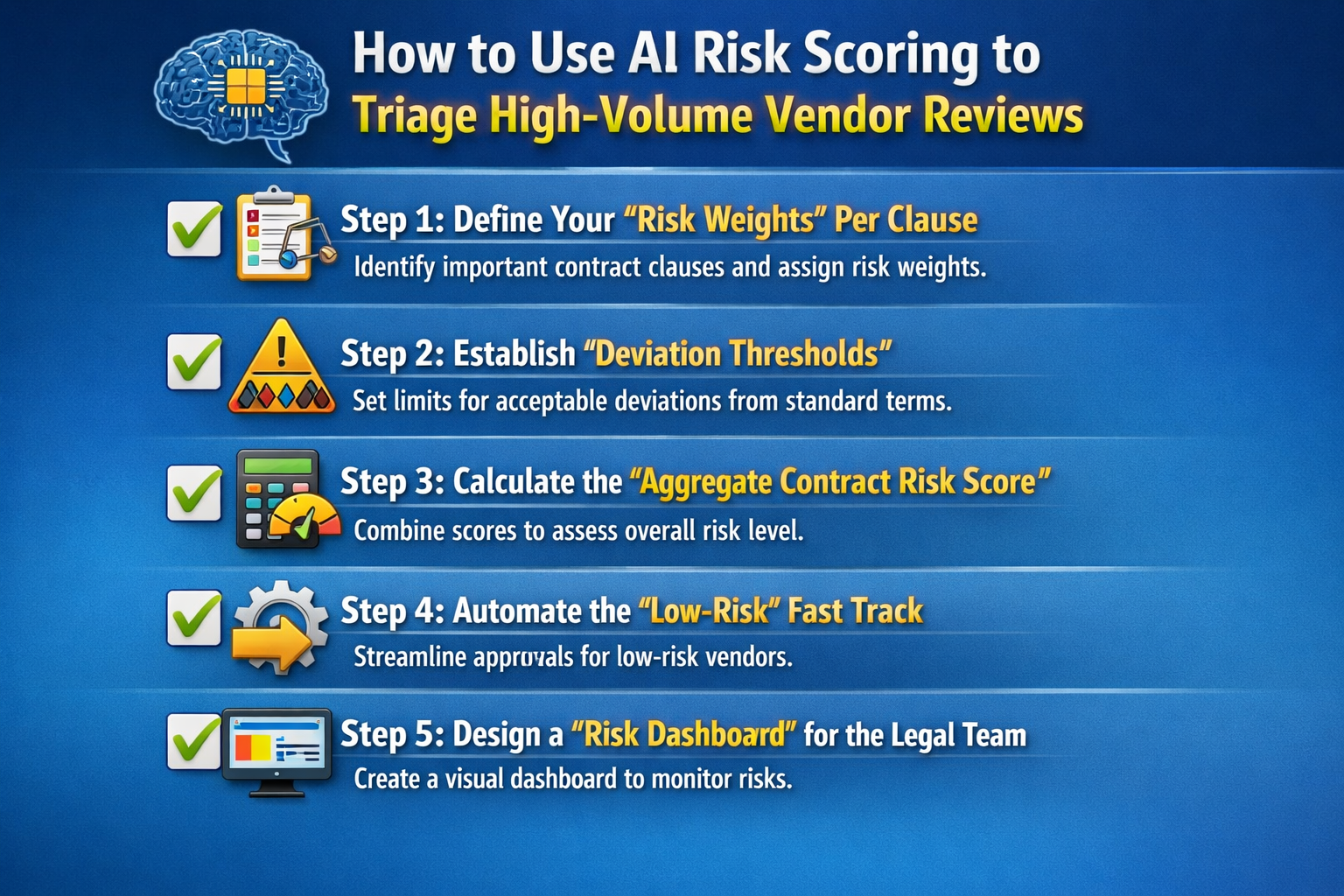
AI Risk Scoring to Triage Vendor Reviews
If you’ve successfully figured out how to automate redlines on external contract templates, you’ve already solved the speed problem.
But as your volume grows, you might be wondering how to decide which contracts even need human eyes-on review in the first place? Or how to separate the “no-brainer” renewals from the high-risk agreements that could sink a quarter?
If that’s you, you’re not alone.
Here are the 5 steps to using AI risk scoring to triage your vendor reviews:
Step 1: Define Your “Risk Weights” Per Clause
AI doesn’t inherently know that an Indemnity clause is more dangerous than a Notice clause.
You have to tell it.
The first step is assigning a weight to every contract clause category in your playbook based on how much it impacts the business if that specific clause deviates from your standard.
We suggest a simple 1-10 weighting system:
- High Weight (8-10): Limitation of Liability, IP Ownership, Data Privacy.
- Medium Weight (4-7): Termination for Convenience, Audit Rights, Insurance Requirements.
- Low Weight (1-3): Governing Law, Force Majeure, Confidentiality.
Step 2: Establish “Deviation Thresholds”
Once you have your weights, the AI needs to measure how far the vendor’s contract clause language has strayed from yours. A 5% change in clause wording might be a “Low Deviation,” while a completely missing clause is a “High Deviation.”
You could set your thresholds like this:
- Exact Match: 0 points (No risk).
- Minor Variation: 2 points (Standard clause language but with different phrasing).
- Major Deviation: 10 points (The vendor has completely removed your clause protection or reversed the clause intent).
Step 3: Calculate the “Aggregate Contract Risk Score”
This is where the math happens.
To get your total, the contract review system performs a two-part calculation: Multiply the weight by the deviation for each clause, then Add those results together for a final contract-wide score.
For example:
- Liability Clause: Weight (10) x Deviation (8) = 80
- Force Majeure Clause: Weight (1) x Deviation (2) = 2
- Aggregate Contract Score: 80 + 2 = 82
You can now set a rule that says “Any contract with a total score over 50 must be reviewed by a Senior Lawyer.”
Step 4: Automate the “Low-Risk” Fast Track
The goal of risk scoring isn’t just to find the bad stuff; it’s also to ignore the safe stuff.
If a contract comes in with an aggregate score of 10 or less, meaning every contract clause is either standard or low-risk, you can “Fast-Track” it. This means the system can auto-approve the document without Legal ever touching a single clause.
We recommend setting your fast-track rules based on:
- Standard Templates: Any contract on your own paper with zero clause redlines.
- Pre-Approved Libraries: Trusted partners where you’ve already agreed to their “Master Clauses.”
- Dollar Thresholds: Any contract under $5,000 where every high-risk contract clause is within acceptable limits.
Step 5: Design a “Risk Dashboard” for the Legal Team
Instead of opening every Word doc to see what’s inside, your team should work from a dashboard that ranks the “In-Flight” reviews by their total score. This ensures that the most dangerous contract clauses are handled at 9:00 AM, while the low-risk “paperwork” is handled at the end of the day.
Your dashboard should highlight:
- The “Red Zone”: Contracts that hit high-weight contract clause triggers (like an Uncapped Liability clause).
- The “Trend Data”: Are specific vendors consistently sending high-risk indemnity clauses? This helps you negotiate better Master Agreements in the future.
Conclusion
And there you have it!
We hope this article helps you work smarter by giving your legal team the “permission to ignore” the noise so they can focus on high-value contract clause risks.
If you’re drowning in a sea of “Medium-Risk” vendor contracts and want to see how we build automated triage systems that analyze every contract clause, feel free to book a demo with us below.
Otherwise, check out our next article on how to streamline the internal contract review process.
See it in action
Turn contract chaos into a streamlined workflow
Join legal teams who cut contract turnaround time by 60%. Book a 15-minute demo to see how.