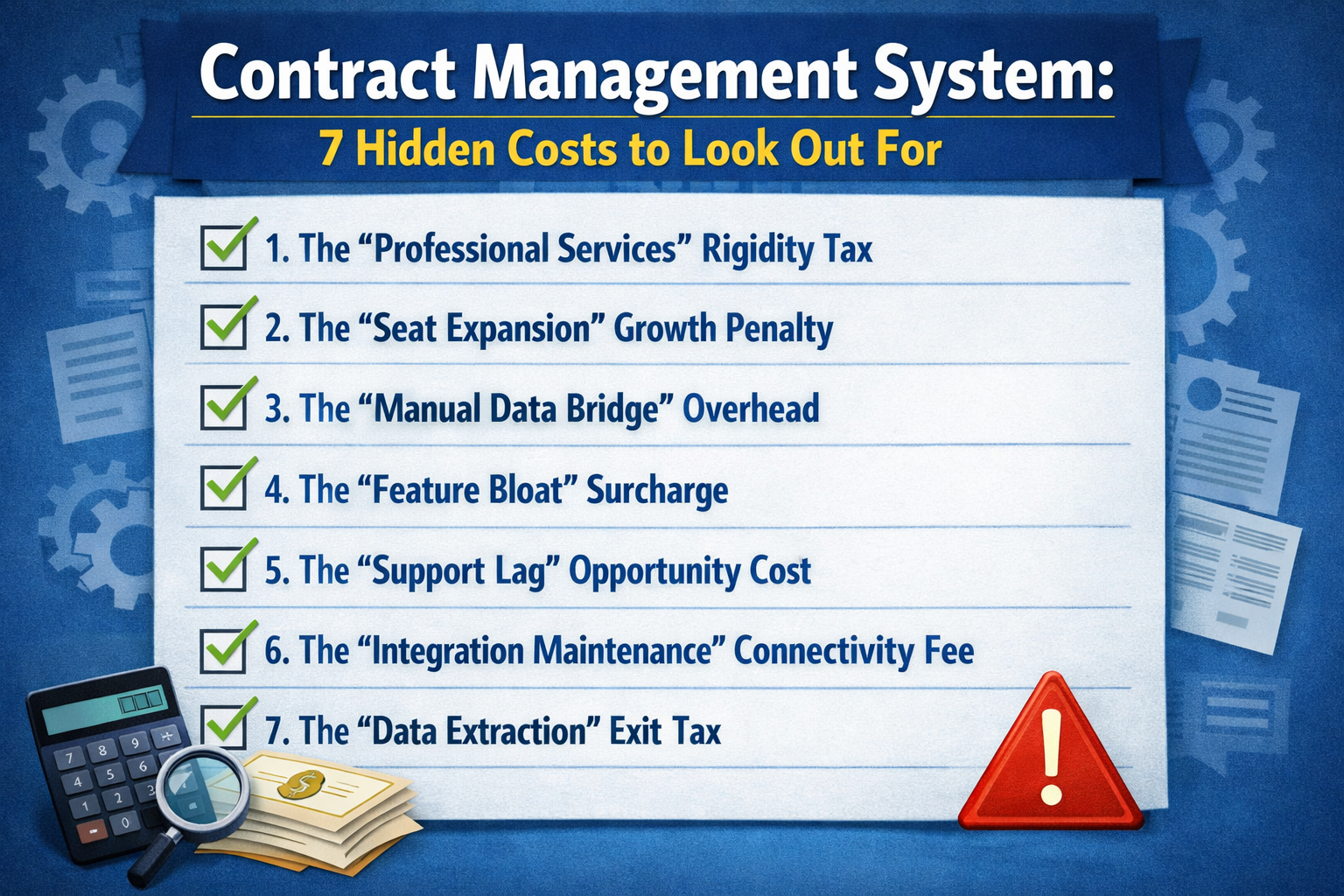
Contract Management System: 7 Hidden Costs
If you are currently improving your contract management adoption or looking to switch systems, you might have already stumbled upon some “hidden costs.”
These often look like surprise line items for “implementation overages,” mandatory training fees, or the realization that you’re paying for a massive feature set that your team never actually touches.
If that’s you, you’re not alone.
Many legacy platforms are built on a “lock-in” model that makes growth expensive.
Here are 7 hidden costs to look out for in your contract management system:
1. The “Professional Services” Rigidity Tax
Take a look at your vendor-led configuration spend over the last year. If every minor adjustment to a contract approval workflow requires a paid engagement with the vendor’s services team, you aren’t just paying for software, you’re paying a “rigidity tax.” A high-ROI system should allow your Legal Ops lead to make these changes in-house without a statement of work.
2. The “Seat Expansion” Growth Penalty
Many vendors charge a premium for every new user, which often discourages you from giving access to the people who need it most (like Sales or Finance). If you find yourself hesitant to scale the tool because the “per-seat” bill will skyrocket, the pricing model is actively working against your contract management adoption goals.
3. The “Manual Data Bridge” Overhead
The true cost of a system includes the time your team spends “babysitting” the data. If your lawyers are manually re-typing terms from a signed PDF into your CRM because the systems don’t sync, you are paying a high hourly rate for clerical work. This “manual bridge” usually hides thousands of dollars in wasted legal hours that an integrated contract management system would eliminate.
4. The “Feature Bloat” Surcharge
It is worth auditing which modules of your current platform actually show user activity. Many legal teams pay for high-end “All-in-One” suites, including advanced AI analytics or procurement modules, that never actually made it out of implementation. If you are only using the repository and e-signature, you are essentially subsidizing the vendor’s R&D for features you don’t use.
5. The “Support Lag” Opportunity Cost
Time is money during a deal cycle. Audit the average response time for your current vendor’s support team. If a technical glitch in your contract drafting tool halts a major deal for 48 hours while you wait for a ticket response, that “downtime” cost is a hidden expense that belongs on the software’s annual price tag.
6. The “Integration Maintenance” Connectivity Fee
Some legacy vendors charge an additional annual fee just to keep an API connection “active” (like your Salesforce or Slack integration). These “connectivity fees” often go unnoticed until renewal time. You should check whether you are being charged for the privilege of connecting your own contract data to your own tech stack.
7. The “Data Extraction” Exit Tax
Finally, look at how difficult it is to get your own data back. Some vendors charge significant “export fees” or provide your data in a format that is intentionally difficult to migrate. This “exit tax” is a hidden cost designed to prevent you from switching your contract management system. Knowing this cost now allows you to plan your exit strategy or negotiate it out of your next renewal.
Conclusion
Identifying the hidden costs of your contract management system isn’t just about cutting spend; it’s about ensuring your budget is being spent on value, not friction. By surfacing these “vendor taxes,” you can build a stronger business case for a system that scales with your team rather than penalizing your growth.
If your current vendor’s “hidden fees” are starting to pile up, feel free to check out our contract management system for a more transparent, ROI-focused approach.
Otherwise, check out our next article on signs you should simplify your contract management system.
See it in action
Turn contract chaos into a streamlined workflow
Join legal teams who cut contract turnaround time by 60%. Book a 15-minute demo to see how.