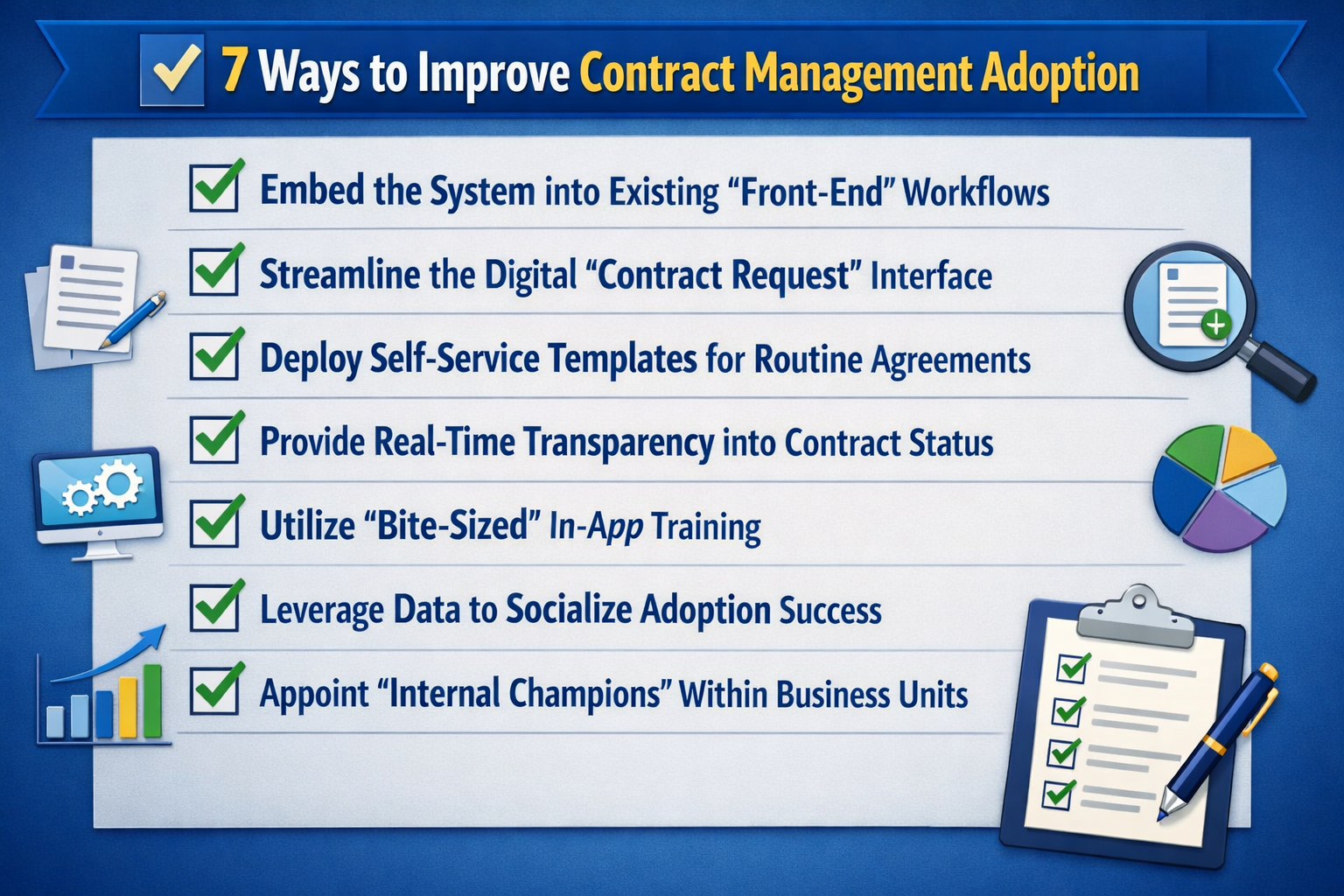
7 Ways to Improve Contract Management Adoption
If you are currently in the process of switching your contract management system or are considering a new implementation, you are likely already thinking about user adoption.
Perhaps wondering if your Sales or Procurement teams will actually swap out their manual workarounds in email and Slack for a new platform, or if the tool will just become expensive “shelf-ware.”
If that’s you, you are not alone.
Here are 7 ways we have seen work to improve contract management adoption:
1. Embed the System into Existing “Front-End” Workflows
Meeting your users where they already live is the fastest path to adoption. Instead of forcing a Sales rep to log into a separate contract management portal, you might find it better to integrate the system directly into their CRM. When a rep can generate a contract with a single click inside the tools they already use, the incentive to go “rogue” disappears because the system is officially the path of least resistance.
2. Streamline the Digital “Contract Request” Interface
Intake forms are often where adoption goes to die. If your request form is 20 fields long and full of legal jargon, users will find a way around it. We’ve noticed that high-adoption teams use “dynamic intake,” asking only for the bare essentials. By reducing the friction of the initial contract request, you make it easier for the business to stay within the guardrails you’ve set.
3. Deploy Self-Service Templates for Routine Agreements
The perceived “Legal Bottleneck” is the primary driver of manual workarounds. You could consider empowering your business teams with self-service templates for low-risk agreements like NDAs or standard renewals. When users see that using the contract management software allows them to bypass the Legal queue and get a signature in minutes, they become the tool’s biggest internal advocates.
4. Provide Real-Time Transparency into Contract Status
Nothing kills trust in a new system faster than a “black hole” where users don’t know where their agreement stands. You might find that providing a real-time status dashboard, where Sales can see exactly who is currently redlining the document, reduces the need for follow-up emails. This transparency proves that the contract management system is a tool for velocity, not just oversight.
5. Utilize “Bite-Sized” In-App Training
Traditional, four-hour training sessions are rarely effective. You could try providing contextual support within the tool itself instead. Short, 60-second video clips or “hover-over” tips that explain how to use specific contract management features are far more useful. This “just-in-time” learning approach ensures users don’t feel overwhelmed when they encounter the system for the first time.
6. Leverage Data to Socialize Adoption Success
Using the system’s own data to highlight internal wins can help normalize the new process. For example, you could broadcast the “Fastest Closing Team” based on the contract negotiation velocity data pulled from the system. When the executive team recognizes departments that maintain 100% compliance within the contract management tool, it signals that the software is a core business priority.
7. Appoint “Internal Champions” Within Business Units
You might consider identifying one power user in Sales and one in Procurement to act as “Internal Champions.” These shouldn’t be Legal team members; they should be peers who speak the language of their own department. When a Sales rep can ask a fellow rep who is already a pro at the contract management platform, adoption spreads much faster than if the training always comes from Legal.
Conclusion
Improving contract management adoption is less about the technology and more about the human experience. By making the system invisible (through integrations) and valuable (through self-service), you can ensure your tech investment actually pays off.
If you’re struggling to get your business teams to use your current system, feel free to check out our contract management software to see how we design for user adoption.
Otherwise, check out our next article on auditing your contract management software’s hidden costs.
See it in action
Turn contract chaos into a streamlined workflow
Join legal teams who cut contract turnaround time by 60%. Book a 15-minute demo to see how.