
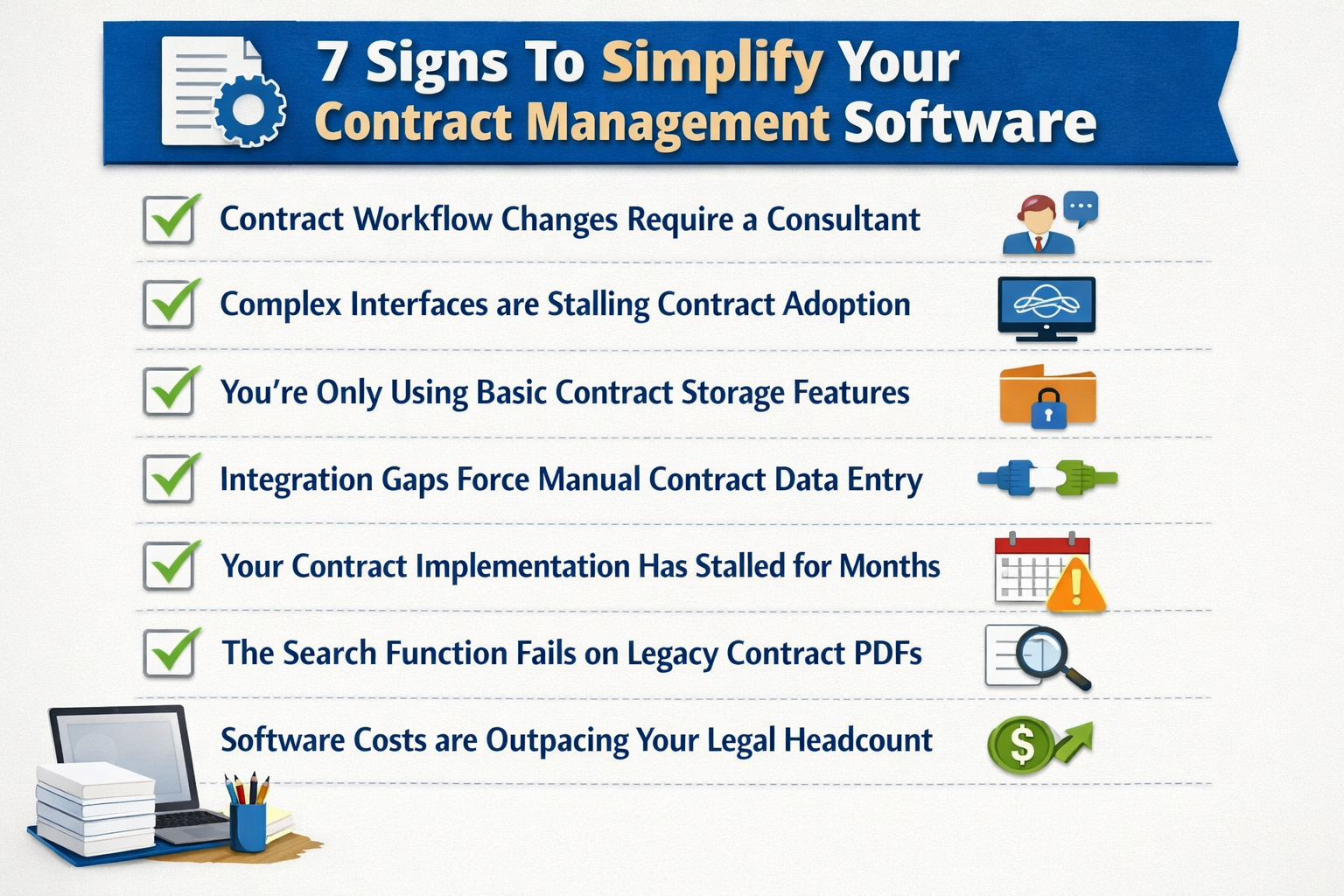
7 Signs To Simplify Your Contract Management Software
If you’ve recently conducted a hidden cost audit of your contract management system, you might have realized that “more” isn’t always “better.”
This often happens as a result of legal teams being sold on the dream of the “All-in-One” CLM or a platform that promises to handle everything from procurement to complex AI analytics.
If that’s you, you’re not alone.
Here are 7 signs that it’s time to simplify your current contract management software:
1. Contract Workflow Changes Require a Consultant
If you have to call a vendor every time you want to tweak a contract approval path or add a new template, your system is too complex. A streamlined team needs a system where Legal Ops can manage the contract backend in-house, without a Statement of Work for every minor change.
2. Complex Interfaces are Stalling Contract Adoption
When a tool is over-built, the contract request interface becomes cluttered and intimidating. If your Sales team is still sending agreements via email because the portal is too confusing, it’s a sign that you need to simplify the user experience to drive contract management adoption.
3. You’re Only Using Basic Contract Storage Features
Take a hard look at your usage data. Are you actually using the high-end AI risk-scoring or procurement modules? Most legal teams just need a fast way to draft, negotiate, and store agreements. If you are paying for an enterprise suite but only utilizing the digital contract repository, you are essentially subsidizing bloat.
4. Integration Gaps Force Manual Contract Data Entry
A system that tries to do everything often fails to do the one thing you need: connect. If your team is manually syncing data because your contract management integrations are brittle, you’ve outgrown the “All-in-One” dream. You need a simpler, API-first hub that syncs contract metadata automatically.
5. Your Contract Implementation Has Stalled for Months
The “All-in-One” trap often leads to perpetual implementation. If you are six months into a rollout and still haven’t moved past the “configuration” phase for your core templates, the system is too heavy for your organization. Simplifying your approach allows you to see contract management value in weeks, not years.
6. The Search Function Fails on Legacy Contract PDFs
More features shouldn’t mean worse search. If you can’t find a specific clause across 500 legacy MSAs without opening every single PDF, your contract repository is likely over-complicated but under-powered. A simpler, focused system with robust AI-assisted OCR search is often more effective than a bloated suite.
7. Software Costs are Outpacing Your Legal Headcount
If your annual renewal increases significantly every time you add a new department or user, the “All-in-One” model is penalizing your growth. At a certain point, the “vendor tax” becomes an anchor. Simplifying your tech stack often comes down to a financial realization: it’s time for a more agile contract management system.
Conclusion
Choosing to simplify your system isn’t a step backward, it’s a step toward reclaiming your team’s productivity.
If these signs look familiar, feel free to check out our contract management system that is designed for speed and adoption rather than bloat.
Otherwise, check out our next article on why you need to stop using Excel for contract management.
See it in action
Turn contract chaos into a streamlined workflow
Join legal teams who cut contract turnaround time by 60%. Book a 15-minute demo to see how.