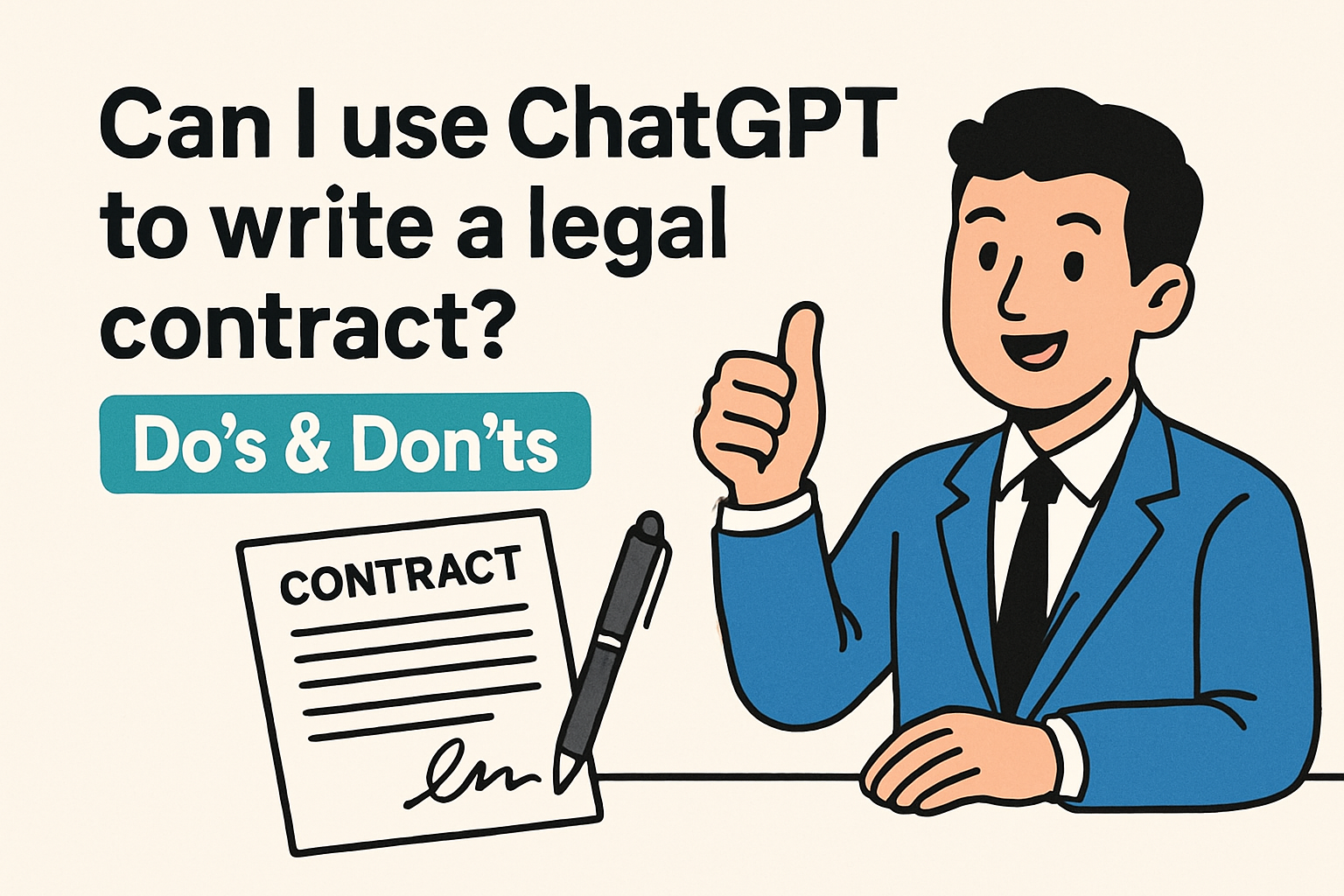
Can ChatGPT Write a Legal Contract? Do's and Don'ts
This question represents the ultimate temptation in utilizing generative AI for legal work. If ChatGPT can produce coherent essays and code, surely it can draft a boilerplate contract?
The answer is nuanced but carries a heavy warning…
Yes, ChatGPT can generate contract language and outlines, but you should not use it to write a final, legally binding B2B contract independently.
The Core Principle: Raw Clay, Not a Finished Sculpture
Think of ChatGPT as providing raw clay, not a finished, legally binding sculpture.
It is a powerful tool for generating the structure of a document but critically lacks the legal expertise, liability coverage, and contextual awareness necessary for final contract execution.
Treating its output as a final draft introduces immediate and unacceptable risks that fall squarely on your organization:
- Lack of Legal Credibility: The output has no legal warranty or liability coverage.
- Missing Essential Protections: Templates are bare and often omit crucial, high-stakes clauses (IP, jurisdiction, termination).
- Contextual Blindness: The AI does not know your specific jurisdiction, industry, or negotiation history.
To leverage AI safely in this high-risk area, you must understand where it is a helpful starter and where it is a dangerous liability.
The AI Draftsman: Where ChatGPT Serves as a Contract Starter
While using public AI for final contract drafting is unsafe, the technology is highly effective at speeding up the initial, low-risk stages of the document creation process or simple comparison of two contracts.
1. Generating a Starting Point and Outline
- Templates: Useful for generating simple, non-complex agreement outlines or common correspondence (e.g., general-purpose NDAs, initial vendor inquiry letters).
- Boilerplate Clauses: Helpful when you already know the specific clause required (e.g., standard confidentiality or governing law language) but need fast, clean text. This is why lawyers often use it for initial contract drafting purposes to overcome writer’s block.
2. Auxiliary Legal Correspondence
Many firms find the greatest time savings in using AI for administrative or low-risk communications where precise legal standing is not the primary goal:
- Correspondence: Excellent for drafting cease and desist letters, disengagement letters, explanatory comments, or negotiation emails—tasks that require clear communication but not complex legal analysis.
The Drafting Deficit: 4 Reasons ChatGPT Creates Legal Liability
The time saved by using AI to draft a contract is immediately offset by the exponential increase in legal liability. For any contract that binds your business, the following deficits make relying on a public LLM an unacceptable risk:
1. Lack of Legal Credibility and Warranty
The most fundamental flaw is the absence of legal standing. ChatGPT is a predictive text engine, not a fiduciary.
- No Liability Coverage: If the AI generates an error that leads to a financial dispute or litigation, the AI provider assumes zero liability. The entire financial and legal risk falls squarely on your organization and the employee who used the tool.
- Un-enforceability: To be legally valid and enforceable, contracts must often meet specific jurisdictional and industry requirements. ChatGPT does not guarantee this validity; its output must be validated by a qualified legal expert.
2. Missing Essential Protections (Bare Templates)
ChatGPT excels at general outlines but critically fails at the specific, high-stakes clauses that protect your business.
- High-Stakes Omissions: The templates it generates are often “bare” and fail to include necessary legal protections such as detailed intellectual property assignment, robust termination clauses, specific dispute resolution mechanisms, or detailed representations and warranties.
- Contextual Voids: The AI does not know that your specific B2B transaction requires specialized clauses for data handling (GDPR/CCPA), industry-specific indemnities, or limitations on liability that align with your firm’s insurance policy.
3. Limited Contextual Understanding and Legal Errors
Contracts are dynamic documents based on negotiation history and specific business context. The AI operates in a void.
- Jurisdictional Blindness: The output is generic. It doesn’t know if the standard “Governing Law” clause it suggested is enforceable in the state or country where your client is located.
- Inaccurate/Outdated Law: Since the public LLM’s training data is static (and sometimes inaccurate or fabricated, known as “hallucination”), it can fail to incorporate the latest statutory or case law changes, making the resulting contract legally flawed.
4. Policy Risk: Inputting Proprietary Requirements
To get a useful contract draft, users are often tempted to input proprietary business details (e.g., specific pricing models, client data, or negotiation secrets) into the public chat interface.
- Confidentiality Breach: As detailed in our previous article, [uploading entire contracts onto ChatGPT (Internal Link to “Is It Safe…”)] compromises data security. Inputting proprietary terms for drafting guidance carries the same risk of data leakage and policy violation.
The Safe Path: From ChatGPT Draft to Professional Legal Agreement
The goal is to leverage AI’s speed without inheriting its risk. For B2B organizations, this means abandoning public LLMs for final contract drafting and moving to secure, specialized platforms.
1. Utilize Secure, AI-Powered Drafting Platforms
True professional drafting requires tools built with security, compliance, and legal knowledge at their core.
- Secure Drafting: Specialized AI contract review platforms offer secure environments where your proprietary drafting instructions and templates are guaranteed to remain private and never used for external training.
- Precedent Libraries: These platforms integrate your company’s approved legal templates and precedents, ensuring every draft starts with clauses that have already been vetted for legal soundness and risk tolerance.
2. Human Supervision is Non-Negotiable
Any text generated by an AI—no matter how sophisticated—must be treated as a draft and requires final legal oversight.
- Legal Vetting: The final step must always be a review and stamp of approval by a qualified legal professional to confirm jurisdictional validity and enforceability.
Final Thought: The Strategic Drafting Caveat
And there you have it…
To summarize the strategic path:
- For Initial Drafting: If you are looking to generate a simple boilerplate clause or a basic outline for initial contract drafting purposes, a general LLM can be a fast, time-saving tool.
- For Final Execution: For any contract that will lead to legal execution or bind your organization financially, the final document must be built on secure, purpose-built platforms and reviewed by a qualified human expert. The risk of the AI missing essential protections or hallucinating an unenforceable clause is simply too high.
If you have any other questions - feel free to book a demo with us today!
We will be more than happy to guide you!
See it in action
Turn contract chaos into a streamlined workflow
Join legal teams who cut contract turnaround time by 60%. Book a 15-minute demo to see how.