How to Build a University Contract Clause Library
If you’ve successfully streamlined your grant management, you might be wondering how to address inconsistent legal language within your contracts.
And if there is a centralized library that provides “pre-approved” options for your team, without stripping away the flexibility needed to handle complex intellectual property and academic freedom nuances.
If that’s you, you’re not alone.
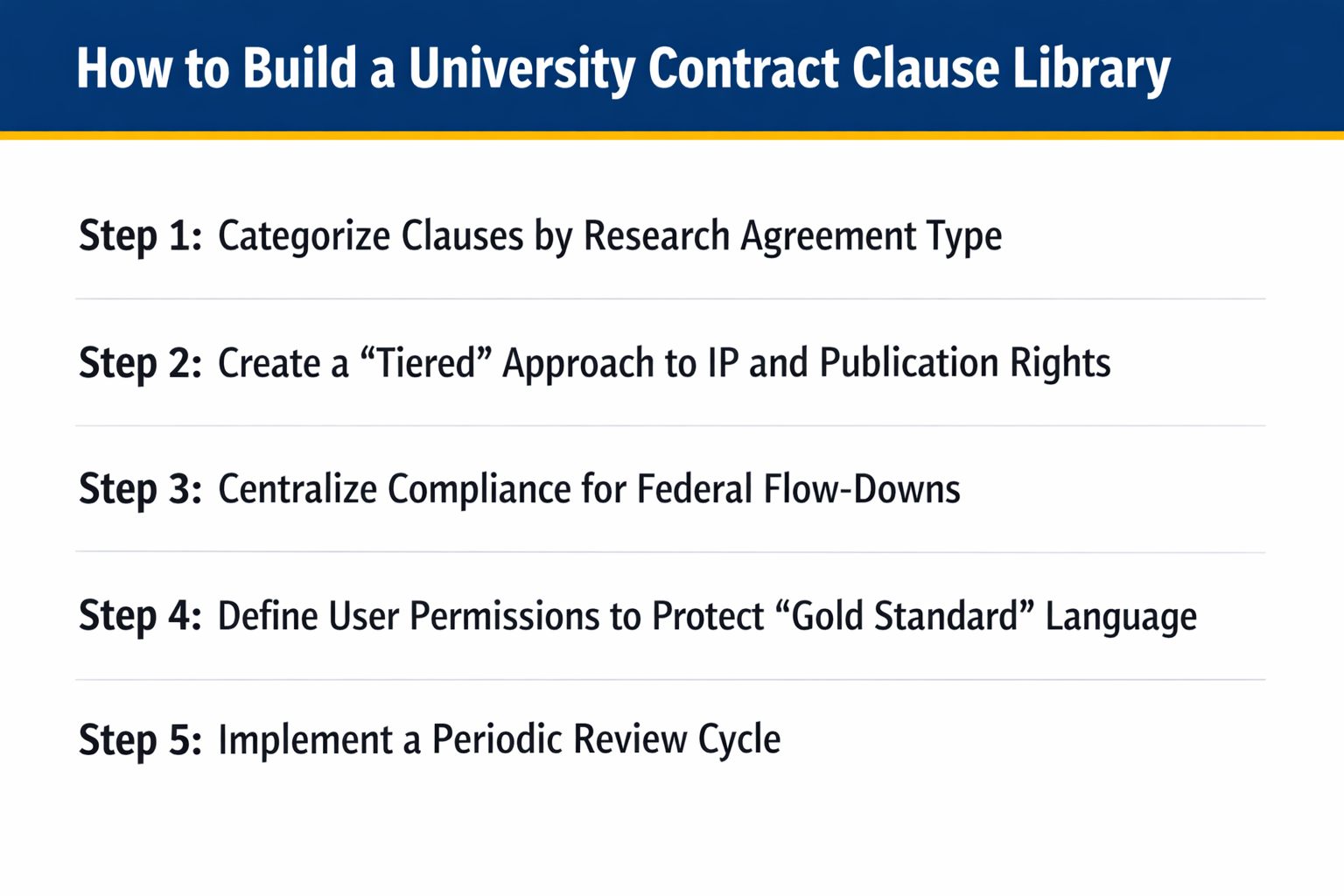
Here are the 5 steps to building a university contract clause library:
Step 1: Categorize Clauses by Research Agreement Type
To keep the team from digging through irrelevant language, organize your library so that clauses are grouped by the specific agreement type they belong to.
Consider organizing categories for:
- Sponsored Research (SRAs): Standardized blocks for IP, publication rights, and overhead.
- Material Transfer (MTAs): Specific modules for inbound vs. outbound biological or technical materials.
- Non-Disclosure (NDAs): Clean, pre-approved templates for one-way or mutual disclosures.
Step 2: Create a “Tiered” Approach to IP and Publication Rights
Instead of forcing a single rigid stance, try building “tiers” into your library that provide your contract managers with pre-vetted fallback positions.
To simplify negotiations:
- Develop Standard Fallbacks: Have a “Preferred” clause and an “Acceptable” fallback already vetted by your General Counsel.
- Tag Clauses by Risk: Consider marking aggressive IP stances as “High Review” so the system flags them for senior attention automatically.
Step 3: Centralize Compliance for Federal Flow-Downs
To ensure regulatory updates are pushed to every draft instantly, centralize your federal compliance modules rather than updating templates one by one.
To keep your compliance current:
- Use Version Control: Update a federal module once in the central library to ensure no one is accidentally using an expired 2 CFR 200 clause.
- Automate Mandatory Inserts: Consider setting “must-include” rules for specific grant types so the software won’t allow a draft to be finalized without them.
Step 4: Define User Permissions to Protect “Gold Standard” Language
To keep your library’s integrity intact and prevent unvetted tweaks, set clear permissions on who can modify the master library versus who can simply use the clauses in a draft.
Consider implementing:
- Role-Based Access: Allow the team to use the clauses, but restrict editing rights to a few senior legal officers.
- Locking Critical Clauses: Lock high-risk paragraphs (like Indemnity or Governing Law) so they cannot be edited within a draft without a formal override.
Step 5: Implement a Periodic Review Cycle
Instead of waiting for an audit finding or a major compliance gap, set a recurring schedule to look at which clauses are actually being used and which ones are constantly being rejected in negotiations.
To stay agile:
- Track Negotiation Data: If a specific “Publication” clause is rejected in the majority of your deals, use that data to rewrite a more “market-standard” version.
- Schedule Annual Audits: Conduct a formal review of the library every 12 months to ensure it still aligns with the university’s current risk appetite.
Conclusion
By building a centralized university contract clause library, you’re doing more than just organizing text, you’re creating a scalable framework for your entire Research Office.
If you’re ready to see how a dedicated contract drafting software can house and automate your university-specific library, feel free to book a demo with us.
Otherwise, check out our next article on streamlining internal approvals for University research contracts.
See it in action
Turn contract chaos into a streamlined workflow
Join legal teams who cut contract turnaround time by 60%. Book a 15-minute demo to see how.