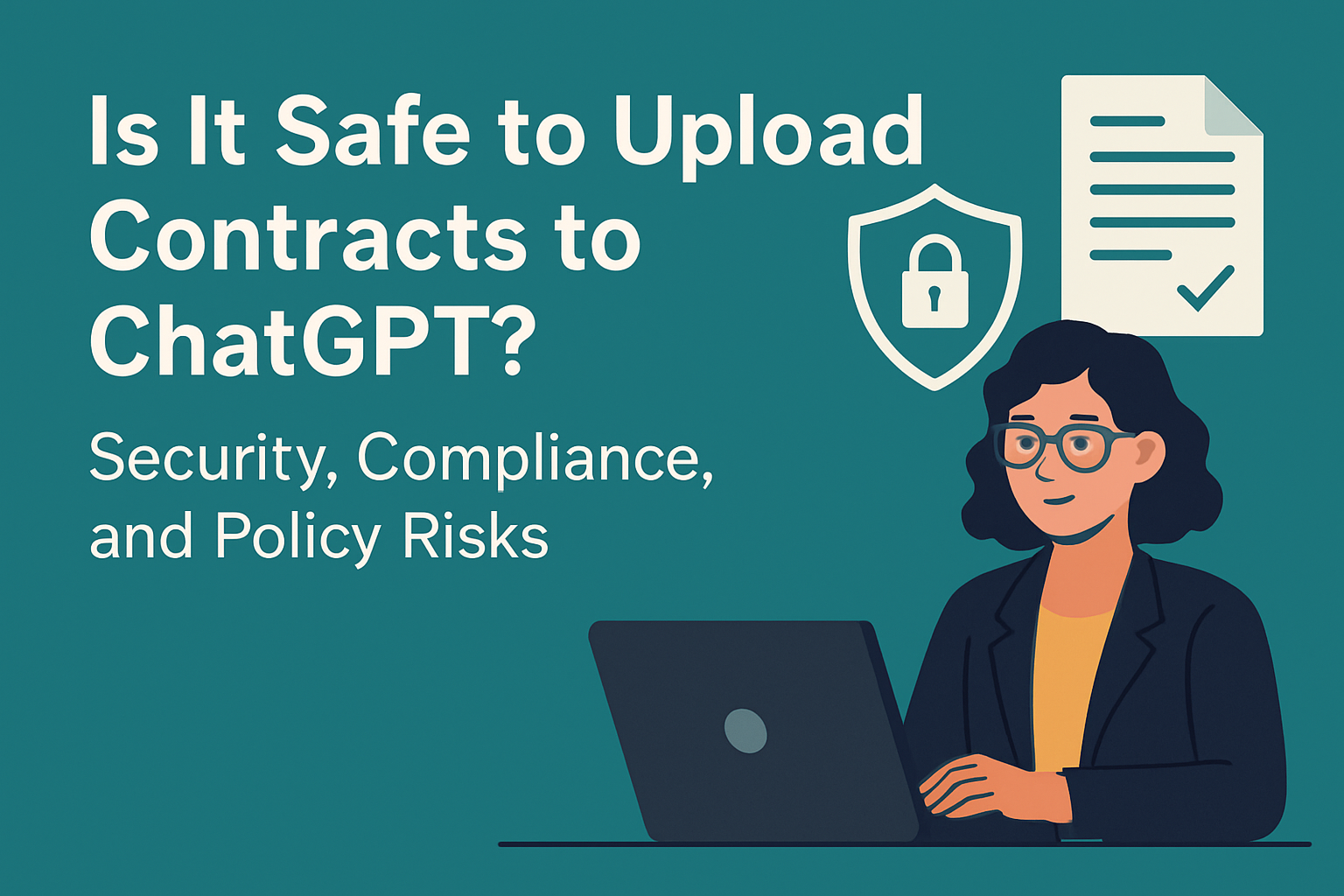
Is It Safe to Upload Contracts to ChatGPT?
This question is at the forefront of every legal and IT department today.
With the temptation to accelerate contract review and summary, the urge to simply paste a lengthy client agreement into a large language model (LLM) is strong.
However, the definitive answer is clear: No, it is generally not safe or compliant to upload un-redacted, sensitive business contracts to the default version of ChatGPT or other public LLMs.
The Core Risk: A Confidentiality Breach
The fundamental problem is one of confidentiality and policy.
A sensitive contract contains client PII (Personally Identifiable Information), proprietary business terms, and legal commitments.
When you upload this data to a public AI service, you create two distinct, major risks:
Data Training Risk: By default, your input is often used to train the next version of the LLM. This means your private client data could potentially become embedded in the AI’s knowledge base.
Compliance Risk: Uploading unredacted client data almost certainly violates your company’s privacy policies, client confidentiality agreements (NDAs), and major regulations like GDPR or CCPA.
Treating ChatGPT like a universal, secure document repository is a critical mistake.
It is an interaction tool that processes data, and until you verify the security and data-retention policies of the specific service you are using, you must assume your information is not private
The Compliance Crisis: Why Unredacted Contracts Are a Breach Risk
For B2B organizations, the risk extends far beyond simple privacy and into the realm of legal liability. The following factors make the use of public LLMs for sensitive legal documents a significant compliance crisis:
1. Data Training and Auditing Failure
As mentioned, when you input data into many public AI models, that data may be consumed for training. Even if a vendor promises data isn’t used for training, the logging and auditing controls often fall short of enterprise requirements. If a data breach were to occur, you would have no auditable trail to prove the data was handled in accordance with industry security standards (like SOC 2 or ISO 27001).
2. Accidental Leakage: The Unintended Error
The greatest technical danger lies in the potential for data spillage. As reported by numerous users, errors in the AI model can sometimes result in one user being shown sensitive, previously uploaded information from a completely different, unrelated user. This unintentional exposure immediately turns a simple query into an unrecoverable breach of client trust and confidentiality.
3. Violation of Client Agreements and Regulatory Laws
Every client contract likely includes a clause regarding the secure handling of shared information. By pasting a contract into a public AI service, you breach this agreement. Furthermore:
- GDPR/CCPA: If the contract contains personal data (names, signatures, addresses), using it without specific consent and security guarantees is a direct violation of consumer privacy laws.
- NDAs: The entire purpose of a Non-Disclosure Agreement is voided the moment you upload its contents to a third-party service that makes no security guarantee.
Beyond Security: ChatGPT’s Legal Accuracy and Nuance Deficiencies
Even if an employee managed to upload a contract without triggering a compliance breach, the limitations of general-purpose AI would still introduce significant, career-ending risk into the workflow.
ChatGPT and other public LLMs are predictive text engines, not legal experts, and they suffer from three critical deficiencies when applied to complex B2B contracts:
1. The Hallucination Problem and Factual Inaccuracy
For legal professionals, precision is everything. However, LLMs are known to “hallucinate”—they generate confident, plausible-sounding outputs that are completely fabricated.
- Fabricated Legal Citations: LLMs have famously provided users with non-existent case citations, which, when submitted in court documents, lead to professional sanctions and major reputational damage.
- Out-of-Date Information: Since the training data for public models is often not real-time, the AI can miss recent statutory or case law developments, leading to advice that is legally unsound or outdated for the jurisdiction in question.
Relying on AI for anything beyond general brainstorming requires 100% human verification—which eliminates much of the promised efficiency.
2. Lack of Contextual and Organizational Understanding
Contracts are not just words; they are documents built on business context, negotiation history, and specific organizational risk tolerance. Public AI models lack this critical layer of embedded knowledge.
No Playbook Enforcement: ChatGPT doesn’t know your company’s preferred fallback positions, negotiation strategy, or internal risk playbook. It may suggest a generic edit that looks good but violates a core business policy (e.g., agreeing to an indemnity clause that your CFO would never accept).
Jurisdictional Blind Spots: Legal language often relies on subtle differences between jurisdictions (e.g., California law versus Delaware law). A general LLM may miss these state- or country-specific requirements, rendering a clause invalid or unenforceable.
3. The Absolute Liability Gap
The most significant risk is that the human user is always 100% responsible for the AI’s output.
No Legal Warranty: AI providers explicitly state that their tools do not offer legal advice and come with no warranty. If the AI provides a faulty summary or inaccurate redline that leads to a financial dispute or litigation, the company—and the supervising lawyer—assumes all financial and professional liability.
Waiver of Privilege: Inputting confidential client data into an unsecure public channel may inadvertently waive attorney-client privilege over that communication, exposing otherwise protected legal strategy.
A Safer Approach: How to Strategically Use AI for Contracts
Given the high stakes of contract management, the solution is not to avoid AI, but to apply it strategically and securely. The key is to move from general-purpose tools to specialized, controlled environments.
1. Utilize Purpose-Built, Secure Platforms
For high-stakes B2B work, the only acceptable option is a secure, contract review platform.
AI-Native CLM: Specialized CLM solutions often incorporate AI trained specifically on billions of lines of legal text (not general web content). These platforms offer Zero Data Retention agreements, ensuring your contracts are never used for external model training.
Enterprise-Grade Security: Look for platforms that meet rigorous enterprise security standards like SOC 2 Type II and maintain strict confidentiality policies. Examples include secured cloud environments like Azure OpenAI where data handling is explicitly segregated.
2. Redact and Abstract for General Tasks
If you must use a public model for non-critical work, you must adopt a strict, manual redaction policy.
Anonymize Data: Replace all confidential elements with placeholders: replace client names with [Company A], monetary amounts with [$Fee], and addresses with [Address].
Use for Low-Risk Tasks: Restrict public AI use to simple, generalized tasks: creating a plain-English summary of a fully redacted clause, or brainstorming generic boilerplate language.
3. Embed AI into Workflow, Not Replace Judgment
The most successful B2B organizations use AI as a powerful co-pilot, augmenting human expertise, not replacing it.
Focus on Extraction: Use AI to flag or redline contracts and extract key information (e.g., renewal dates, governing law, indemnity clauses) for human review.
Enforce Playbooks: The best solutions allow your organization’s legal playbook and risk tolerance to be formally encoded into the AI, ensuring consistency across all reviews.
Final Policy Policy Over Platform
The single greatest risk isn’t the AI model itself, but the lack of a clear, enforceable internal policy.
The time saved by using public AI is dramatically outweighed by the financial and legal liability of a single data breach or a single AI-generated legal error. Your policy should prohibit the upload of any unredacted client or proprietary contract data to any non-approved, general-purpose platform.
If you have questions regarding the safe implementation or use of AI-powered tools for contract review, please book a demo with us today.
We will be more than happy to guide you!
See it in action
Turn contract chaos into a streamlined workflow
Join legal teams who cut contract turnaround time by 60%. Book a 15-minute demo to see how.