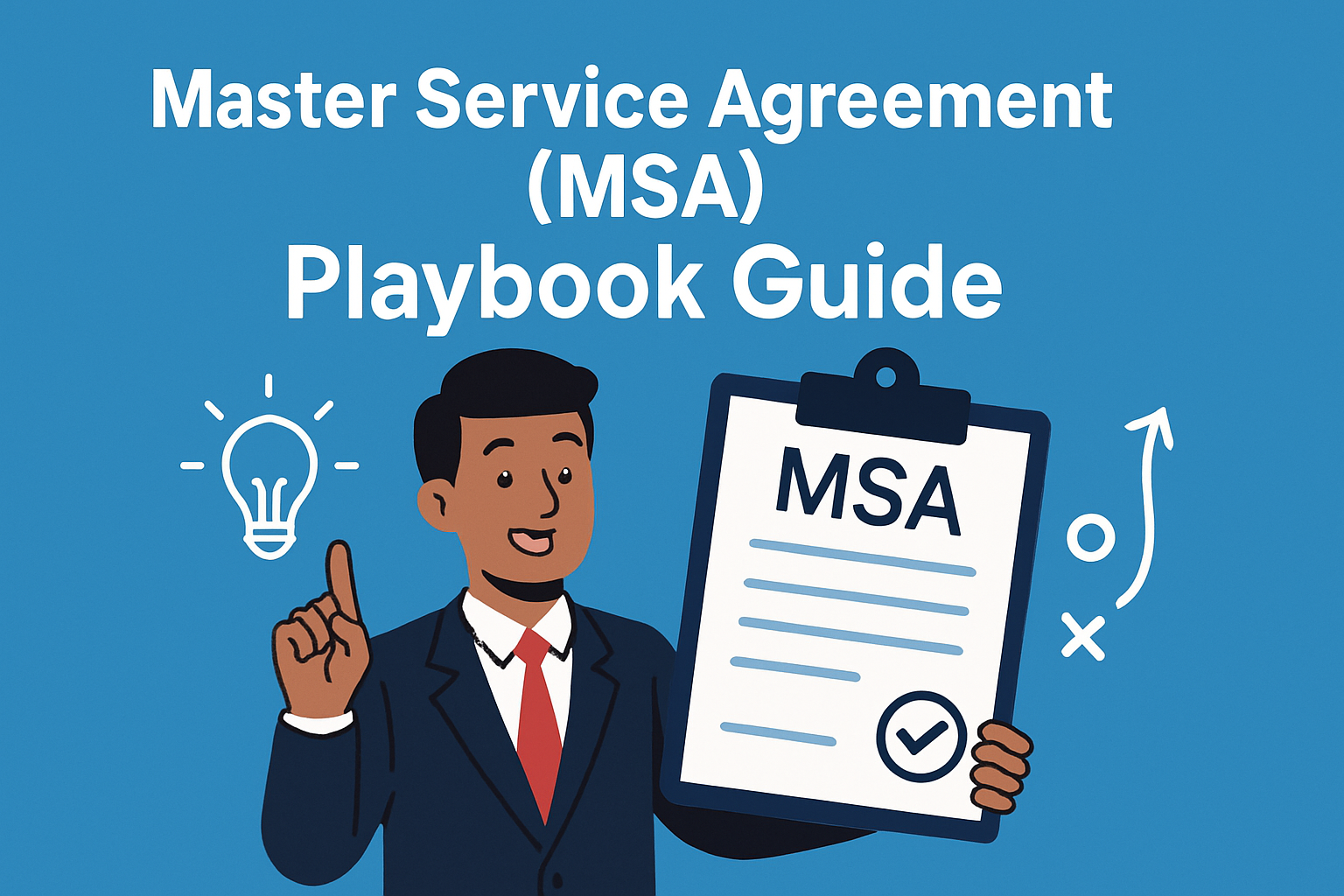
Master Service Agreement (MSA) Playbook Guide
A Master Service Agreement (MSA) is the ultimate sales enablement tool.
It is designed to govern the long-term relationship between you and your client, allowing you to move through future deals with incredible speed.
By front-loading the heavy legal lifting—like indemnity, IP ownership, and liability—into one master document, you ensure that your business is protected while making it easier for your customers to keep buying from you.
The Benefits of a Standardized MSA Playbook
To start, think of an MSA as a way to “lock in” your legal protections so they don’t have to be renegotiated every month.
Without an MSA playbook, your sales team is stuck in a loop of repetitive redlining.
A standardized approach allows you to:
- Shorten the Sales Cycle: Once the MSA is signed, new projects can be greenlit with a simple one-page SOW, bypassing the legal department entirely.
- Protect Your Intellectual Property: Establish a clear boundary between “Background IP” (what you owned before the deal) and “Deliverables” (what the client is paying for).
- Create Predictable Cash Flow: Standardize billing cycles, late fees, and “suspension of service” rights across your entire customer base.
How to Create Your MSA Playbook
Building on that, the secret to a robust MSA is separating the “Legal Rules” from the “Project Details.”
To build an effective rubric, you first need to identify the common MSA clauses that protect your company’s value.
From there, you should define your “Lines in the Sand” for:
- The IP Transfer Trigger: Does the customer own the work as soon as it’s created, or only after the final invoice is paid in full? (Hint: Always choose the latter).
- Liability Limits: Set a standard “Cap on Damages”—usually tied to the amount paid in the previous 12 months—to ensure a single mistake doesn’t sink your company.
- Termination Rights: Define how both parties can “break up.” Can they leave for any reason with 30 days’ notice, or are they committed for the full term?
How to Use an MSA Playbook in Your Organization
Lastly, the MSA should be the “quiet engine” that powers your growth, not a roadblock that stops it. The implementation needs to be seamless so your team can focus on delivery, not documentation:
- The “SOW Bridge”: Train your project managers to ensure that every Statement of Work explicitly “incorporates by reference” the terms of the MSA.
- Fallback Levels: Give your sales leaders pre-approved language for when a client demands “Work Made for Hire” or “Unlimited Liability,” allowing them to negotiate in real-time.
- Audit and Review: Finally, use the playbook to conduct annual audits. If you find that 80% of your clients are redlining your “Net-30” payment terms, use that data to decide if it’s time to shift your standard to “Net-45.”
The Bottom Line
And there you have it…
We hope this guide helps you build a Master Service Agreement framework that scales with your business. If you’re ready to stop treating every contract like a first date, try our free MSA Playbook Generator.
It’s the fastest way to turn your legal standards into a ready-to-use rubric, allowing you to sign more clients and protect your work in minutes.
See it in action
Turn contract chaos into a streamlined workflow
Join legal teams who cut contract turnaround time by 60%. Book a 15-minute demo to see how.