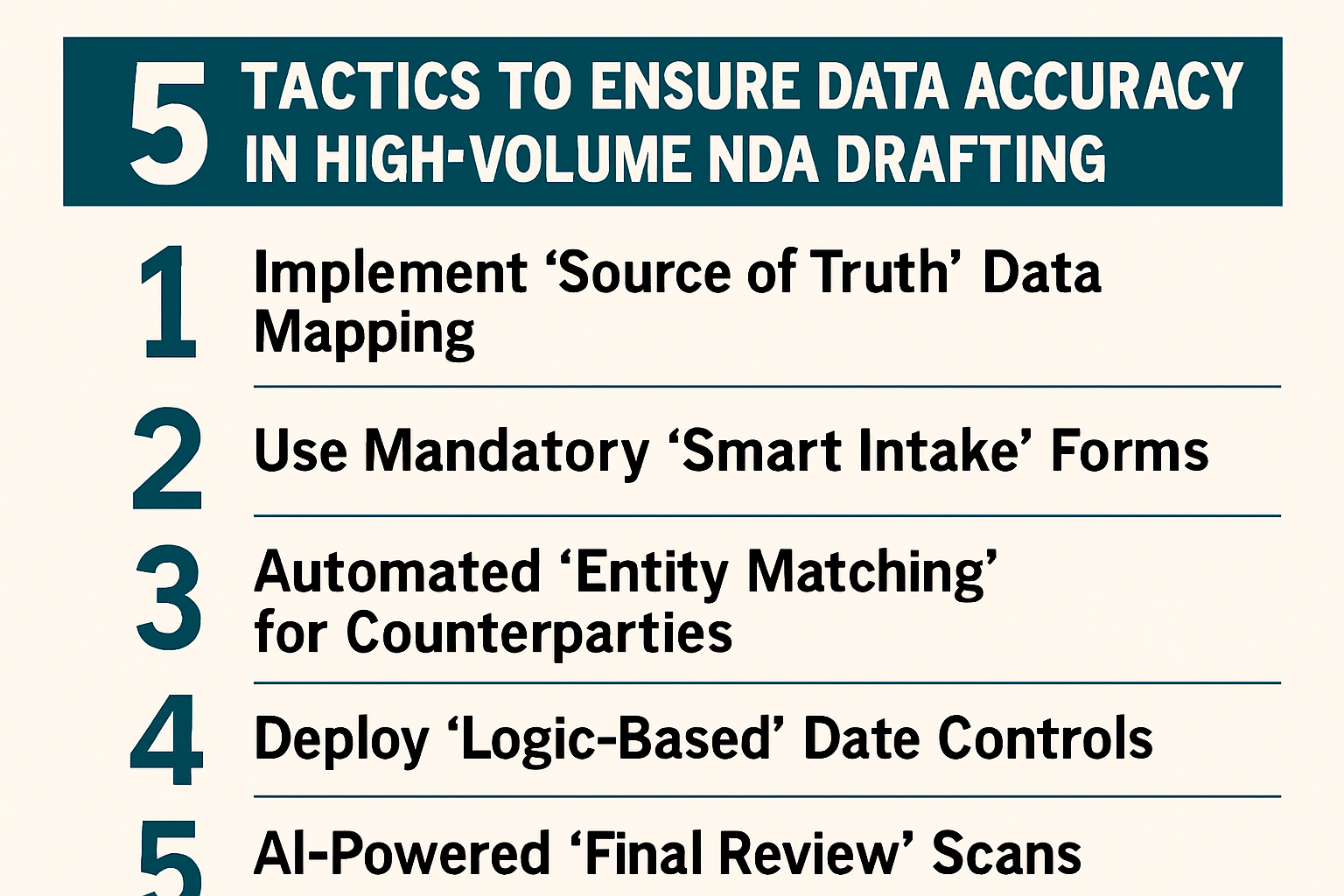
5 Tactics for Data Accuracy in NDA Drafting
In 2026, speed is only an asset if it’s paired with precision. While some legal teams have successfully implemented regional NDA drafting checklists, maintaining data integrity becomes significantly harder as your deal volume scales.
To maintain a “Zero-Error” environment, you need a system that removes the human element from data entry.
Here are five tactics to ensure data accuracy in your high-volume NDA drafting workflow.
1. Implement “Source of Truth” Data Mapping
- The Tactic: Never allow a drafter to manually type information that already exists in your company’s database.
- The How-To: Map your contract drafting software directly to your CRM (like Salesforce) or ERP. When a user requests an NDA, the system “pulls” the counterparty’s legal name and address directly from the verified account record.
- The Outcome: This ensures that the NDA contract matches your official records exactly, eliminating “Company Ltd” vs. “Company Limited” discrepancies.
2. Use Mandatory “Smart Intake” Forms
- The Tactic: Replace open-ended email requests with structured, questionnaire-driven intake forms.
- The How-To: Use field validation in your intake questionnaire. For example, if a “Notice Email” is required, the form should reject any input that doesn’t follow a valid email format.
- The Outcome: By forcing structured data at the start, you guarantee that the NDA drafting engine receives clean data, preventing “garbage in, garbage out” scenarios.
3. Automated “Entity Matching” for Counterparties
- The Tactic: Use external database integrations to verify counterparty details in real-time.
- The How-To: Connect your drafting tool to a global business registry (like Dun & Bradstreet). As the user types a company name, the tool should suggest the verified legal entity and its registered office address.
- The Outcome: This removes the risk of drafting an NDA against a subsidiary or a non-existent entity, which is a common error in high-volume environments.
4. Deploy “Logic-Based” Date Controls
- The Tactic: Use automated calculations to prevent impossible or conflicting dates within the contract.
- The How-To: Set rules within your NDA template so that the “Expiration Date” must be a minimum of X years after the “Effective Date.” If a user tries to enter a date in the past, the system flags it immediately.
- The Outcome: This eliminates the embarrassing and legally risky “scrivener’s errors” that often occur when teams are rushing to meet deadlines.
5. AI-Powered “Final Review” Scans
- The Tactic: Use a specialized AI layer to perform a “sanity check” on the document before it is sent for signature.
- The How-To: The AI scans the completed NDA draft for internal inconsistencies—such as a party name being spelled two different ways or a defined term that is never used.
- The Outcome: This acts as a final “automated proofreader,” ensuring that every NDA contract leaving your department is polished and professional.
Closing Thoughts
And there you have it…
We hope this article has been helpful in showing you how to maintain total accuracy in your high-volume NDA drafting process.
Share:
See it in action
Turn contract chaos into a streamlined workflow
Join legal teams who cut contract turnaround time by 60%. Book a 15-minute demo to see how.