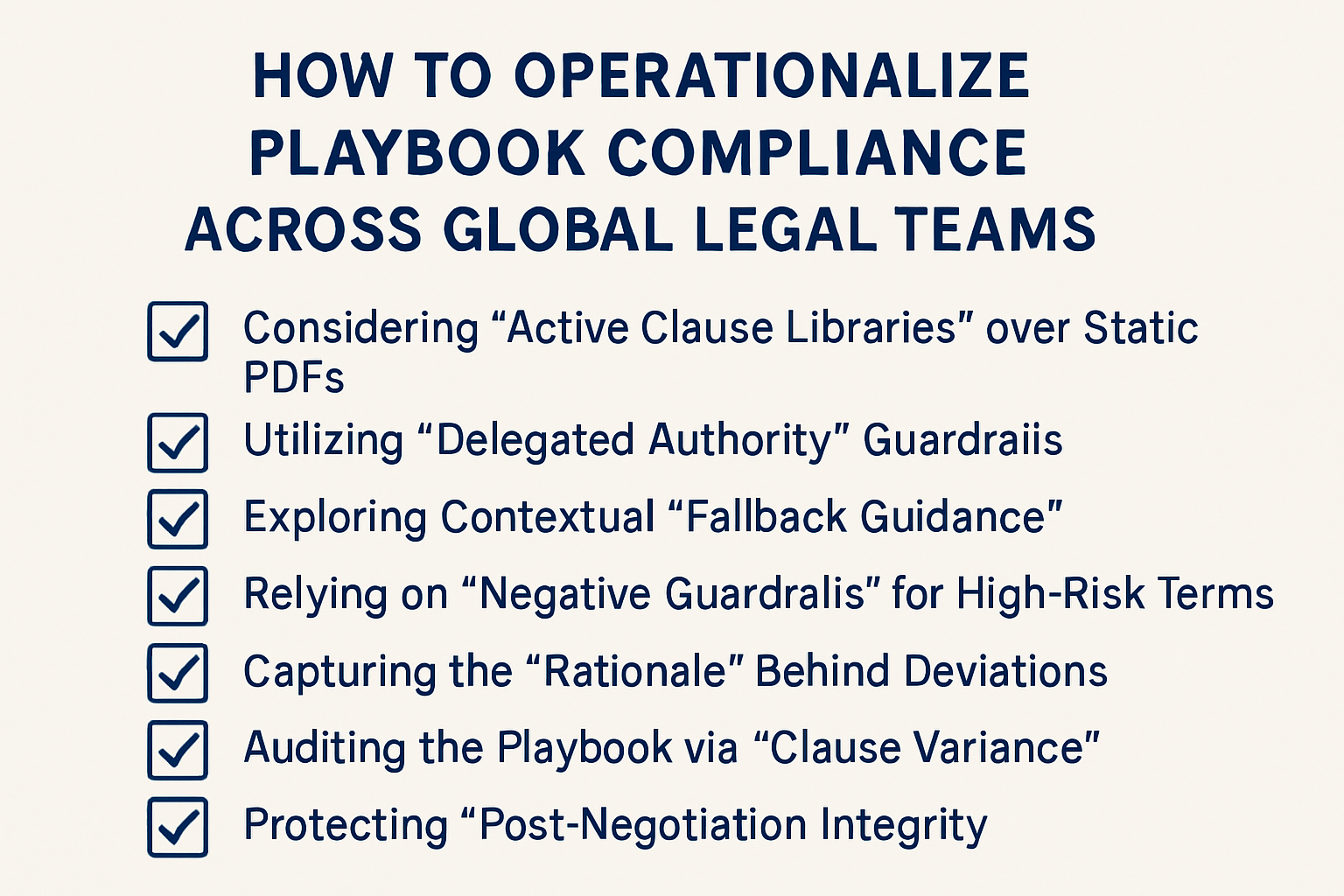
7 Strategies for Playbook Compliance Across Teams
If you’ve recently transitioned from leading a small team to managing a global department—or if you’ve been in the seat for years watching deal volume explode—you might have noticed a subtle but persistent challenge.
At Pactly, we call this Institutional Variance.
In your case, it might be those instances where you find yourself wondering if a negotiator in another region is conceding a critical point just to hit a deadline, or if your “Standard” terms have drifted so far from market reality that your team is forced to “go rogue” to keep deals moving.
If that sounds familiar, you are not alone.
In our experience, moving toward systemic Playbook Compliance can be a powerful way to provide your team with a framework that makes the “right” way to negotiate the path of least resistance.
Here are 7 ways we have seen departments operationalizing their standards:
1. Considering “Active Clause Libraries” over Static PDFs
If your playbook currently lives in a 50-page PDF, it’s easy for it to become a passive resource that is rarely consulted during a live negotiation. We’ve seen many teams find success by deconstructing those policies into a Digital Clause Library. By surfacing approved language and fallbacks contextually inside the redlining environment, the “Gold Standard” simply becomes the most convenient option for a lawyer to reach for.
2. Utilizing “Delegated Authority” Guardrails
Defining exactly when a redline crosses the line from a “minor tweak” to a “strategic risk” can be a constant grey area. One approach is to embed Escalation Thresholds into your negotiation software. This allows routine work to stay with the frontline while providing you with the peace of mind that high-risk deviations—like uncapped liability—will be automatically surfaced for your specific review.
3. Exploring Contextual “Fallback Guidance”
Compliance can often feel like a hurdle when a negotiator isn’t quite sure which fallback applies to a specific counterparty objection. We’ve found that surfacing approved fallbacks alongside the legal rationale behind them can turn every negotiation into a silent coaching moment. It’s a practical way to maintain a unified “Firm Voice” across the department, regardless of an individual’s seniority.
4. Relying on “Negative Guardrails” for High-Risk Terms
Many GCs find that relying solely on manual spot-checks to catch “toxic” clauses is a high-stakes gamble. A strategy we often see is the use of Automated Keyword Detection to flag prohibited terms—such as specific IP assignments—the moment they appear in a counterparty’s draft. This allows for intervention long before the deal reaches the final approval stage.
5. Capturing the “Rationale” Behind Deviations
Variance is often inevitable, but we’ve seen that undocumented variance can become a significant liability later on. You might find it helpful to require a “Rationale Tag” for any deviation from the playbook. This tends to encourage a more disciplined internal dialogue and creates an audit trail that explains the commercial trade-offs made—invaluable context for future renewals or disputes.
6. Auditing the Playbook via “Clause Variance”
Sometimes, if a “Standard” clause is being redlined in the majority of deals, it may be a sign that the playbook—rather than the team—is out of step with the current market. Using Variance Analytics can help you pivot from “enforcement” to “optimization,” ensuring your standards protect the company without creating unnecessary friction for your Sales or Procurement partners.
7. Protecting “Post-Negotiation Integrity”
The final risk point many departments face is the “Version Gap”—ensuring the signed document perfectly matches what was actually approved. Moving toward a centralized negotiation environment allows you to “lock” a document once approvals are met. This helps eliminate the risk of manual version errors or “sneaky redlines” occurring in the final mile of the deal.
Conclusion
We hope this has been a helpful look at some of the ways global teams are navigating the complexities of playbook compliance.
If you’re interested in seeing how a digital clause library can facilitate this kind of governance, feel free to check out our enterprise contract negotiation software.
Otherwise, check out our next article on automating conditional approval routing.
See it in action
Turn contract chaos into a streamlined workflow
Join legal teams who cut contract turnaround time by 60%. Book a 15-minute demo to see how.