7 Approaches to Automating Conditional Approval Routing
If you’ve ever looked at your inbox on a Friday afternoon and seen dozens of threads titled “Urgent: Deviation Approval Needed,” you’ve likely experienced the breakdown of manual escalation.
This tension generally manifests in growing departments where the approval process eventually becomes a binary between high-touch manual oversight and a total loss of visibility as teams move faster to hit quarterly targets.
To resolve this, we have noticed shifting toward “Conditional Approval Routing”—often as a natural follow-up to operationalizing playbook compliance—is what allows a department to maintain rigorous oversight without slowing down the business.
Here are 7 approaches we’ve seen strategic departments take to automate this logic:
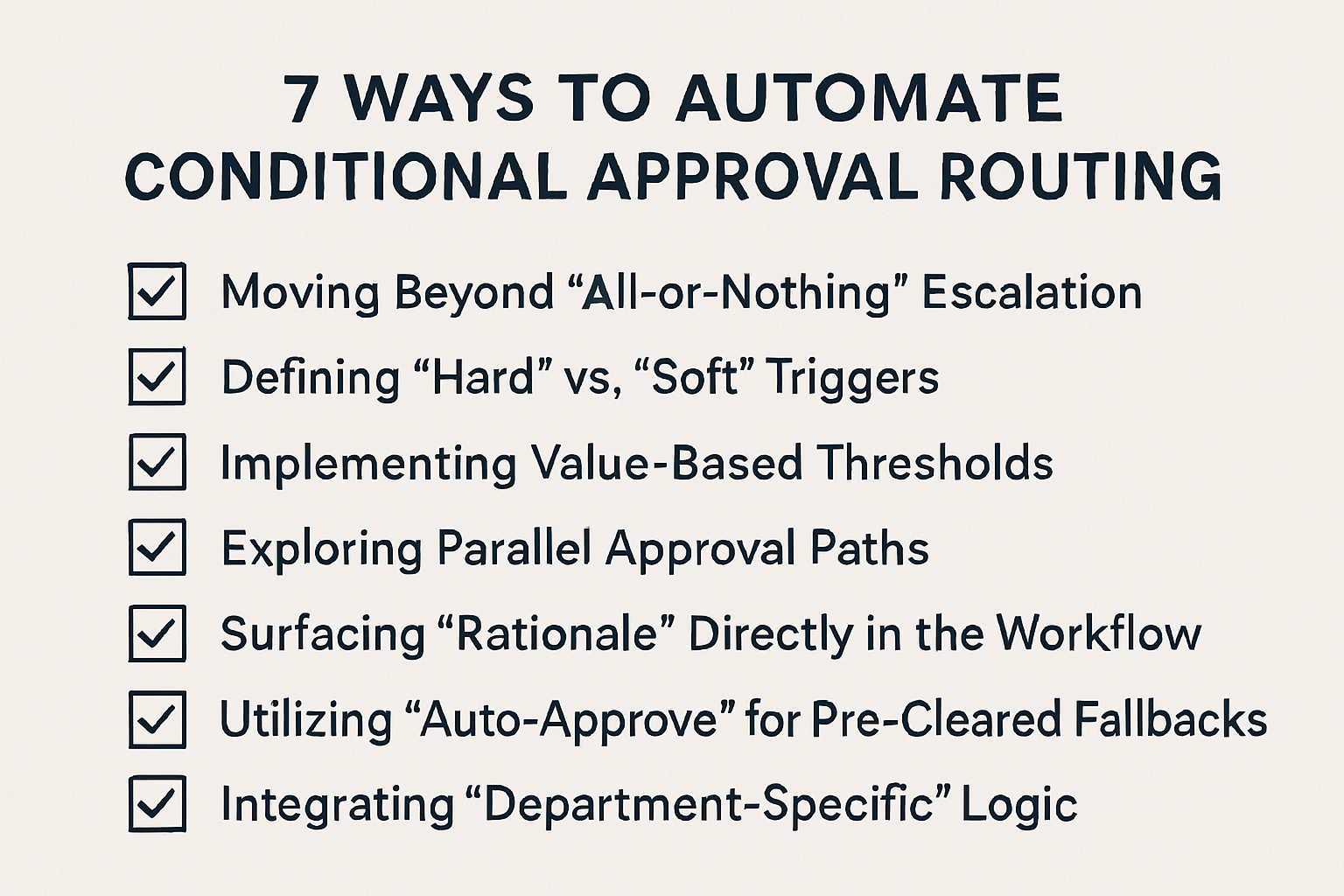
1. Moving Beyond “All-or-Nothing” Escalation
In many traditional setups, any deviation from the standard template triggers a manual email. We’ve found that moving to a conditional model allows for more nuance. By defining specific parameters—such as contract value or the nature of the clause—you can help ensure that routine deviations are handled by the frontline, while high-stakes exceptions are automatically routed to the right stakeholders.
2. Defining “Hard” vs. “Soft” Triggers
It can be helpful to categorize deviations based on their actual risk profile. One approach is the use of Hard Triggers for non-negotiable items (like changes to IP ownership) that require immediate executive intervention. Conversely, Soft Triggers can be set for commercial points that might only require a notification or a sign-off from a senior lead, keeping your desk clear for strategic priorities.
3. Implementing Value-Based Thresholds
If your team handles a wide range of deal sizes, a “one size fits all” approval path often creates unnecessary friction. You might consider routing approvals based on Total Contract Value (TCV). A minor redline on a small-scale vendor agreement may not require the same level of scrutiny as the same redline on a multi-million dollar master service agreement.
4. Exploring Parallel Approval Paths
In complex negotiations, legal is rarely the only department that needs to weigh in. We often see delays occur when a document is stuck in a linear email chain between Finance, Security, and Legal. One strategy is to use Parallel Routing, where a specific deviation (like payment terms) is automatically sent to Finance while the legal review continues, significantly reducing the total “cycle time.”
5. Surfacing “Rationale” Directly in the Workflow
A common time-waster is the “context hunt”—trying to figure out why an approval is being requested in the first place. Many departments are finding success with systems that allow the negotiator to attach their rationale directly to the redline being approved. Seeing the counterparty’s edit, your fallback, and the team’s reasoning in one view often turns a 30-minute investigation into a 30-second decision.
6. Utilizing “Auto-Approve” for Pre-Cleared Fallbacks
If a negotiator uses “Fallback #1” from your playbook, it’s worth asking if they actually need to ask for permission again. We’ve noticed that many teams move faster by pre-clearing specific fallbacks for certain seniority levels. If the system recognizes the language as an approved fallback, it can “Auto-Approve” the change while still logging it for the audit trail.
7. Integrating “Department-Specific” Logic
Strategic approvals often involve specialized expertise. You might find it helpful to route deviations based on the subject matter of the clause. For example, any deviation in Data Privacy can be automatically routed to your DPO, while a change in Tax Indemnity goes to the Tax Lead. This ensures the most qualified eyes are on the risk without you having to manually play “traffic cop.”
Conclusion
We hope this has been a helpful look at some of the ways enterprise teams are navigating the complexities of approval bottlenecks.
If you’re interested in seeing how automated routing can help streamline your internal approvals, feel free to check out our enterprise contract negotiation platform.
Otherwise, check out our next article on maintaining contract version control.
See it in action
Turn contract chaos into a streamlined workflow
Join legal teams who cut contract turnaround time by 60%. Book a 15-minute demo to see how.