7 Tactics for Rapid Legacy Contract Audits
If you’ve ever had to respond to a regulatory change or an M&A request by manually reviewing thousands of PDF contracts, you’ve likely experienced the “Legacy Data Gap.”
To combat this, we’ve noticed that shifting toward automated “discovery” audits—often as a natural extension of tracking negotiation velocity—is what allows a department to gain instant visibility into their entire portfolio without a massive manual effort.
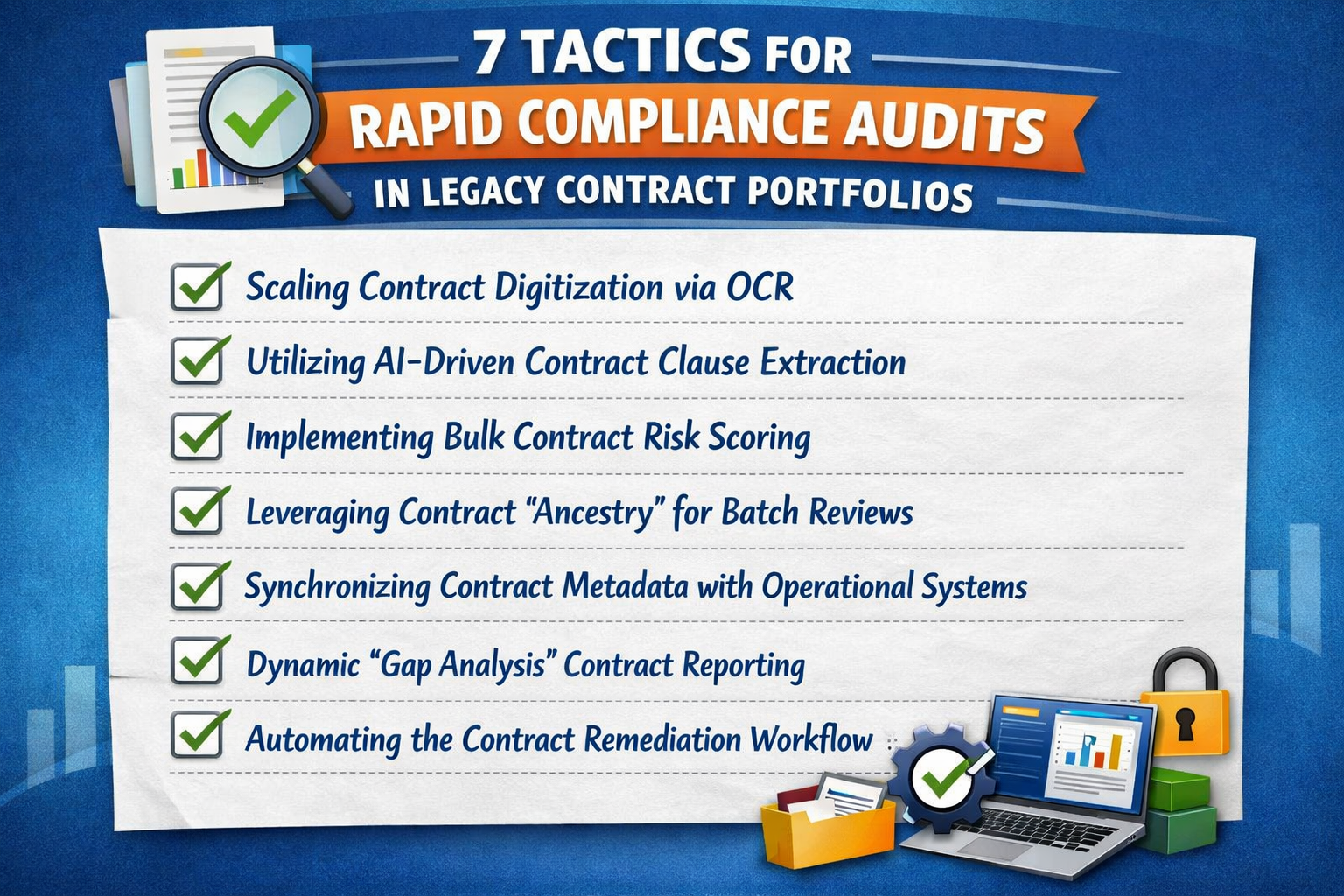
Let’s take a look at 7 tactics we’ve seen departments use to operationalize compliance audits across legacy contracts:
1. Scaling Contract Digitization via OCR
Rather than viewing digitization as a simple filing task, you might find it more effective to prioritize an OCR-enabled environment for all executed agreements. This isn’t just about making documents “searchable”; it’s about transforming static images into structured data. By creating this clean, digital baseline, you ensure that even 10-year-old “wet ink” signatures are indexed and ready for a rapid audit whenever a regulatory shift occurs.
2. Utilizing AI-Driven Contract Clause Extraction
Instead of assigning a team to manually read every contract for specific “Change of Control” or “Data Processing” provisions, you could look at using AI to “pull” these clauses into a structured table for side-by-side comparison. This allows your team to move away from individual document review and toward pattern recognition, focusing your human expertise only on the outliers that deviate from your standard language.
3. Implementing Bulk Contract Risk Scoring
You might also find it helpful to apply a global “risk score” to your legacy data rather than reviewing contracts one by one. This involves setting parameters for what a “compliant” clause looks like and letting the system flag any agreement that falls outside that threshold. By assigning a numerical value to risk levels (e.g., High, Medium, Low), you can direct your most senior legal talent to the high-exposure contracts first.
4. Leveraging Contract “Ancestry” for Batch Reviews
One approach we’ve seen work well is using “clustering” technology to group similar legacy document types together based on their linguistic “ancestry.” Because many contracts are variations of the same original template, auditing the “parent” template first often allows you to clear hundreds of descendant contracts—like standard NDAs or MSAs—at once. This “audit once, clear many” approach is a highly effective way to shrink a massive backlog.
5. Synchronizing Contract Metadata with Operational Systems
You could also consider linking your legacy contract data with internal systems like Finance or HR to ensure that “on-paper” obligations match “real-world” execution. This creates a two-way validation: a compliance audit shouldn’t just be about what is in the text, but whether the payment terms or non-compete clauses are actually being met by the operational teams.
6. Dynamic “Gap Analysis” Contract Reporting
Instead of starting from scratch every time a new regulation hits, you could try running “Gap Analysis” reports that compare your current “Gold Standard” or updated clause library against your entire legacy database. This produces an instant delta report, showing you exactly where your exposure lies and creating a prioritized “To-Do” list for your remediation team without the need for a manual document sweep.
7. Automating the Contract Remediation Workflow
Finally, you might find that an audit is only as useful as the action it triggers. Many teams are now using audit results to trigger an automated amendment process. Once non-compliant contracts are identified and flagged, the system can automatically generate a “mass amendment” draft and send it to the relevant counterparties via an e-signature workflow. This allows you to close the compliance loop on thousands of agreements without a single manual drafting session.
Conclusion
We hope this series has been a helpful look at how large legal teams are moving toward a more automated, data-driven department.
From streamlining approvals to conducting rapid audits of legacy data, the goal is always the same: to move the Legal team from a reactive function to a strategic business partner.
If you’re interested in seeing how our platform can help you audit your legacy contracts and automate your negotiation workflows, feel free to check out our contract negotiation platform.
See it in action
Turn contract chaos into a streamlined workflow
Join legal teams who cut contract turnaround time by 60%. Book a 15-minute demo to see how.