7 Tactics to Ensure Contract Version Control
If you’ve ever had to reconcile three different sets of redlines from Finance, Security, and the counterparty into a single document, you’ve likely experienced the “Version Gap.”
This usually happens in a multi-stakeholder environment where the “Master Document” often fractures into several parallel versions living in different inboxes.
To combat this, we’ve noticed that automating conditional approvals and shifting toward a unified negotiation environment helps ensure the final signed contract actually reflects the terms you worked so hard to approve.
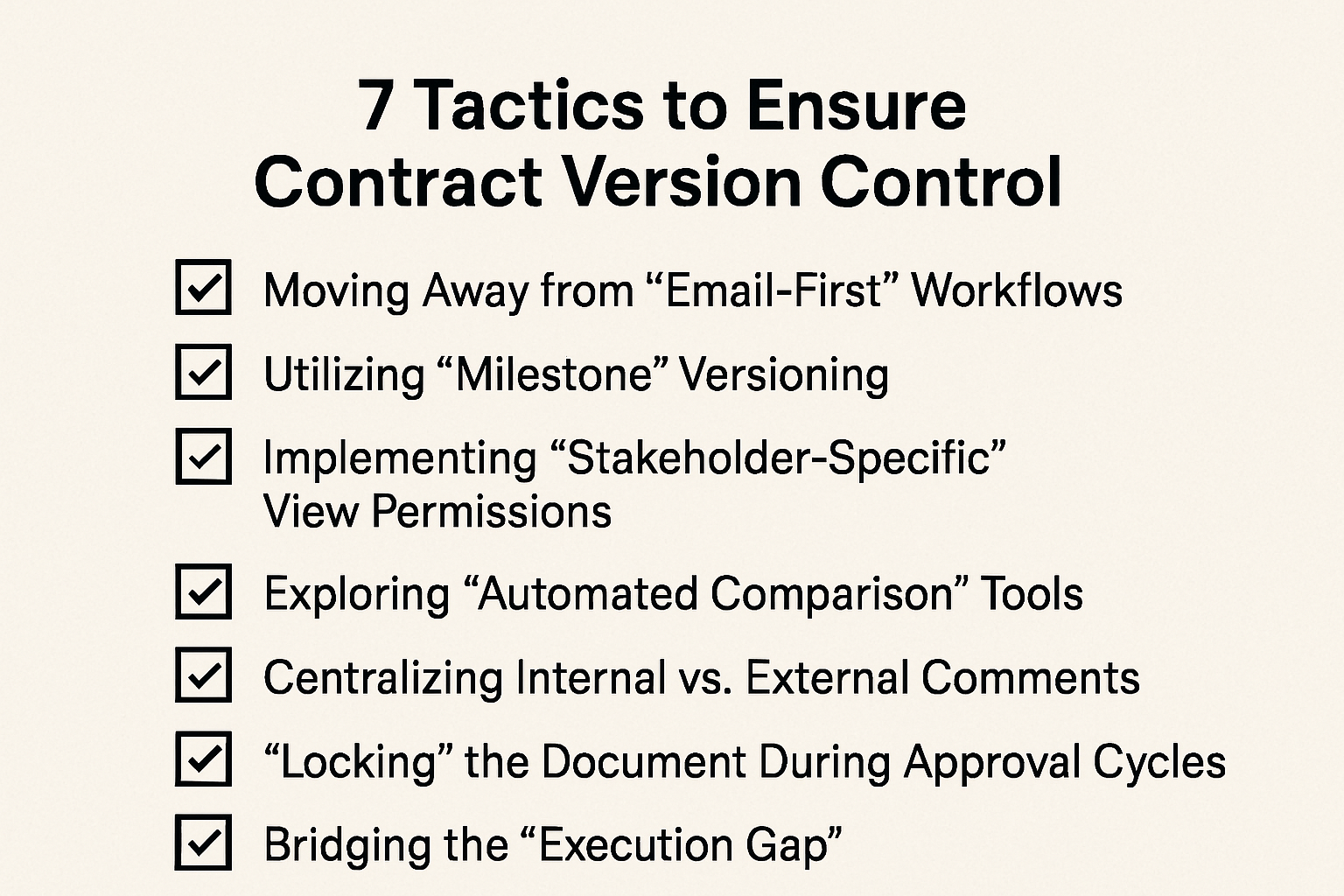
Let’s take a look at 7 tactics we’ve seen departments use to maintain contract version control during multi-stakeholder negotiations:
1. Moving Away from “Email-First” Workflows
We’ve noticed that many versioning errors start the moment a document is downloaded and renamed. A strategy that often works for large teams is keeping the “live” document in a centralized environment where stakeholders can contribute simultaneously. This helps eliminate the “Final_v2_EDITS” naming convention and ensures that everyone is always looking at the same iteration.
2. Utilizing “Milestone” Versioning
Not every minor edit needs to be a new version, but major milestones—like the end of a round of counterparty negotiations—certainly do. We’ve seen teams find success by using a system that creates a “Clean Milestone” after each major phase. This allows you to quickly “look back” at what was conceded in Round 1 without sifting through dozens of minor formatting tweaks.
3. Implementing “Stakeholder-Specific” View Permissions
When Finance or Security enters a negotiation, they don’t always need to see the entire history of the legal redlines. One approach is to use a system that allows for role-based visibility. This ensures that stakeholders can contribute to their specific sections without the risk of accidentally overwriting or deleting unrelated legal protections.
4. Exploring “Automated Comparison” Tools
Manual “blacklining” between versions is a notorious source of human error. We’ve found that GCs prefer a workflow that automatically generates a comparison between the current draft and the last approved version the moment a document is uploaded. This helps catch “sneaky redlines” or formatting changes that might otherwise go unnoticed.
5. Centralizing Internal vs. External Comments
One of the biggest risks in multi-stakeholder deals is accidentally sending internal “strategy notes” to the counterparty. A strategy we often see is using a platform that bifurcates comments—keeping internal discussions visible only to your team while maintaining a separate, clean thread for counterparty communication, all within the same view.
6. “Locking” the Document During Approval Cycles
Version drift often happens when a negotiator continues to tweak a document while it is out for executive approval. We’ve noticed that shifting toward a “Lock-on-Submit” model helps maintain integrity. Once a document is sent for a conditional approval, it becomes read-only until the approval is granted or rejected, ensuring the version you sign is exactly the version you reviewed.
7. Bridging the “Execution Gap”
The final hurdle is ensuring the e-signature tool pulls the exact final approved version from your negotiation environment. Integrating your negotiation platform directly with your signature tool helps eliminate the “final-final” manual upload, ensuring that the integrity maintained throughout the negotiation remains intact through execution.
Conclusion
We hope this has been a helpful look at how large teams are managing the complexities of version control with multiple stakeholders.
If you’re interested in seeing how a centralized negotiation environment can help maintain your document integrity, feel free to check out our enterprise contract management software.
Otherwise, check out our next article on 7 KPIs to track contract negotiation velocity.
See it in action
Turn contract chaos into a streamlined workflow
Join legal teams who cut contract turnaround time by 60%. Book a 15-minute demo to see how.