Contract Playbook vs Checklist: What's the Difference?
“We already have a checklist. Why would we need a playbook?”
It’s the question legal ops hears most when proposing contract playbooks. Fair question — especially when your team is already drowning in work and another tool to maintain sounds like the opposite of help. Both checklists and playbooks aim to standardize contract review. Both help you avoid missing critical issues. Both can be shared, updated, and passed around the team.
They’re not interchangeable, though. Organizations that treat checklists as playbooks typically hit a wall. Understanding the difference helps you know when each tool serves you best.
The Core Difference
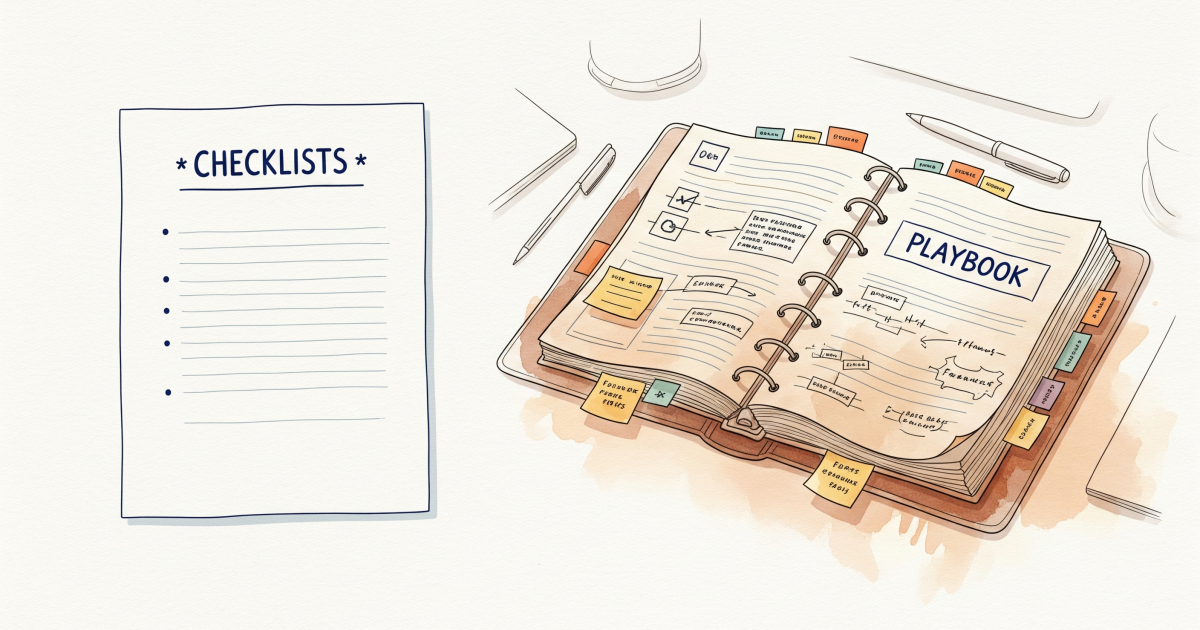
A checklist tells you what to look for.
A playbook tells you what to do when you find it.
That’s the fundamental distinction. Everything else flows from there.
What a Contract Checklist Actually Does
A good contract review checklist ensures you don’t miss important provisions. It’s a systematic way to verify that you’ve examined each material section of an agreement.
A typical checklist might include items like:
- Party names and addresses present
- Effective date stated
- Term and renewal provisions included
- Scope of services/deliverables defined
- Payment terms specified
- Termination clause present
- Governing law stated
The reviewer works through each item, checking the box when they’ve confirmed it’s present. Maybe they add notes about some of these or flag missing items for follow-up. But the checklist itself doesn’t say whether what’s there is acceptable. It just ensures nothing gets skipped.
When Checklists Work Well
Checklists shine in specific situations:
Highly experienced reviewers. When the person using the checklist already knows the company’s positions, they don’t need the playbook guidance. The checklist serves as a memory aid, not a decision framework.
Simple agreements. Some contracts genuinely don’t require nuanced position guidance. A straightforward purchase order confirmation or invoice reconciliation doesn’t need a tiered fallback strategy. It needs someone to verify the standard terms are present and the numbers match.
First-pass triage. Before detailed review, a checklist can help categorize contracts by complexity. Does this agreement have unusual provisions? Are standard clauses present? The answers inform whether the contract needs senior attention or can be handled routinely.
Compliance verification. For post-execution audits (“Do our existing contracts meet policy X?”), checklists excel. You’re not negotiating; you’re verifying.
Where Checklists Fall Short
The limitations become apparent as soon as situations require judgment.
A checklist might include “Limitation of liability clause identified.” Great, you found it. Now what? The counterparty caps liability at fees paid. Is that acceptable? For this deal size? For this vendor type? If you push back, what should you request instead?
The checklist provides no answers. The reviewer must know the company’s position, research past precedents, or escalate.
Multiply this gap across every material provision, and you see why checklist-only approaches struggle at scale. Every ambiguous item either slows review or introduces inconsistency as each person makes their own judgment call.
What a Contract Playbook Provides
A playbook picks up where the checklist stops.
Yes, it tells you to review the limitation of liability clause. But it also tells you:
What your company’s preferred liability cap is
What alternative positions are acceptable in which circumstances
Where the absolute floor sits—below which escalation is mandatory
Why these positions exist (the underlying risk rationale)
Who to escalate to when you hit the floor
Sample language for markup
The playbook transforms contract review from something dependent on individual expertise into a process, executable by anyone trained on the playbook.
The Structure of Playbook Guidance
Playbooks typically organize guidance in tiers. Here’s how that might look for an indemnification clause:
Preferred Position:
Mutual indemnification for third-party claims arising from each party’s breach, negligence, or willful misconduct. Each party indemnifies for its own IP infringement. Indemnification subject to standard limitations on liability.
Acceptable for Low-Risk Vendors (<$50K annual spend):
Mutual indemnification for third-party claims arising from each party’s breach. Vendor indemnifies for IP infringement. Customer indemnifies for misuse of services.
Acceptable for Strategic Vendors (with Legal Director approval):
Customer-only indemnification for third-party claims arising from Customer’s use of services, provided vendor maintains robust insurance and passes security review.
Escalate to General Counsel:
Any broad customer indemnification without corresponding vendor obligations; any indemnification language with uncapped exposure.
Notice what this provides that a checklist cannot: a decision framework calibrated to risk. The reviewer doesn’t need to guess whether a one-sided indemnity is acceptable—they know it requires specific approval, under specific conditions.
Side-by-Side Comparison
Here’s how the two tools compare in practice:
| Aspect | Checklist | Playbook |
|---|---|---|
| Primary function | Ensure nothing is missed | Guide decisions on what’s found |
| Answers the question | ”Did I review this?" | "What should I do about this?” |
| Judgment required | High, reviewer decides positions | Moderate, playbook provides defaults |
| Training time for new hires | Low | Medium to high |
| Maintenance burden | Low | Higher, requires regular updates |
| Scalability | Limited by reviewer expertise | Can scale with trained staff |
| Consistency | Varies by reviewer | Standardized across team |
| Speed impact | Minimal | Significant reduction in review time |
| Useful for | Experienced attorneys, simple contracts | Volume operations, varied experience levels |
How Teams Actually Use These Tools
There’s no universal path to standardizing contract review. Different organizations start in different places based on their needs, resources, and maturity.
The Gradual Approach
Many legal teams start with a simple checklist. It’s quick to build, easy to share, and provides immediate value—especially when you’re still figuring out what your positions should be.
The checklist works fine until patterns emerge:
Multiple reviewers ask the same questions about liability caps
Different attorneys take opposite positions on identical indemnification language
Senior counsel spends hours each week answering “is this acceptable?” questions
Contracts stall in review while junior staff waits for guidance
These pain points signal that your checklist has outgrown itself. You’re ready for playbook guidance on at least some provisions.
The Direct-to-Playbook Approach
Other organizations skip checklists entirely. If you’re facing regulatory requirements, handling high contract volumes, or building a legal ops function from scratch, you might know from day one that you need decision frameworks, not just verification lists.
Companies in this category often have clear drivers: a compliance mandate requiring documented positions, a merger creating inconsistent practices across teams, or explosive growth that’s overwhelmed the existing review process.
Starting with a playbook makes sense when the cost of inconsistency exceeds the effort of building guidance upfront.
The Hybrid Model
The smartest approach for many teams: use both tools strategically.
Build playbook guidance for your high-impact, high-frequency provisions — the ones where inconsistency causes real problems. Liability caps, indemnification, IP ownership, data protection. These appear in most contracts and carry significant risk. Document your positions, escalation paths, and fallback language.
For emerging issues or low-frequency provisions, stick with a checklist. Maybe you’re seeing AI clauses for the first time. Maybe force majeure only appears in a handful of contracts. You don’t need a full playbook framework with tiered positions and approval matrices. A checklist item that says “Flag for senior review” works fine while you’re still learning what your position should be.
This hybrid approach solves a real problem: playbooks require maintenance. Every position you document is another thing to update when business conditions change. By limiting playbook guidance to provisions that truly need it, you get consistency where it matters without creating an unsustainable maintenance burden.
As you gain experience with those emerging provisions, you can always convert them to full playbook guidance later.
Building Your First Playbook
If your checklist is generating more questions than answers, that’s not a problem—it’s a signal. Your team is ready for playbook guidance on at least some provisions.
Start with one high-impact clause. The one that causes the most delays, the most inconsistency, or the most “can you just look at this?” escalations. Document your preferred position, your acceptable fallbacks, and your escalation threshold. See how it works. Refine it. Move to the next provision.
If you want to see what that structure looks like in practice, Pactly’s playbook generator walks you through building tiered positions for your specific clauses—no sign-up required. Sometimes seeing the framework filled in is easier than starting from scratch.
The question isn’t checklist versus playbook. It’s which provisions need which level of guidance right now.
See it in action
Turn contract chaos into a streamlined workflow
Join legal teams who cut contract turnaround time by 60%. Book a 15-minute demo to see how.
.png)
.jpg)