Contract Management Workflow: A 5-Step Checklist
Implementing a contract management workflow doesn’t require a 6-month overhaul. It requires a clear set of rules and the right software to enforce them.
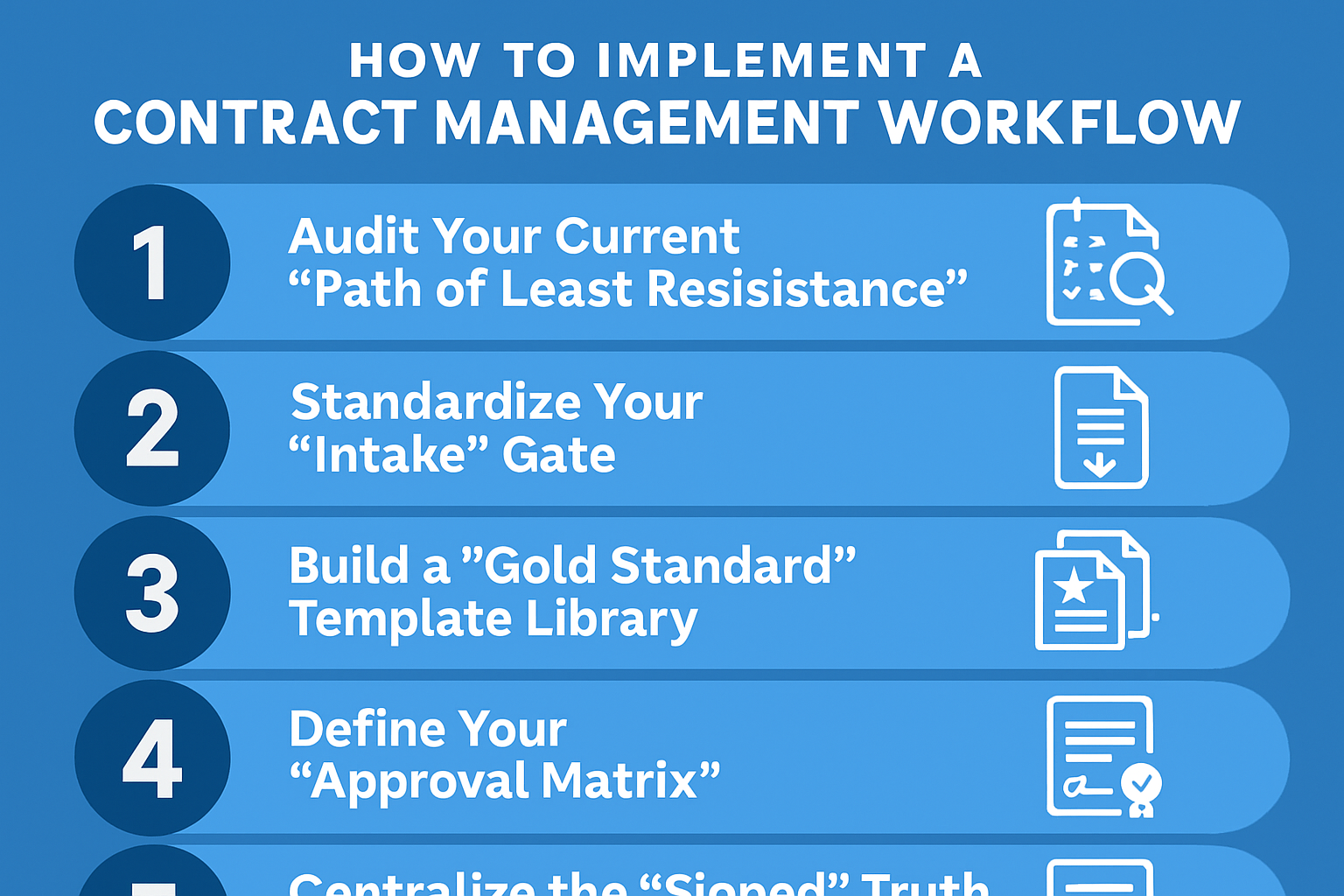
Here is a 5 step checklist to implement your own contract management workflow:
1. Audit Your Current “Path of Least Resistance”
Before you build a new system, you need to see where the old one is leaking.
The Action: Trace your last three deals. Who requested them? Where did the redlines live? Who gave the final “OK”?
The Goal: Identify the “Bottleneck Person.” Is it a single lawyer overwhelmed by requests, or a VP who forgets to check their signature cues? Knowing the pain points ensures you build a solution that people actually use.
2. Standardize Your “Intake” Gate
A messy workflow almost always starts with a messy request.
The Action: Stop accepting contract requests via Slack, Zoom, or “drive-by” office chats. Create a simple, mandatory intake form.
The Best Practice: Ensure this form captures the “Big 4”: Counterparty Name, Deal Value, Effective Date, and Special Terms so that when you begin drafting, you have 100% of the data you need to avoid the “back-and-forth” email trap.
3. Build a “Gold Standard” Template Library
You cannot have a fast workflow if every contract starts from a blank page or an old “Save As” document.
The Action: Take your three most-used agreements (likely an NDA, an MSA, and an Order Form) and create “Master Templates.”
The Strategy: Lock the “non-negotiable” clauses so they can’t be changed without a high-level alert. By avoiding common mistakes like using outdated liability caps, you ensure your team is always starting from a place of safety.
4. Define Your “Approval Matrix”
One of the biggest deal-killers is “Approval Ambiguity”—not knowing who needs to sign off on what.
The Action: Create a simple logic table:
- Deals < $10k: Direct to Signature.
- Deals $10k - $50k: Needs Finance Manager approval.
- Deals > $50k: Needs CFO + Legal Head approval.
The Result: When you build a system with clear rules, the CLM software can automatically route the document to the right person, eliminating the “Who needs to see this next?” confusion.
5. Centralize the “Signed” Truth
A workflow isn’t finished until the document is filed in a way that it can be found in five seconds.
The Action: Set up a naming convention that everyone must follow (e.g., YYYY-MM-DD_ClientName_ContractType).
The Strategy: Move away from local hard drives. Every signed document must live in your central repository. This ensures that when it comes time for post-signature management, your team isn’t hunting through old inboxes for the final version.
The Bottom Line
Implementation isn’t about perfection; it’s about consistency.
By starting with a clear intake process and a locked-down template library, you’ve already won 80% of the battle. This works across the board—whether you’re closing sales or trying to manage your vendors more effectively to avoid those surprise renewals
Remember, the goal is to create a path where the right way to do things is also the easiest way to do things.
See it in action
Turn contract chaos into a streamlined workflow
Join legal teams who cut contract turnaround time by 60%. Book a 15-minute demo to see how.