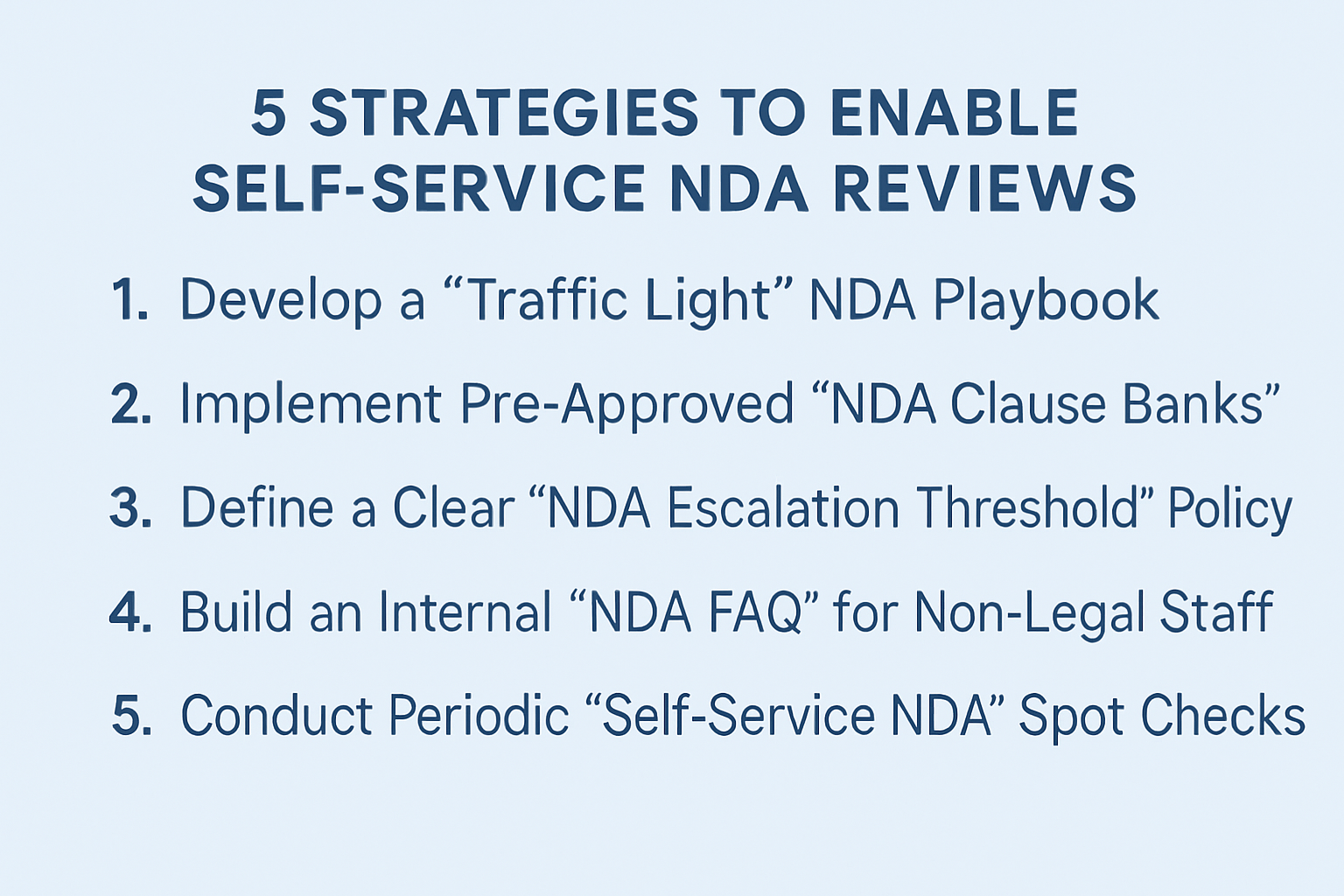
5 Strategies to Enable Self-Service NDA Reviews
If you find yourself “handholding” researchers or sales reps through every minor redline despite tracking and managing changes in the NDA review process, you are not alone.
While having a clear version history is a great first step, the sheer volume of routine, low-risk agreements can still leave your legal expertise spread too thin.
To help your team move faster without increasing risk, here is a practical framework to enable safe, self-service NDA reviews for your non-legal departments.
Step 1: Develop a “Traffic Light” NDA Playbook
- The Action: Create a simple, one-page guide that categorizes common NDA clauses into three clear decision zones for the business team.
- The How-To: Define Green (standard terms they can sign immediately), Yellow (acceptable fallbacks they can swap in), and Red (terms that must be escalated to Legal).
- The Result: This empowers non-legal staff to handle basic points independently, significantly increasing turnaround speed while maintaining your risk standards.
Step 2: Implement Pre-Approved “NDA Clause Banks”
- The Action: Provide the business team with a list of pre-approved alternative paragraphs they can use to resolve common NDA disputes.
- The How-To: If a counterparty rejects a 5-year confidentiality term, provide a “Clause Bank” that includes an approved 3-year version they can copy-paste into the draft themselves.
- The Result: This reduces “inbox clutter” by giving the business team the approved language they need to keep a negotiation moving without asking for permission on every line.
Step 3: Define a Clear “NDA Escalation Threshold” Policy
- The Action: Establish specific “triggers” that determine when an NDA draft must be handed back to a legal professional.
- The How-To: Set specific limits—such as any NDA with an uncapped liability or any agreement involving intellectual property ownership—that automatically move the file out of the self-service track.
- The Result: This ensures your time is protected for high-risk negotiations, while routine “standard” NDAs move through the system on a faster, decentralized track.
Step 4: Build an Internal “NDA FAQ” for Non-Legal Staff
- The Action: Create a central internal resource (like a Wiki page or short videos) explaining the “why” behind your standard NDA positions.
- The How-To: Briefly explain why the company insists on its own Governing Law or a specific definition of Confidential Information, so the business team can explain it to counterparties with confidence.
- The Result: This provides “on-demand” training, which stops you from having to repeat the same justifications to different departments every week.
Step 5: Conduct Periodic “Self-Service NDA” Spot Checks
- The Action: Perform a light audit of signed NDAs once a month to ensure the self-service process is being followed correctly.
- The How-To: Review a random sample of 3–5 signed agreements to verify that the business team stayed within the “Green” and “Yellow” zones of your playbook.
- The Result: This provides peace of mind that the company’s risk profile remains protected while allowing you to identify if the playbook needs updating based on new market trends.
Closing Thoughts
And there you have it…
We hope this article has been helpful in showing you how to empower your team to handle NDA contract negotiations independently.
If you would like to see the automated version of a self-service workflow, check out our contract review platform.
Otherwise, if your team is operating across different offices and you’re losing oversight, check out our guide on how to maintain consistency across regional NDA reviews.
See it in action
Turn contract chaos into a streamlined workflow
Join legal teams who cut contract turnaround time by 60%. Book a 15-minute demo to see how.