Tracking Research Contract Milestones (How-To)
If you would like to manage grant contract renewals without a spreadsheet so you can better handle the hundreds of other expiration dates and compliance obligations across your departments, you’re not alone.
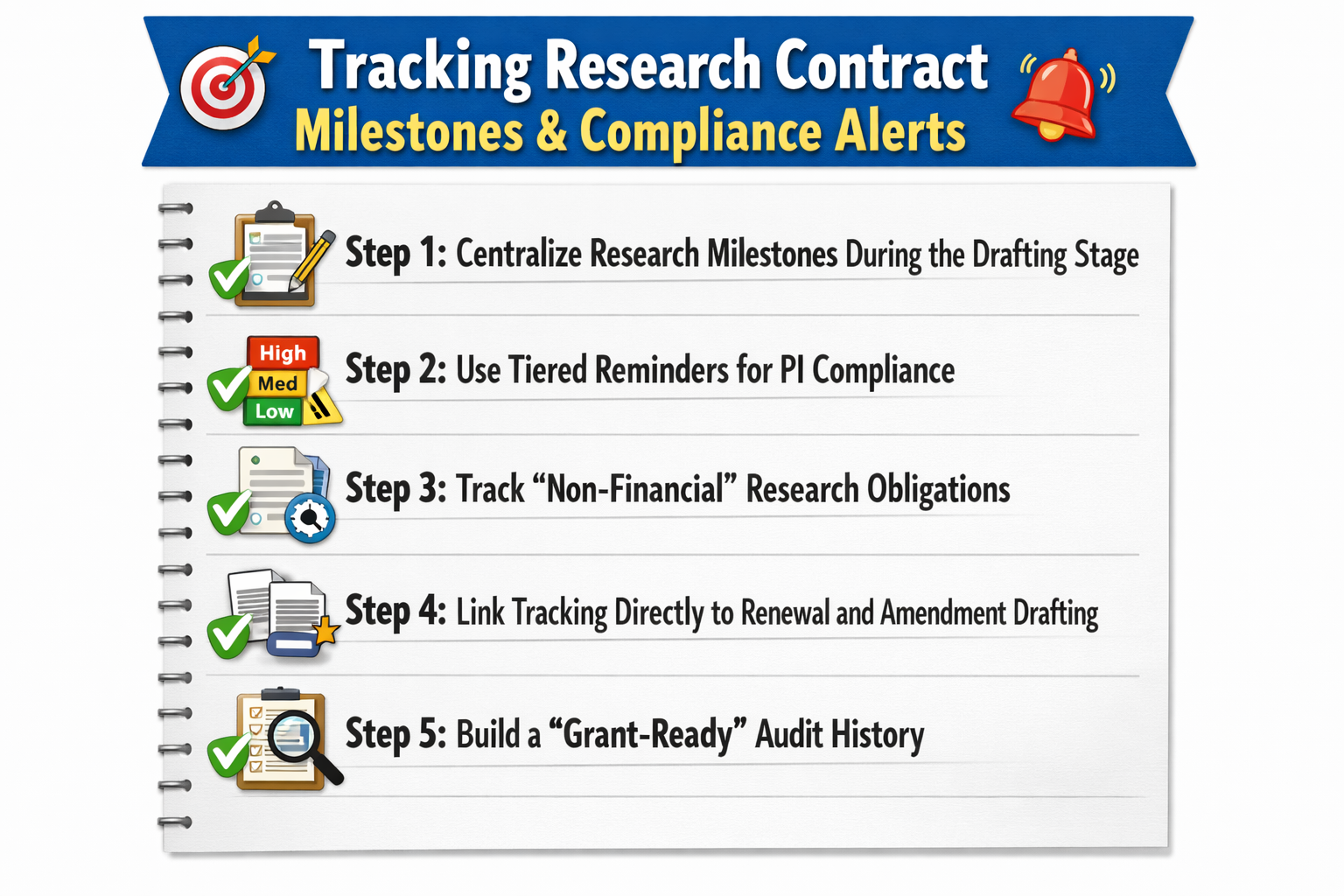
Here are 5 steps to move toward a more predictable system for tracking research contract milestones:
Step 1: Centralize Research Milestones During the Drafting Stage
We recommend capturing specific research milestones, like Technical Report due dates or Subrecipient Monitoring intervals, the moment the agreement is finalized. Waiting to extract this data from a mountain of signed PDFs later is where most errors occur.
To stay organized, consider:
- Immediate Metadata Tagging: Try to tag dates for interim scientific reports as part of your final filing process so they feed directly into a central dashboard.
- A Single Source of Truth: We suggest moving away from scattered department folders and into a database where every upcoming obligation is visible across the entire OSP or Research Office.
Step 2: Use Tiered Reminders for PI Compliance
Not every deadline is a crisis, but a missed Sponsored Research Agreement (SRA) renewal can halt funding. We recommend a notification system that gives you and your PIs plenty of lead time before a deadline becomes a “stop-work” issue.
To make your alerts more effective, try to:
- Set 90-60-30 Day Pings: We suggest a 90-day heads-up for the Research Office to check for “No-Cost Extensions”, and a 30-day “nudge” for the PI to submit their final deliverables.
- Make it Actionable: Ensure reminder emails include a direct link to the specific contract record so the PI doesn’t have to hunt through their inbox for the original terms.
Step 3: Track “Non-Financial” Research Obligations
It’s easy to focus on when the funding arrives, but Intellectual Property disclosures, equipment title transfers, and Data Use Agreement (DUA) expiries are just as critical. We recommend treating these as high-priority milestones to avoid compliance gaps with federal sponsors.
To maintain oversight, consider:
- Category Mapping: Create specific tags for Export Control and Conflict of Interest (COI) disclosures so these obligations don’t get lost in a sea of financial reporting.
- Closing the Loop: We suggest requiring a simple “Proof of Completion” (like a copy of the disclosure) to officially close a milestone in your system.
Step 4: Link Tracking Directly to Renewal and Amendment Drafting
To handle a contract renewal or supplemental funding amendment, we recommend having your contract tracking software trigger the drafting process. The setup can be something as simple where an “Expiring Soon” status allows you to initiate the next iteration without re-keying data.
To simplify the hand-off, try:
- Automated Renewal Triggers: Set the system to offer a “Start Renewal” option as soon as a tracking alert is acknowledged by the Research Office.
- Inherit Terms: We suggest ensuring that any new amendment automatically pulls in the pre-vetted clauses from the original agreement to save time on legal re-review.
Step 5: Build a “Grant-Ready” Audit History
When an auditor or a federal sponsor asks for proof of compliance, digging through old email threads isn’t enough. We recommend maintaining an automated log that records every alert sent and every milestone met throughout the life of the project.
To make reporting easier, consider:
- Compliance Health Snapshots: Use your tracking data to generate quick reports showing what percentage of your active research portfolio is currently “on track.”
- Permanent Archiving: We suggest ensuring that even after a grant is closed out, the history of its alerts and renewals stays archived and searchable for the mandatory retention period.
Conclusion
We hope these steps make the post-signature phase feel a little less chaotic and a lot more manageable. By automating the “busy work” of tracking and reminders, you can get back to the strategic work of supporting your university’s research mission.
See it in action
Turn contract chaos into a streamlined workflow
Join legal teams who cut contract turnaround time by 60%. Book a 15-minute demo to see how.