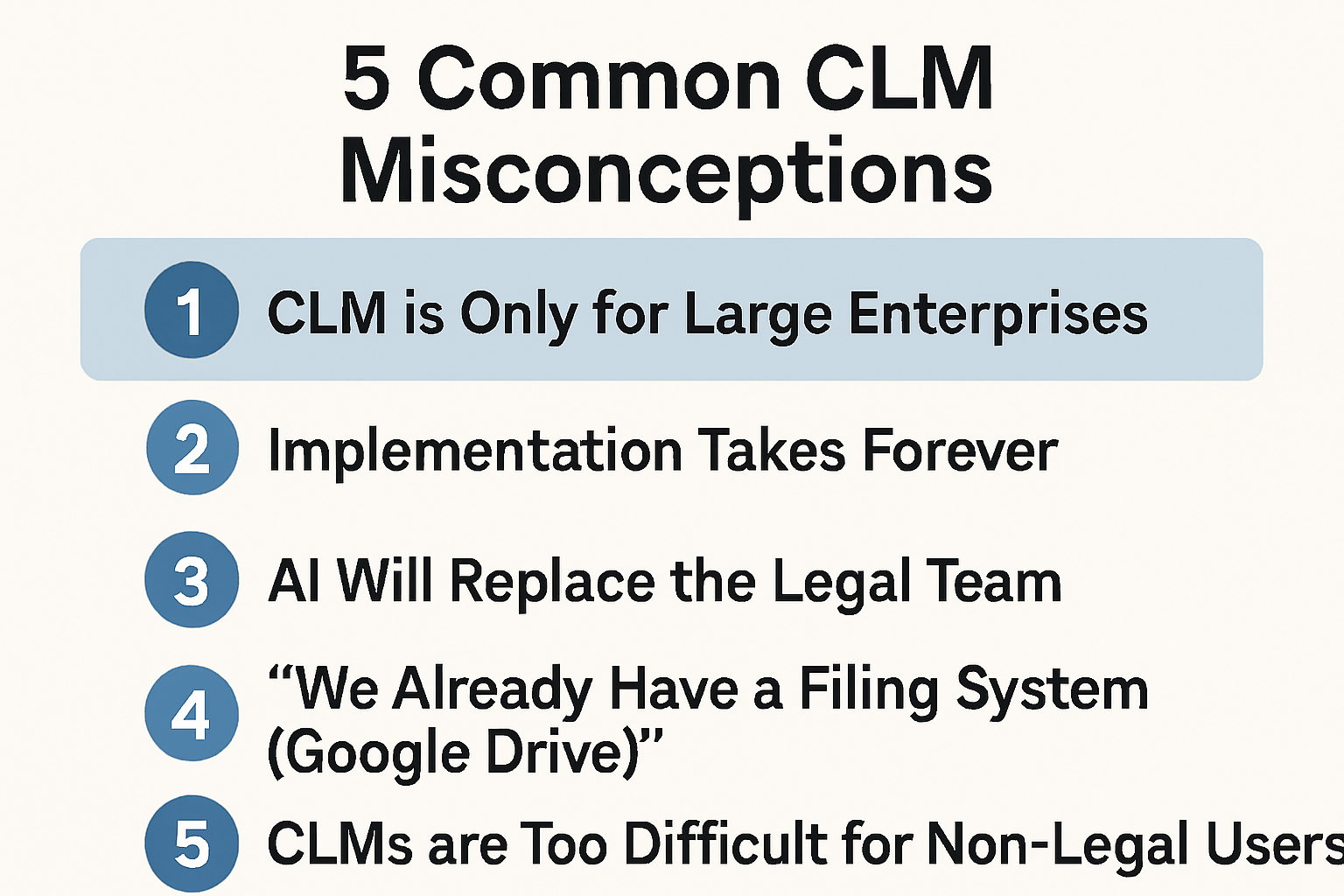
5 Common CLM Misconceptions
When teams start talking about Contract Lifecycle Management (CLM) software, it’s easy for the conversation to get derailed by outdated ideas of what these platforms actually do.
Some see it as an expensive digital filing cabinet, while others fear it’s a complex monster that will take months to learn.
To help you get a clearer picture of the modern legal tech landscape, let’s debunk the five most common misconceptions that tend to hold companies back from scaling their operations.
#1: CLM is Only for Large Enterprises
There is a lingering belief that you need a Fortune 500 budget and a dedicated Legal Ops team of ten to see any value from a CLM.
- The Reality: While the massive, legacy platforms of the past were built for enterprises, modern CLMs are designed for high-growth startups and mid-market companies. If you’re handling more than a handful of contracts a month, the “hidden cost” of manual errors and slow deals usually far outweighs the cost of the software.
#2: Implementation Takes Forever
We’ve all heard horror stories of CLM implementations that dragged on for a year. This leads to the common mistake of delaying a purchase because “it isn’t the right time” for a massive project.
- The Reality: It doesn’t have to be a “Big Bang” rollout. By focusing on a specific department or a few key templates first, you can be up and running in weeks, not months. Modern platforms are built for agility, allowing you to build the “engine” while you’re already driving it.
#3: AI Will Replace the Legal Team
This is perhaps the biggest “elephant in the room.” There is a fear that AI contract review is meant to automate lawyers out of a job.
- The Reality: Technology is a “force multiplier,” not a replacement. AI is excellent at the repetitive, “low-value” work—like spotting mismatched dates or finding specific clauses across 100 documents. By letting the software handle the data-scanning, your legal team is actually freed up to focus on high-level strategy and complex negotiations that require a human touch.
#4: “We Already Have a Filing System (Google Drive)”
Many teams believe that because their contracts are stored in a cloud folder, they have “contract management” covered.
- The Reality: A cloud folder is just a static cemetery for PDFs. It doesn’t alert you when a contract is about to expire, it doesn’t help you with standardizing redlines, and it certainly doesn’t give you data on your deal velocity. A true CLM is a dynamic tool that manages the life of the contract, not just its storage.
#5: CLMs are Too Difficult for Non-Legal Users
There’s a fear that Sales or Procurement teams will find the software too “legal-centric” and refuse to use it, leading to a failed implementation.
- The Reality: Modern CLMs prioritize the “User Experience” (UX). The goal is to make requesting or approving a contract as easy as ordering a pizza. When the system is designed correctly, it actually removes friction for the Sales team, helping them close deals faster without the usual “Legal bottleneck” frustration.
The Bottom Line
Most of the “risks” people associate with CLM are actually holdovers from how software used to work a decade ago. In 2026, the real risk isn’t adopting a CLM—it’s staying stuck in a manual process while your competitors move at the speed of light.
By clearing away these misconceptions, you can stop “firefighting” your contracts and start using them as a strategic tool to grow your business.
See it in action
Turn contract chaos into a streamlined workflow
Join legal teams who cut contract turnaround time by 60%. Book a 15-minute demo to see how.