Contract Negotiation Checklist for Small Legal Teams
When you’re part of a legal team of two or five, your day-to-day is rarely just about the law.
More often than not, it’s about balance.
This checklist is designed to help you reclaim your focus, moving away from manual triage and toward a more strategic, ROI-driven negotiation process.
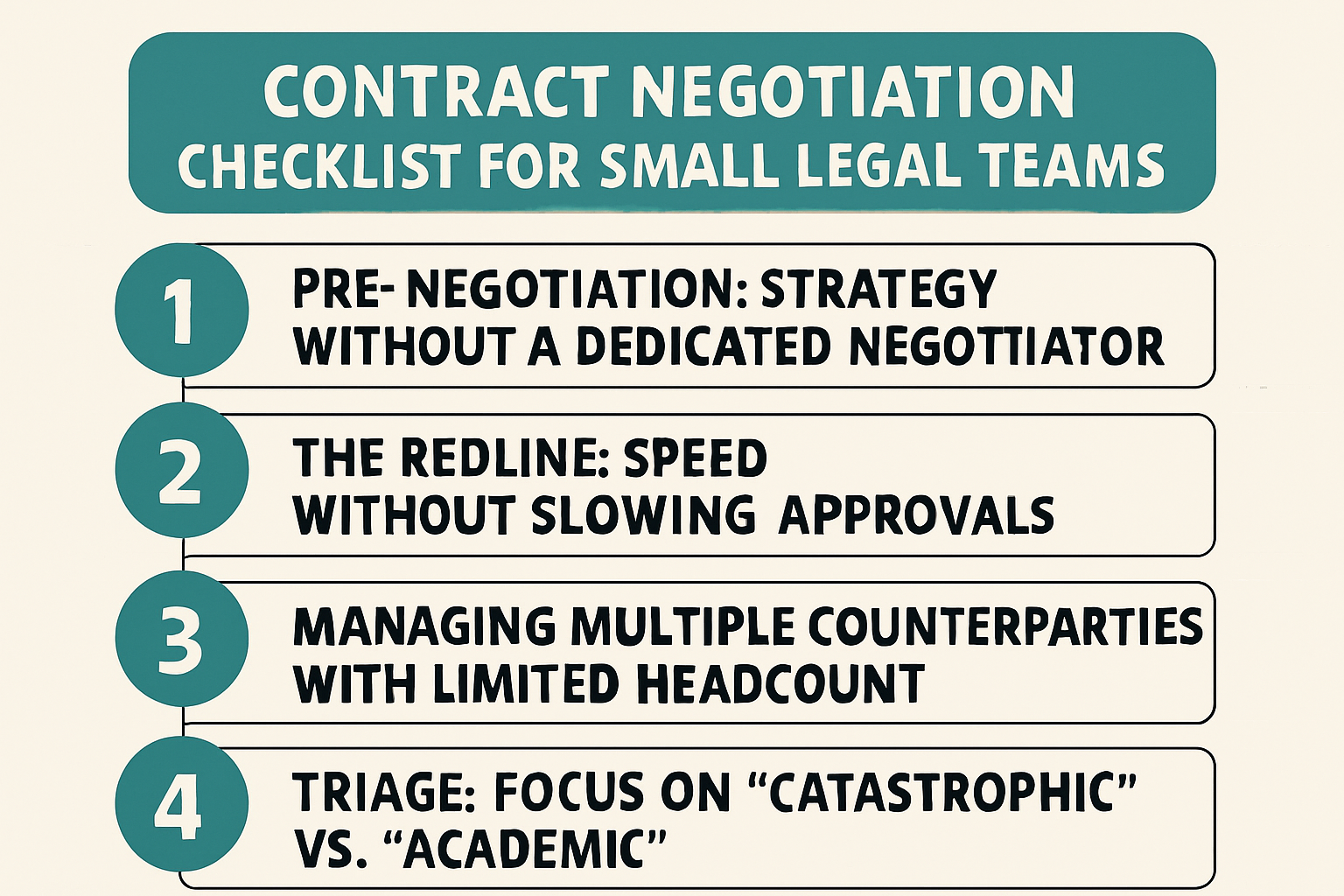
1. Pre-Negotiation: Strategy Without a Dedicated Negotiator
Since you likely don’t have a dedicated “Head of Global Negotiations,” you have to shift from legal analyzer to commercial strategist the moment a contract hits your desk.
- The 3-Bullet Brief: Before you open a document, ask the business lead for three things: The “why” behind the purchase, the “must-have” go-live date, and our leverage in the deal.
- Set the “No-Fly” Zone: Determine your non-negotiables (like IP ownership or uncapped liability) early. Knowing your boundaries in advance means you don’t have to pause the momentum to consult stakeholders on every call.
- Align on the “Business Why”: Ask the stakeholder what the actual cost of a delay is. This allows you to prioritize deals based on real business impact rather than just who is following up the most on Slack.
2. The Redline: Speed Without Slowing Approvals
When legal resources are the scarcest part of the supply chain, “version control” can’t become your full-time job; your redlines need to be definitive and educational.
- Own the Paper: Whenever possible, use your company’s templates. It is significantly faster to defend your own familiar language than to audit a vendor’s 60-page agreement for hidden traps.
- The “Explain Your Why” Rule: Try not to delete a clause without adding a brief comment. Explaining the risk you’re trying to mitigate prevents unnecessary back-and-forth phone calls later.
- Batching for Momentum: Avoid “ping-pong” redlining. Group your feedback into logic blocks—Commercial, Liability, and Operational—so the counterparty can review and approve in chunks.
3. Managing Multiple Counterparties with Limited Headcount
Managing 20 deals in flight requires you to stop being a “reviewer” and start being a “project manager” who knows exactly where every bottleneck lives.
- Prioritize Risk, Not Volume: Resist the urge to work on a “first-in, first-out” basis. Focus on revenue-critical deals or high-risk data agreements first, even if they aren’t the “easiest” to clear.
- Status Transparency: Maintain a simple, shared view where Sales or Procurement can see exactly where a deal sits. This reduces the “status update” emails that clutter your morning.
- The “Bottleneck” Bypass: If you aren’t the final sign-off, use a brief “Executive Summary” for the approver. Summarize what the deal is, what risks were accepted, and why you recommend moving forward.
4. Triage: Focus on “Catastrophic” vs. “Academic”
A common mistake is treating every contract with the same level of intensity, which leads to burnout and missed deadlines on high-value deals.
- The Threshold Rule: For low-value or low-risk contracts, consider a “Light Review.” Focus strictly on Data Privacy, Security, and Termination.
- Build a “Mini-Playbook”: Don’t start from scratch every time. Keep a one-pager of your 5 most contested clauses with pre-approved “fallback” language that you can copy and paste into a deal.
Closing Thoughts
We hope this checklist helps you reclaim some of your headspace and narrow your focus down to the risks that actually matter.
And if you’re at the point where manual checklists aren’t enough to keep up with the volume, it might be time to look at contract negotiation software for small legal teams.
If you want to automate these manual steps and get back to the high-value work, let’s chat.
See it in action
Turn contract chaos into a streamlined workflow
Join legal teams who cut contract turnaround time by 60%. Book a 15-minute demo to see how.