5 Common Mistakes When Choosing CLM Software
Choosing a Contract Lifecycle Management (CLM) platform is a big move.
When it works, it’s the “operating system” that makes your legal and sales teams unstoppable. But when it fails, it becomes an expensive piece of “shelfware” that nobody actually wants to use.
To help you find a partner that actually delivers, here are the five most common mistakes we see teams make during the selection process.
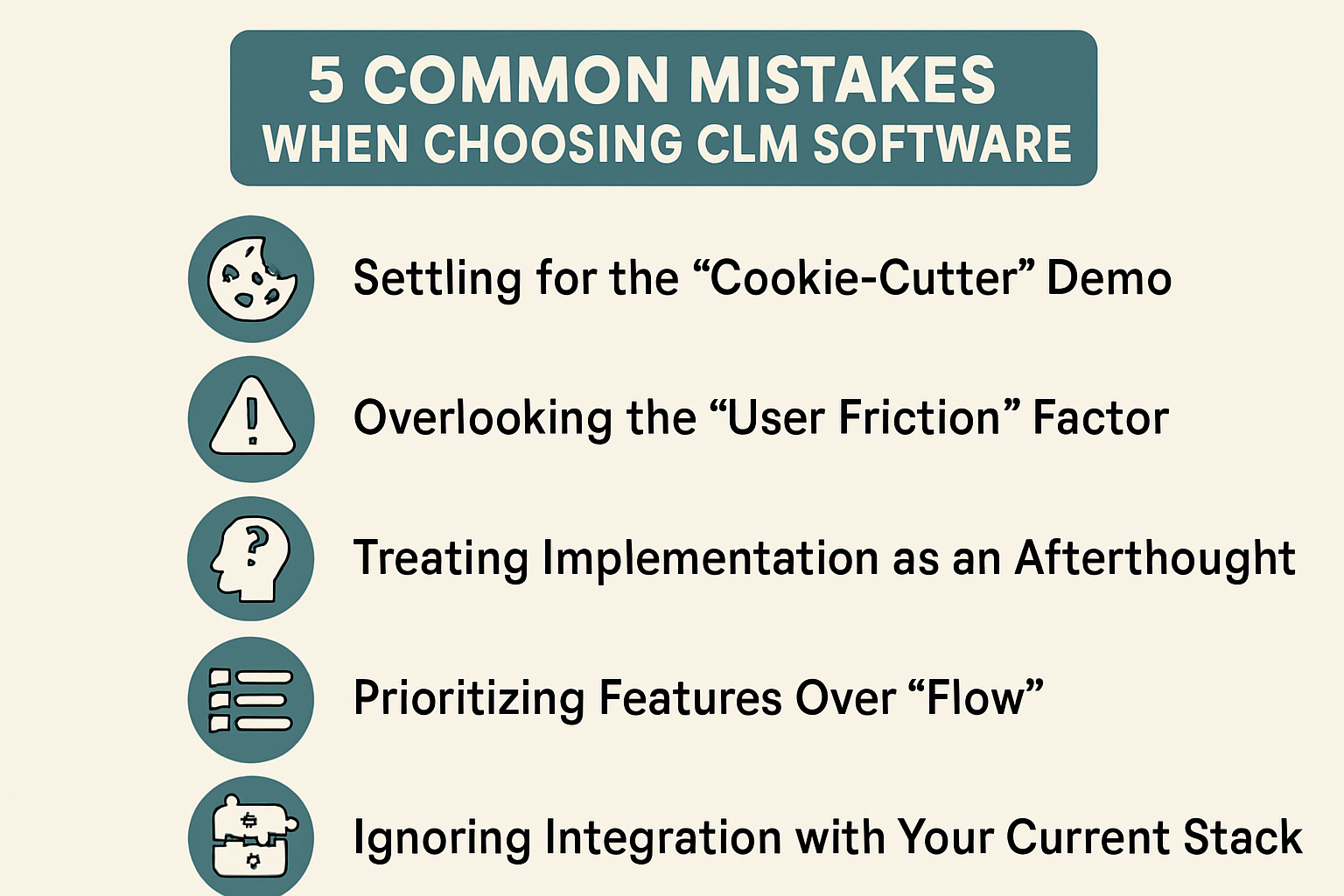
1. Settling for the “Cookie-Cutter” Demo
Every CLM looks amazing in a pre-recorded demo with perfect data and a simplified workflow. The mistake is assuming that “out-of-the-box” ease will translate to your specific business.
- Our Advice: Don’t just watch their presentation; make them run a “live build” or a proof-of-concept using one of your actual messy contracts. If the software can’t handle your real-world edge cases during the sales cycle, it definitely won’t handle them on Day 1 of go-live.
2. Overlooking the “User Friction” Factor
A CLM is only as good as its adoption rate.
We often see companies choose a platform that Legal loves, but Sales finds impossible to navigate.
If your sales team feels like the software is a “barrier” rather than a “bridge,” they will find ways to work around it—and you’ll be right back to messy email threads and version control issues.
- Pro-tip: Bring a “power user” from outside the legal department into your final demos. If they can’t figure out how to request a contract without a manual, keep looking.
3. Treating Implementation as an Afterthought
The biggest mistake you can make is thinking the work ends when you sign the vendor’s contract.
In reality, that’s when it begins.
Many vendors are great at selling software but lackluster at supporting the implementation.
- The Reality: Without a clear plan for data migration and team training, your new CLM will just be an empty digital filing cabinet. Ask potential vendors about their implementation success rate and specifically who will be holding your hand during the first 90 days.
4. Prioritizing Features Over “Flow”
It’s easy to get a “feature-heavy” checklist and assume more is better. However, a CLM with 100 features you don’t use is just a clunky interface that slows you down.
- Focus on the Core: Instead of chasing every bell and whistle, focus on how the tool handles your contract review workflow. Does it automate the boring stuff? Does it provide real-time visibility? Excellence in the 3 or 4 things you do every day is worth more than a dozen features you’ll use once a year.
5. Ignoring Integration with Your Current Stack
Your contracts don’t live in a vacuum—they are tied to your CRM (like Salesforce), your ERP, and your e-signature tools. A common trap is choosing a “standalone” CLM that doesn’t play nice with the tools your team already uses.
- The Goal: You want a “frictionless” data flow. If a salesperson has to manually copy-paste data from your CRM into the CLM, you’ve just traded one manual bottleneck for another.
The Bottom Line
Choosing a CLM is less about finding the “best” software on the market and more about finding the best fit for your team’s actual habits. By avoiding these pitfalls—and keeping a close eye on user adoption and integration—you can ensure your investment actually pays off in the form of faster deals and better protection.
See it in action
Turn contract chaos into a streamlined workflow
Join legal teams who cut contract turnaround time by 60%. Book a 15-minute demo to see how.