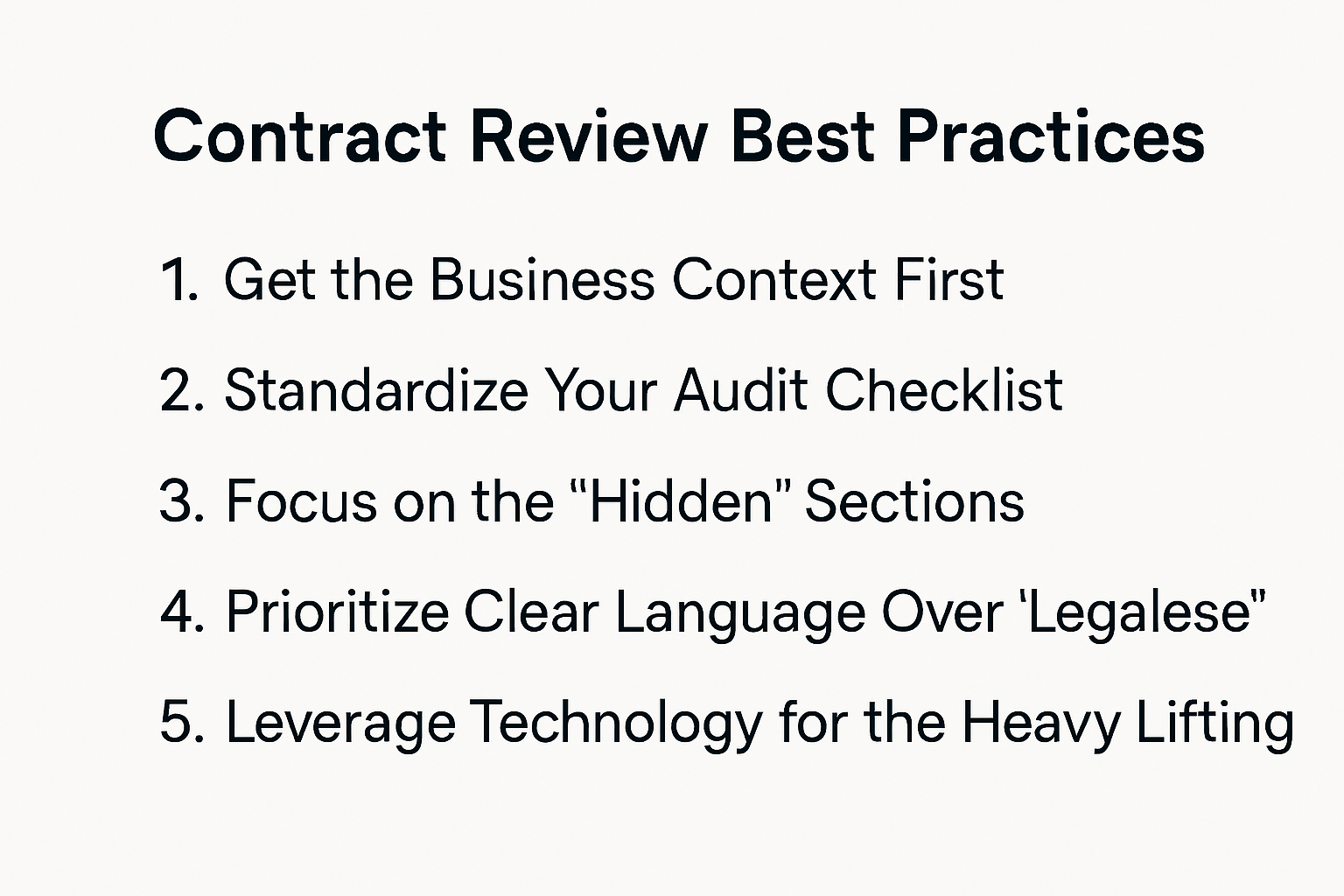
5 Contract Review Best Practices
Reviewing a contract can often feel like looking for a needle in a haystack—except the haystack is 60 pages of legalese and the needle could cost your company thousands of dollars.
Whether you’re a founder, a project manager, or part of a legal team, the goal of a review isn’t just to “read” the document; it’s to ensure the business reality matches the legal language.
If you want to move faster without missing the fine print, here are the 5 best practices we recommend for a more rigorous and efficient review.
1. Get the Business Context First
One of the biggest common mistakes is jumping into the clauses before you understand the deal. Before you open the document, ask the stakeholder: What is the one thing we cannot lose on here? Is it the IP? Is it the 30-day exit clause?
When you know the “must-haves,” you can prioritize your mental energy.
You aren’t just looking for errors; you’re looking for alignment with the business’s goals.
2. Standardize Your Audit Checklist
Don’t rely on your memory.
Even the most experienced reviewers have “off days” where they might skim past a lopsided indemnification clause.
Create a living document—a checklist that every contract must pass through.
This is a core part of a healthy contract review workflow.
Your checklist should always include:
The “Money” Clauses: Are payment triggers tied to dates or specific milestones?
The “Exit” Strategy: Can we get out if the partnership turns sour? Look for “Termination for Convenience.”
The “What Ifs”: Does the limitation of liability actually protect us in a worst-case scenario?
3. Focus on the “Hidden” Sections
Most people spend 90% of their time on the main body of the contract and 10% on the exhibits, schedules, and annexes. Seasoned reviewers do the opposite.
The Danger Zone: Often, the most predatory terms or vague job descriptions are hidden in “Exhibit A” or “Schedule 1.”
The Consistency Check: Make sure the definitions in the main agreement actually match the commercial terms in the annex. If the main body says “Net-30” but the exhibit says “Payment upon receipt,” you’re headed for a dispute.
4. Prioritize Clear Language Over “Legalese”
Another common misconception is that a contract is better if it sounds more complicated. In reality, ambiguity is the enemy of a good deal. If a clause requires three read-throughs to understand, it’s a red flag.
- Pro-tip: Strive for “Plain English.” If you can’t explain the clause to a non-lawyer in one sentence, it needs to be redlined for clarity. Clear language prevents the “I thought you meant X” conversations six months down the line.
5. Leverage Technology for the Heavy Lifting
Lastly, in 2026, manual review is no longer a badge of honor—it’s a bottleneck.
Using AI-assisted contract review software allows you to automate the “low-value” parts of the process, like checking for blank fields, mismatched dates, or inconsistent numbering.
By letting a tool handle the data-scanning, you can save your brainpower for the high-level negotiation. Technology should be your “first pass” reviewer, flagging the obvious red flags so you can spend your time solving the complex problems.
See it in action
Turn contract chaos into a streamlined workflow
Join legal teams who cut contract turnaround time by 60%. Book a 15-minute demo to see how.