Contract Review Workflow Guide
If you’ve ever felt like a deal was moving at lightning speed only to hit a “black hole” once it reached the review stage, you aren’t alone.
In most high-growth companies, the contract review process isn’t slow because people aren’t working hard; it’s slow because the path from “Draft” to “Signed” hasn’t been clearly defined.
So, let’s walk through how we can standardize this process and protect your business from common mistakes that tend to slip through when everyone is rushing to hit a deadline.
Defining Your Contract Review Workflow
Think of your workflow as a roadmap.
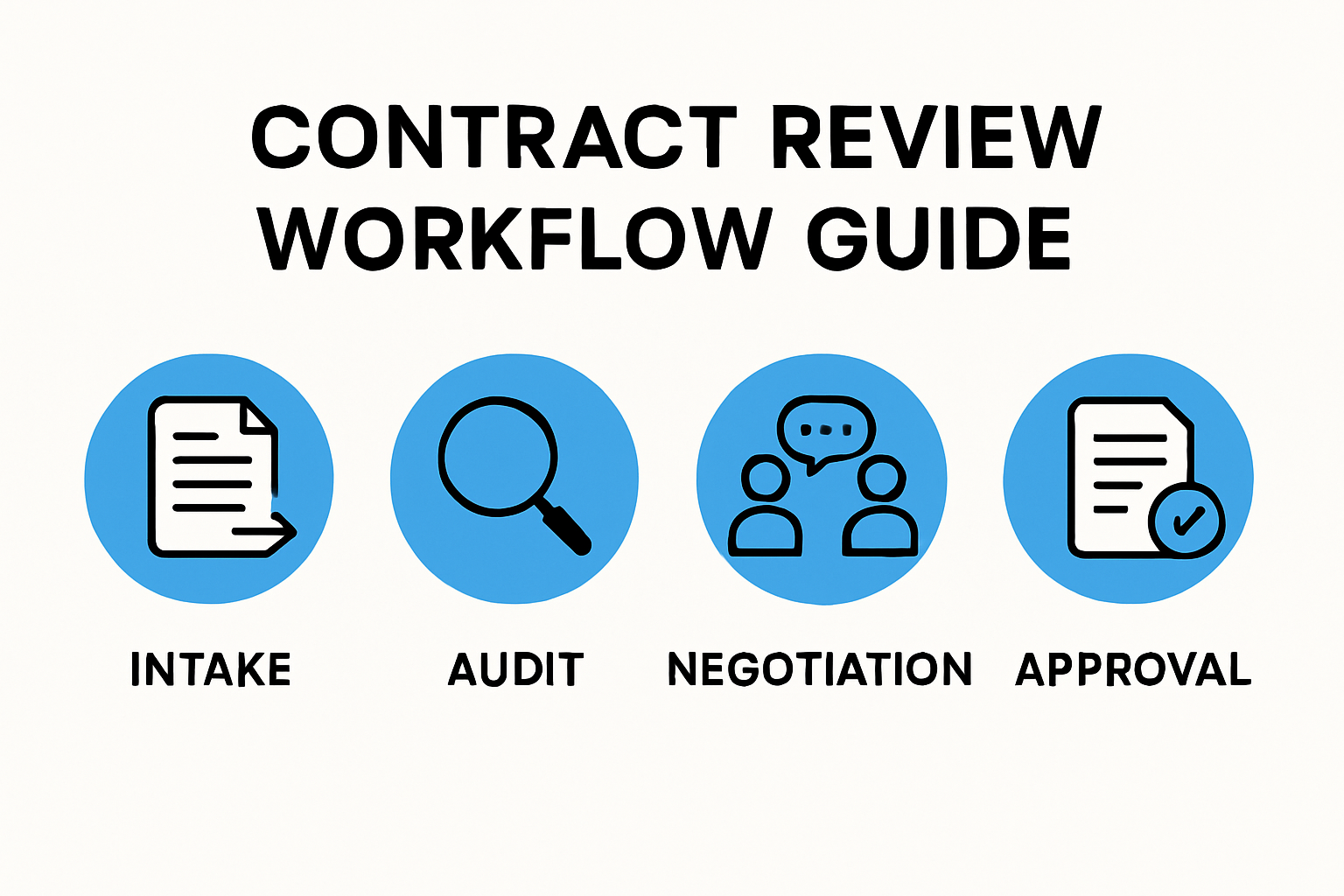
Without it, every contract is a “custom” project that requires a dozen emails just to find the right version. To get organized, most high-performing teams anchor their contract review process around four clear stages:
- Intake: This is your “single source of truth.” All contracts and supporting exhibits should land in one central location so everyone is working on the same version.
- Audit: Before you dive into redlines, do a quick pulse check. Does this deal actually align with your company’s best practices and risk tolerance?
- Negotiation: This is the back-and-forth “Redlining” phase. The goal here is to reach an agreement without losing the original intent of the deal.
- Approval: This is the final internal green light from Legal, Finance, or Leadership before anyone officially signs.
Optimizing Your Contract Approval Workflow
Next, to turn these stages into a high-velocity engine, you need to look at where the “dead time” usually lives. In our experience, focusing on these five areas have proven to shave days off closing time:
- Tiered Review Thresholds: Not every small software subscription needs the same level of scrutiny as a million-dollar partnership. Create an “Express Lane” where low-risk deals bypass senior leadership entirely based on pre-set dollar amounts or the use of your own standardized templates.
- Pre-Approved Fallback Positions: Stop pausing the whole chain for minor changes. Give your reviewers a “Playbook” of alternate clauses so they can resolve redlines on the spot—like moving a payment trigger by 15 days—without waiting for permission.
- Parallel Approval Paths: Stop the “assembly line” where Finance waits for Legal to finish. If you allow departments to review the document at the same time, you eliminate the biggest bottleneck in the entire process.
- Standardized Redline Etiquette: Version control is usually where things fall apart. Establish clear rules for how changes are tracked and named so you never find yourself negotiating an outdated “Final_v2” copy.
- Real-Time Status Visibility: The “Where is this contract?” email is a productivity killer. A high-performing workflow uses a dashboard where Sales, Finance, and Legal can see exactly who has the ball at any given moment.
Automating Your Legal Contract Review with AI
As your volume increases, it becomes nearly impossible to maintain a high level of detail manually. This is where AI contract review can act as a useful backstop. Instead of replacing the human eye, it handles the repetitive, data-heavy tasks that usually lead to burnout.
- Preliminary Auditing: Rather than reading a 50-page document line-by-line just to find the “standard” sections, you can use AI to highlight where the language actually deviates from your company’s requirements. This allows you to jump straight to the negotiation points that matter.
- Catching Small Inconsistencies: When you’re reviewing several contracts a day, it’s easy to overlook a mismatched date, a missing exhibit, or an incorrectly numbered section. Automation is particularly good at spotting these technical errors before the document reaches the signature stage.
- Smarter Triage: You can use these tools to automatically categorize contracts based on risk or deal value as soon as they are uploaded. This ensures that a complex partnership doesn’t sit behind five simple NDAs in the queue.
The Bottom Line
And there you have it…
We hope this guide helps you identify the bottlenecks in your own process and gives you a starting point for turning contract review into a strategic advantage for your business.
See it in action
Turn contract chaos into a streamlined workflow
Join legal teams who cut contract turnaround time by 60%. Book a 15-minute demo to see how.