5 Hidden Liabilities to Track in Expired NDAs
Once you have established your standardized post-signature NDA reporting, your next priority should be to monitor the “zombie clauses” that stay active in the background.
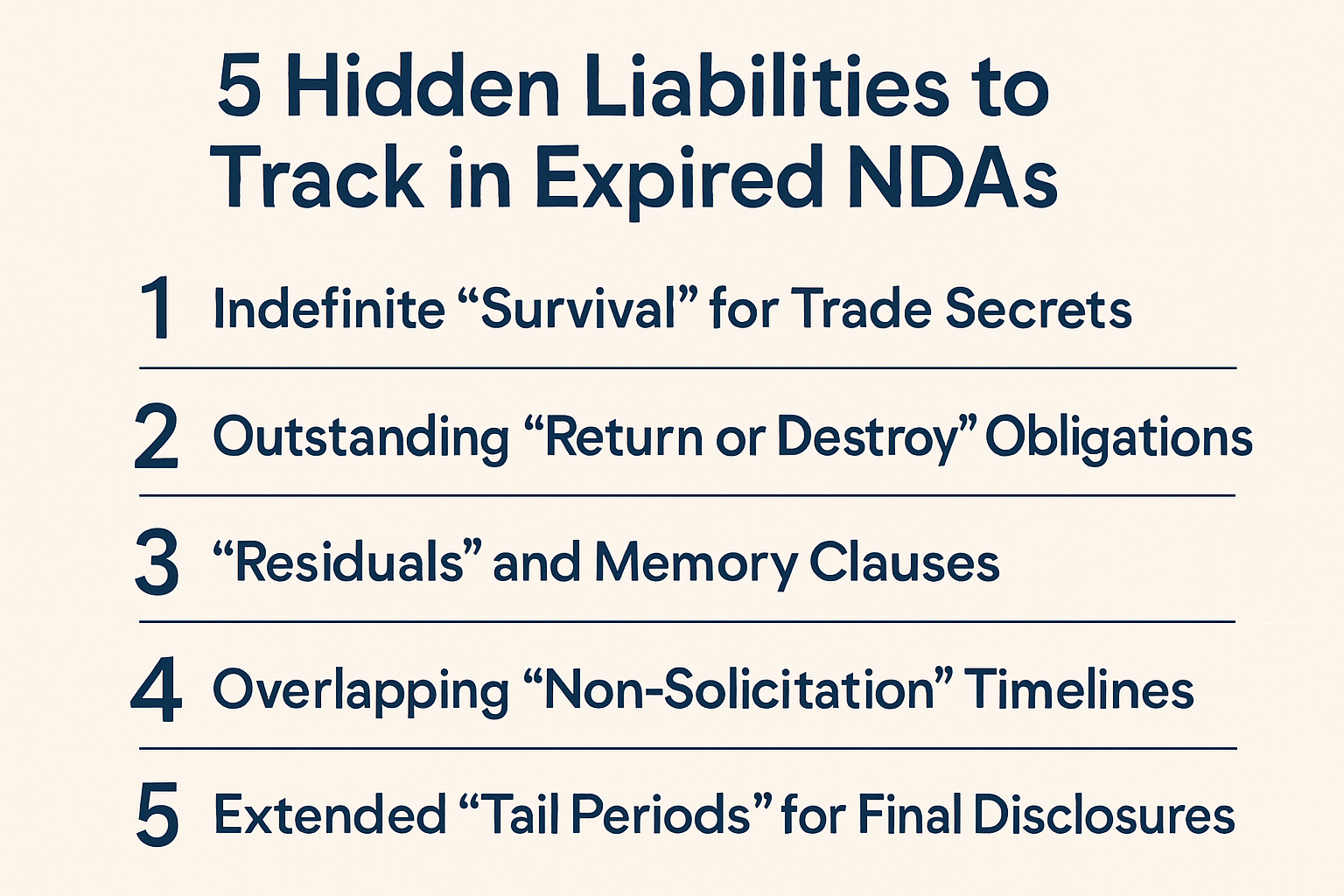
Here are the five most common hidden liabilities to track in your expired NDAs.
1. Indefinite “Survival” for Trade Secrets
The Liability: Many NDAs state that while the general agreement expires in a few years, the protection of Trade Secrets remains active for as long as the information stays confidential.
The Rationale: Because the value of a trade secret is tied to its secrecy, courts often uphold these “permanent” obligations. If your team treats the expiration date as a “green light” to share old technical data, you could be in immediate breach.
The Outcome: By tracking survival periods separately from the contract end date, you ensure that “permanent” secrets stay protected.
2. Outstanding “Return or Destroy” Obligations
The Liability: Most NDAs require an active step—returning or destroying data—to fully release a party from their data-handling liability.
The Compliance Factor: Letting the clock run out doesn’t satisfy the law. If a partner audits your servers and finds their Confidential Information still sitting in an old folder, you are technically in breach of the contract even if the “term” has ended.
The Outcome: Tracking the “completion” of data destruction ensures you move from passive expiration to active compliance.
3. “Residuals” and Memory Clauses
The Liability: Some agreements include “Residuals” language that allows a party to use ideas “retained in the unaided memory” of their staff.
The Strategic Insight: These clauses can create significant “gray areas” regarding what your partners can do with your IP after a project ends.
The Outcome: Identifying which expired agreements have these clauses helps you set clearer boundaries for future collaborations and alerts your R&D leads to potential IP leaks.
4. Overlapping “Non-Solicitation” Timelines
The Liability: “Non-Solicitation” or “Non-Compete” periods buried in an NDA draft often have a different “tail” than the secrecy period.
The Reasoning: You might be legally clear to discuss the project details, but still barred from recruiting the partner’s key talent for an additional 12–24 months.
The Outcome: Tracking these overlapping timelines prevents internal coordination errors between Legal and HR during recruitment efforts.
5. Extended “Tail Periods” for Final Disclosures
The Liability: In many deals, information shared toward the end of the partnership is protected by an additional “Tail Period” (e.g., protection for X years from the date of disclosure).
The Logic: If you shared a sensitive file on the last day of the project, that document might still be protected long after the NDA file is moved to your “Expired” folder.
The Outcome: Tracking these rolling dates ensures your internal records reflect the true window of protection, preventing data from being treated as public before its time.
Closing Thoughts
And there you have it..
We hope this series has helped you build a roadmap for moving from manual spreadsheets to a high-scale, automated legal engine.
By mastering your metrics, your audits, and the tracking of these hidden liabilities, you ensure that your organization’s most valuable assets—its secrets—remain protected for years to come.
If you’d like to see how our platform makes these post-signature NDA updates feel effortless, check out our contract tracking platform.
See it in action
Turn contract chaos into a streamlined workflow
Join legal teams who cut contract turnaround time by 60%. Book a 15-minute demo to see how.