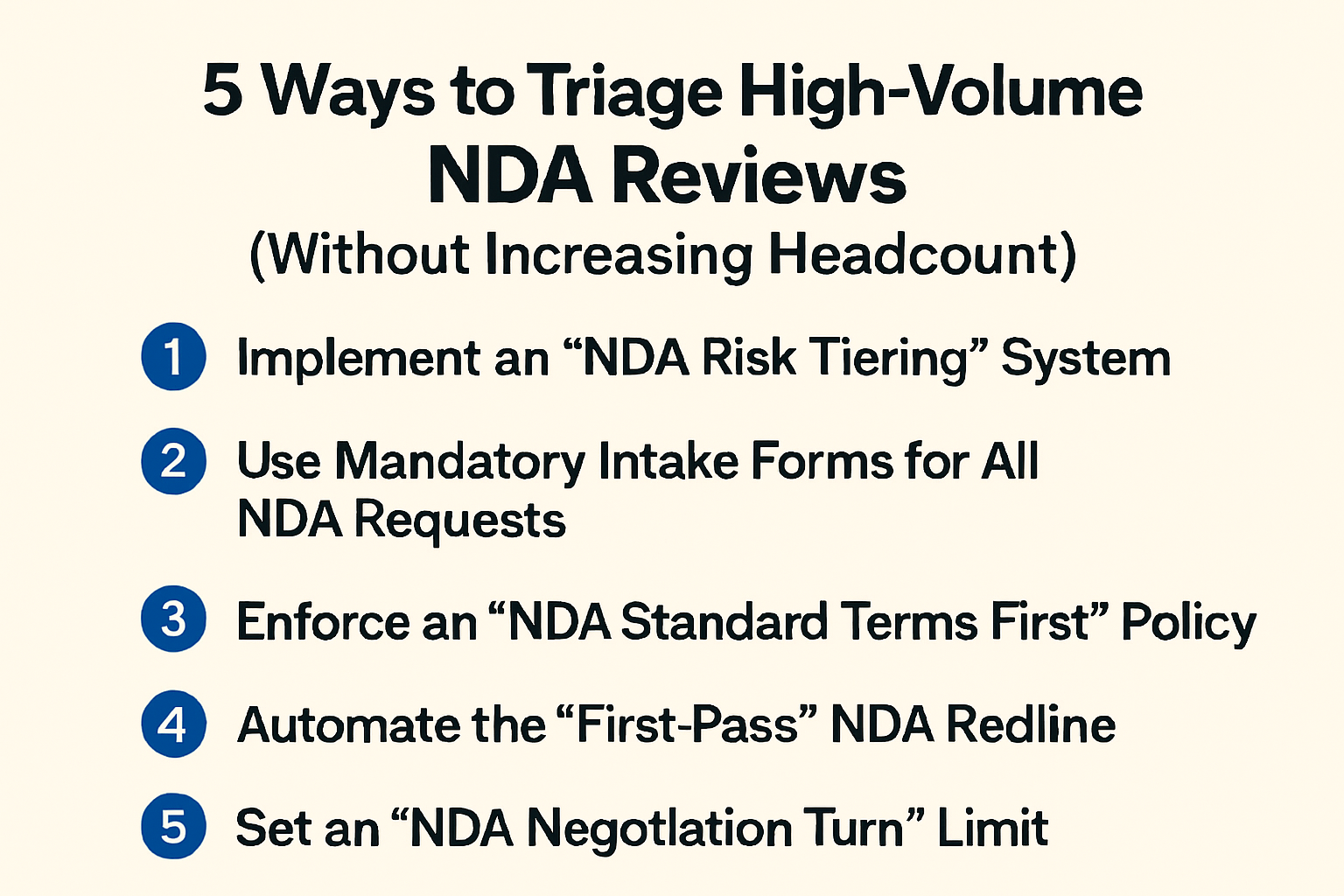
5 Ways to Triage High-Volume NDA Reviews
If you are managing a high-growth organization, the sheer volume of incoming non-disclosure agreements can quickly outpace your team’s capacity.
Even if you have established regional NDA consistency across your offices, the manual effort required to review every incoming draft can become a significant bottleneck.
To help you regain your time, here are five ways to effectively triage high-volume NDA reviews.
1. Implement an “NDA Risk Tiering” System
- The Action: Categorize incoming NDA requests based on the sensitivity of the information being shared and the strategic value of the partnership.
- The How-To: Label agreements as Tier 1 (High Risk: M&A, IP licensing), Tier 2 (Medium Risk: Vendor partnerships), or Tier 3 (Low Risk: General discovery calls).
- The Result: This allows you to prioritize your limited hours for Tier 1 NDA negotiations, while Tier 3s can be fast-tracked or handled by non-legal staff using a pre-approved playbook.
2. Use Mandatory Intake Forms for All NDA Requests
- The Action: Require all departments to submit a standardized form before Legal even looks at an NDA contract.
- The How-To: The form should answer critical questions upfront: Is this a mutual or one-way NDA? What is the purpose? What is the expected duration of the partnership?
- The Result: This eliminates the “ping-pong” of clarifying emails, ensuring that when you finally open the NDA draft, you already have all the context you need to review it in one sitting.
3. Enforce an “NDA Standard Terms First” Policy
- The Action: Make it a company-wide rule that the business team must first push for the use of your own pre-approved NDA template.
- The How-To: Arm your sales and research teams with a “Why Our Template?” talk track. Only if the counterparty flatly refuses to use your paper is the request escalated for a manual redline of their NDA document.
- The Result: Every agreement signed on your own paper is a 0-minute review for Legal, drastically reducing the pile of NDA reviews that require manual attention.
4. Automate the “First-Pass” NDA Redline
- The Action: Use technology to handle the initial “scrub” of a counterparty’s NDA draft to identify high-risk clauses.
- The How-To: Instead of reading every word, use a contract review tool to instantly highlight “Red Flag” terms like uncapped liability or broad IP ownership that contradict your global NDA policy.
- The Result: This cuts the initial review time by up to 70%, as you can jump straight to the problematic clauses rather than reading standard boilerplate over and over.
5. Set an “NDA Negotiation Turn” Limit
- The Action: Establish a policy that limits the number of times an NDA can go back and forth before a manager or executive must sign off on the remaining risk.
- The How-To: If an NDA isn’t settled within two turns, it triggers a “Business Decision” meeting where the stakeholder decides if the deal is worth the continued legal expense.
- The Result: This prevents “over-lawyering” on low-stakes agreements and forces the business team to take ownership of the risks they are asking the company to accept in the NDA.
Closing Thoughts
And there you have it.
We hope this has been helpful in showing you how to bring order, consistency, and speed to your NDA contract negotiation process.
If you would like to see how to automate your triage and “first-pass” reviews entirely, check out our contract review tool.
See it in action
Turn contract chaos into a streamlined workflow
Join legal teams who cut contract turnaround time by 60%. Book a 15-minute demo to see how.