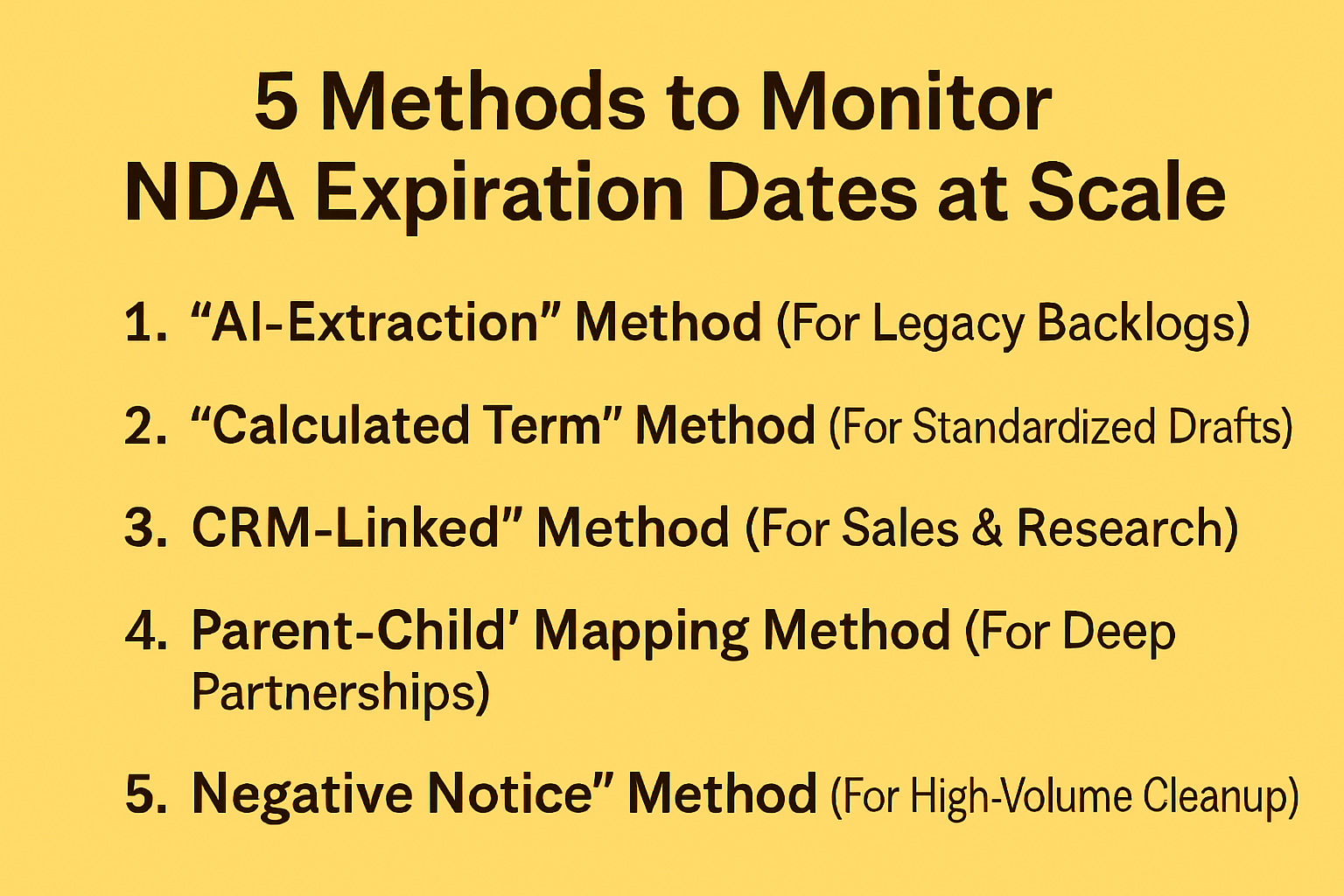
5 Methods to Monitor NDA Expiration Dates at Scale
In 2026, the biggest threat to your trade secrets isn’t a bad actor—it’s a calendar.
While a legal ops dashboard shows you the “big picture” of your risk, you still need a bulletproof system to ensure no individual date slips through the cracks when managing thousands of agreements.
Here are 5 methods to monitor your NDA expiration dates at scale without increasing your team’s manual workload.
1. The “AI-Extraction” Method (For Legacy Backlogs)
- The Action: Use Optical Character Recognition (OCR) to automatically “read” your existing PDFs and pull the expiry date into a structured database.
- Why it Works: It solves the “Data Entry” bottleneck. Instead of a human typing dates from 500 old files, the software extracts the dates in minutes.
- The Outcome: You can convert a “dark” archive of legacy NDA contracts into a searchable, alert-ready database without hiring temporary staff to do manual entry.
2. The “Calculated Term” Method (For Standardized Drafts)
- The Action: Program your system to calculate the expiration date automatically by combining the “Effective Date” with the “Duration” clause (e.g., 24 months).
- Why it Works: Many NDAs don’t list a specific end date; they list a term length. By setting this logic in your NDA repository, the system does the math for you.
- The Outcome: You ensure 100% accuracy across your library, even for NDA drafts where the “Expiry Date” isn’t explicitly written on the page.
3. The “CRM-Linked” Method (For Sales & Research)
- The Action: Sync your contract expiration triggers with your commercial milestones (like “Project End Date” in a CRM or Project Management tool).
- Why it Works: Often, an NDA needs to last as long as the project, not just a random 12-month window. If the project is extended in the CRM, the contract tracking tool automatically adjusts the “Critical” alert date.
- The Outcome: Your legal protection remains perfectly aligned with your business reality, preventing “protection gaps” during long-term research cycles or partnership negotiations.
4. The “Parent-Child” Mapping Method (For Deep Partnerships)
- The Action: Link the expiration of a specific NDA to the expiration of a Master Services Agreement (MSA) or a specific Grant Period.
- Why it Works: In high-volume environments, NDAs often support a larger deal. If the Master Agreement is renewed or extended, the system automatically “drags” the NDA renewal date along with it.
- The Outcome: You reduce “Document Fragmentation,” ensuring that all related confidentiality obligations for a single partner or donor stay synced.
5. The “Negative Notice” Method (For High-Volume Cleanup)
- The Action: Automate a system that sends an “Intent to Expire” notice to internal leads 60 days out, requiring them to “opt-in” to keep it active.
- Why it Works: It flips the responsibility from Legal to the business unit. Instead of Legal asking “Do you still need this?”, the system assumes the NDA will expire unless a commercial lead proactively requests an extension.
- The Outcome: This “self-cleaning” method prevents your NDA repository from being cluttered with thousands of active agreements for projects that ended years ago.
Closing Thoughts
And there you have it…
We hope this guide helps you build a scalable engine for moving from manual spreadsheets to proactive monitoring.
Once your monitoring is on autopilot, check out our next guide on 5 ways to standardize post-signature NDA reporting.
See it in action
Turn contract chaos into a streamlined workflow
Join legal teams who cut contract turnaround time by 60%. Book a 15-minute demo to see how.