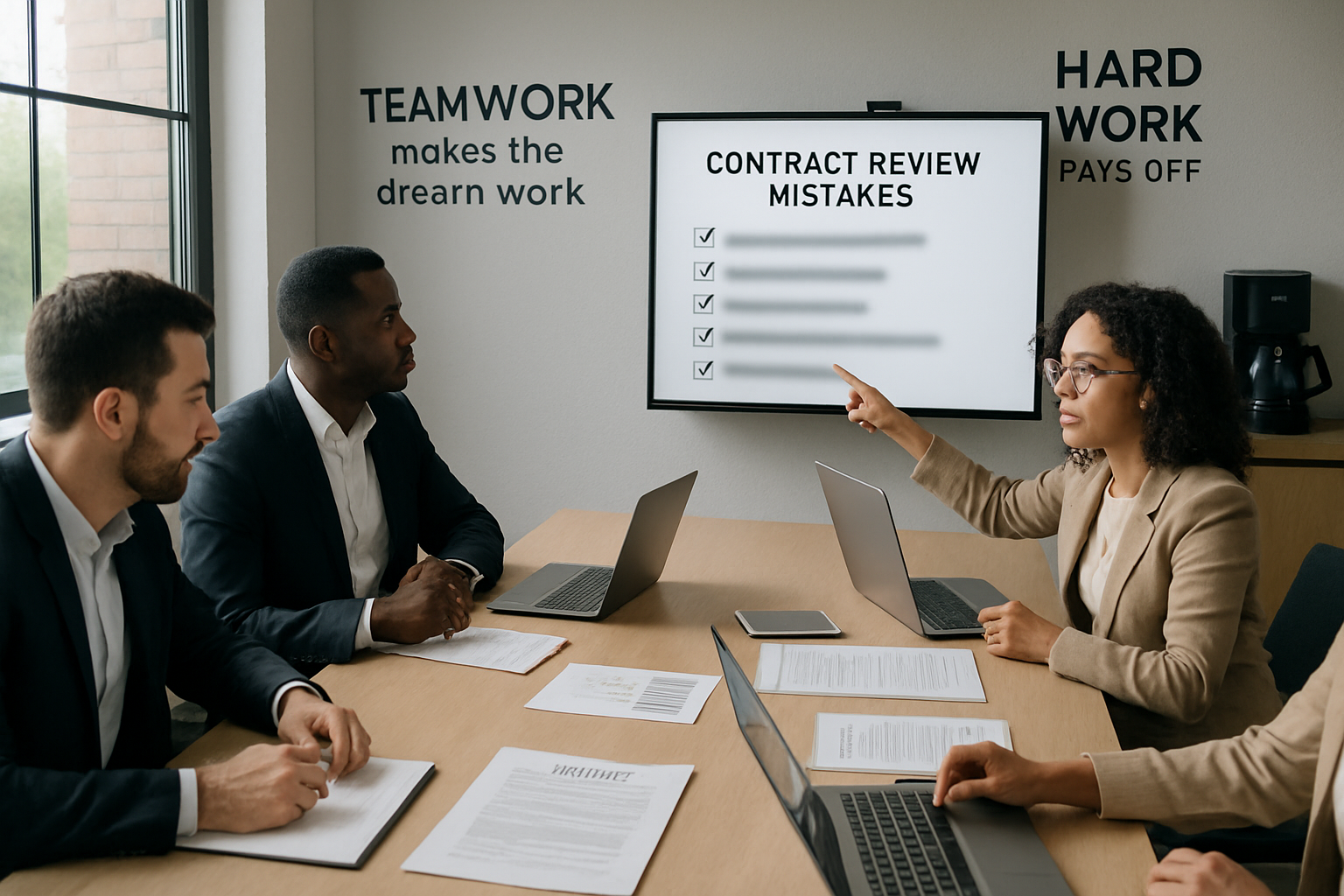
Common Contract Review Mistakes to Avoid
Even the most experienced teams can fall into “contract blindness.” When you are reviewing dozens of documents a month, the brain starts to skim, and that is exactly when expensive errors creep in.
To help you stay on the right side of that line, we’ve highlighted the most common contract review mistakes to avoid below.
1. The “Standard Language” Trap
One of the most frequent errors is assuming that because a clause looks “standard,” it doesn’t need a close read.
Every company has a different definition of “Standard.”
If you don’t cross-reference their draft against your own contract review checklist, you might accidentally agree to unbalanced risk allocation or unfair payment terms that are “standard” only for them.
2. Ambiguity in Job Descriptions and Deliverables
Another common mistake is the use of vague language. Phrases like “reasonable efforts” or “standard industry turnaround” are open to interpretation.
- The Mistake: Failing to define exactly who is responsible for what.
- The Fix: Ensure every deliverable has an objective “Acceptance Criteria.” If a third party can’t read the clause and know exactly when the job is done, it’s too vague.
3. Ignoring the “Tail” of the Contract
A frequently overlooked pitfall is focusing so hard on the start of a deal that you forget to review how it ends.
- The Mistake: Missing auto-renewal deadlines or failing to specify what happens to your data after termination.
- The Fix: Look for “Termination for Convenience” and clear “Survival Clauses” that protect your IP even after the work stops.
4. Over-Reliance on AI Without Oversight
In 2026, assuming AI can handle a review without human eyes is a mistake that is becoming increasingly common as well. You need to be aware that AI can struggle with “clause-heavy” documents or context-specific nuances. If you are feeding poor-quality data into your contract review workflow, the output will be just as flawed. AI should be a co-pilot, not the sole pilot.
5. Not Investing Enough Time (The “Rush” Error)
This is another recurring error where contracts often get signed at the end of the quarter when everyone is in a hurry to hit targets.
- The Mistake: Considering the review a “formality” rather than a strategic task.
- The Fix: Build a repeatable contract review process that allocates specific time for legal, finance, and ops to weigh in before a signature is allowed.
6. Failing to Negotiate “Non-Negotiables”
Lastly, perhaps the most costly mistake is the failure to negotiate. A contract is a starting point, not a final decree. Many professionals mistakenly accept default terms regarding liability or indemnification. If the risk is unbalanced, it is your responsibility to redline until it is fair.
Bottom Line
At the end of the day, most contract errors aren’t the result of a lack of legal knowledge—they are the result of inconsistent systems. When your review process relies on memory or “gut feeling,” you leave your business open to unnecessary risk.
Moving forward, the goal should be to turn your review from a manual chore into a strategic advantage.
By implementing a contract review software that flags these red flags automatically, you don’t just protect your business; you empower your sales team to move faster.
See it in action
Turn contract chaos into a streamlined workflow
Join legal teams who cut contract turnaround time by 60%. Book a 15-minute demo to see how.