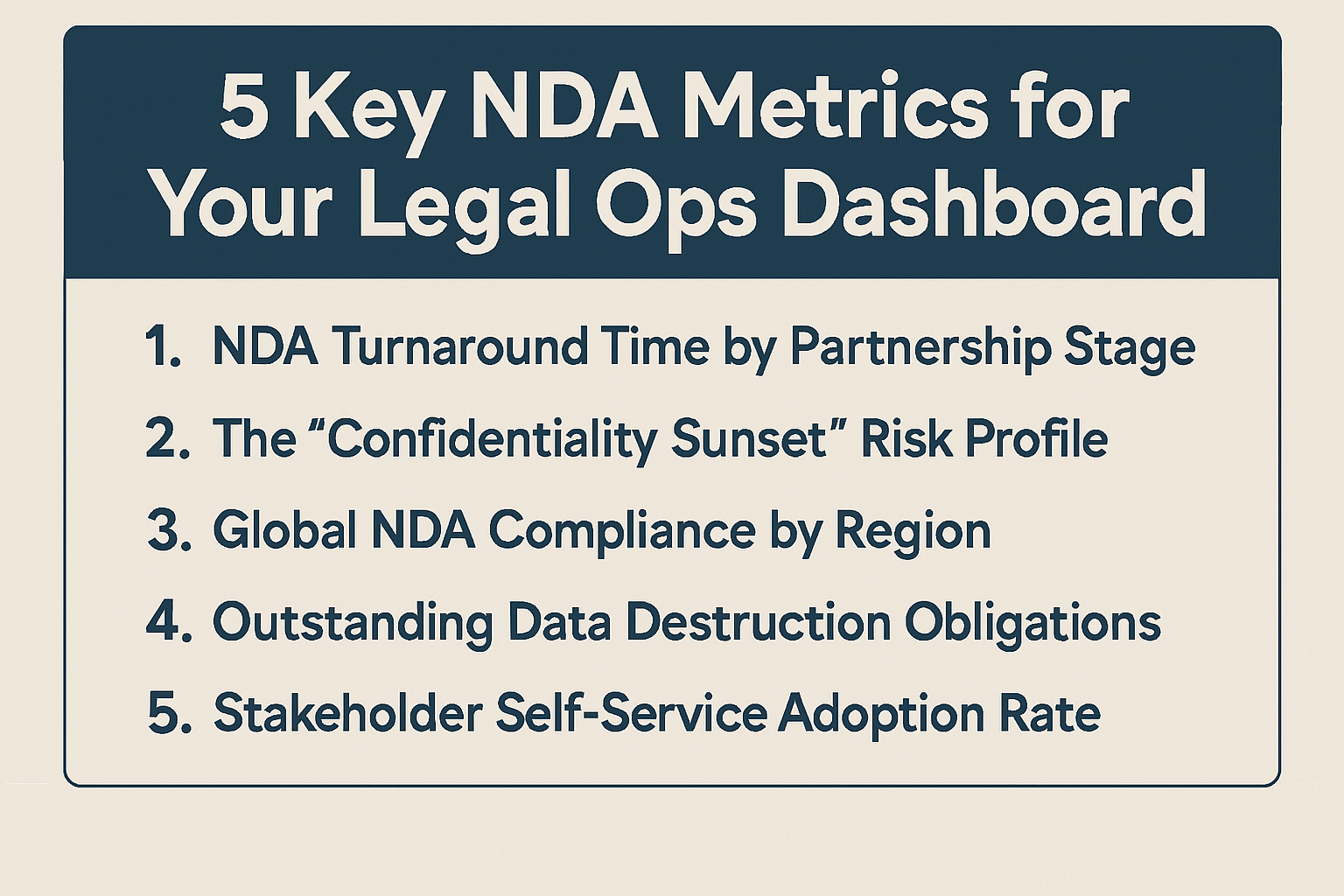
5 Key NDA Metrics to Include in Your Legal Ops Dashboard
In 2026, a list of files isn’t a strategy. While performing an audit of your active NDA obligations gives you a clean baseline, you need a way to visualize that data in real-time to make informed decisions.
Here are the 5 metrics your NDA tracking dashboard should have.
1. NDA Turnaround Time by Partnership Stage
The Metric: The average number of days a confidentiality agreement spends in each phase, from “Initial Request” to “Fully Executed.”
Why it Matters: To a COO, speed is everything. If the dashboard shows that “External Negotiation” is the primary delay, it proves that the Legal team isn’t the bottleneck—the counterparty is.
The Outcome: You move the needle on the “slow legal” perception by providing data-backed evidence on what is actually delaying new business discussions.
2. The “Confidentiality Sunset” Risk Profile
The Metric: A rolling 90-day volume of NDA contracts reaching their “Term of Confidentiality” expiration.
Why it Matters: This isn’t just a calendar; it’s a risk map. It shows the CFO exactly when the company’s trade secrets are about to lose their legal “shield” if a renewal isn’t signed.
The Outcome: You avoid “Silent Expiries” by highlighting the specific volume of IP at risk, allowing for proactive resource allocation instead of last-minute firefighting.
3. Global NDA Compliance by Region
The Metric: The percentage of executed NDAs in each global office that utilize your updated 2026 standard clauses.
Why it Matters: It solves the “No visibility across regions” pain point for global companies. You can instantly report to the Chief Compliance Officer if the “EMEA” or “LATAM” offices are using outdated NDA drafts that don’t meet current donor or privacy standards.
The Outcome: You provide leadership with a “Global Health Check,” ensuring that the organization’s protection is consistent across every territory and entity.
4. Outstanding Data Destruction Obligations
The Metric: The count of expired NDAs that still require a formal “Certificate of Destruction” or “Return of Information.”
Why it Matters: This is a high-stakes compliance metric for the General Counsel. During an audit, you need to prove you aren’t holding counterparty data longer than the NDA contract allows.
The Outcome: You significantly reduce the pressure on your legal team by identifying exactly which projects have “Ghost Obligations” that need to be cleared for donor/grant compliance.
5. Stakeholder Self-Service Adoption Rate
The Metric: The volume of NDA status searches performed by Sales, HR, or Research teams directly within the repository.
Why it Matters: This measures the “Handholding” time you’ve recovered. High adoption proves to the Head of Operations that the contract renewal management software has successfully become the “Single Source of Truth.”
The Outcome: You can prove the ROI of your software to leadership by showing exactly how many manual “Do we have an NDA with X?” emails have been eliminated from the Legal inbox.
Closing Thoughts
And there you have it…
We hope this guide helps you identify the high-impact metrics needed to shift from reactive tracking to strategic risk management.
If your dashboard is set but you need to refine how you actually capture these dates across thousands of files, check out our final guide on 5 methods to monitor NDA expiration dates at scale.
See it in action
Turn contract chaos into a streamlined workflow
Join legal teams who cut contract turnaround time by 60%. Book a 15-minute demo to see how.