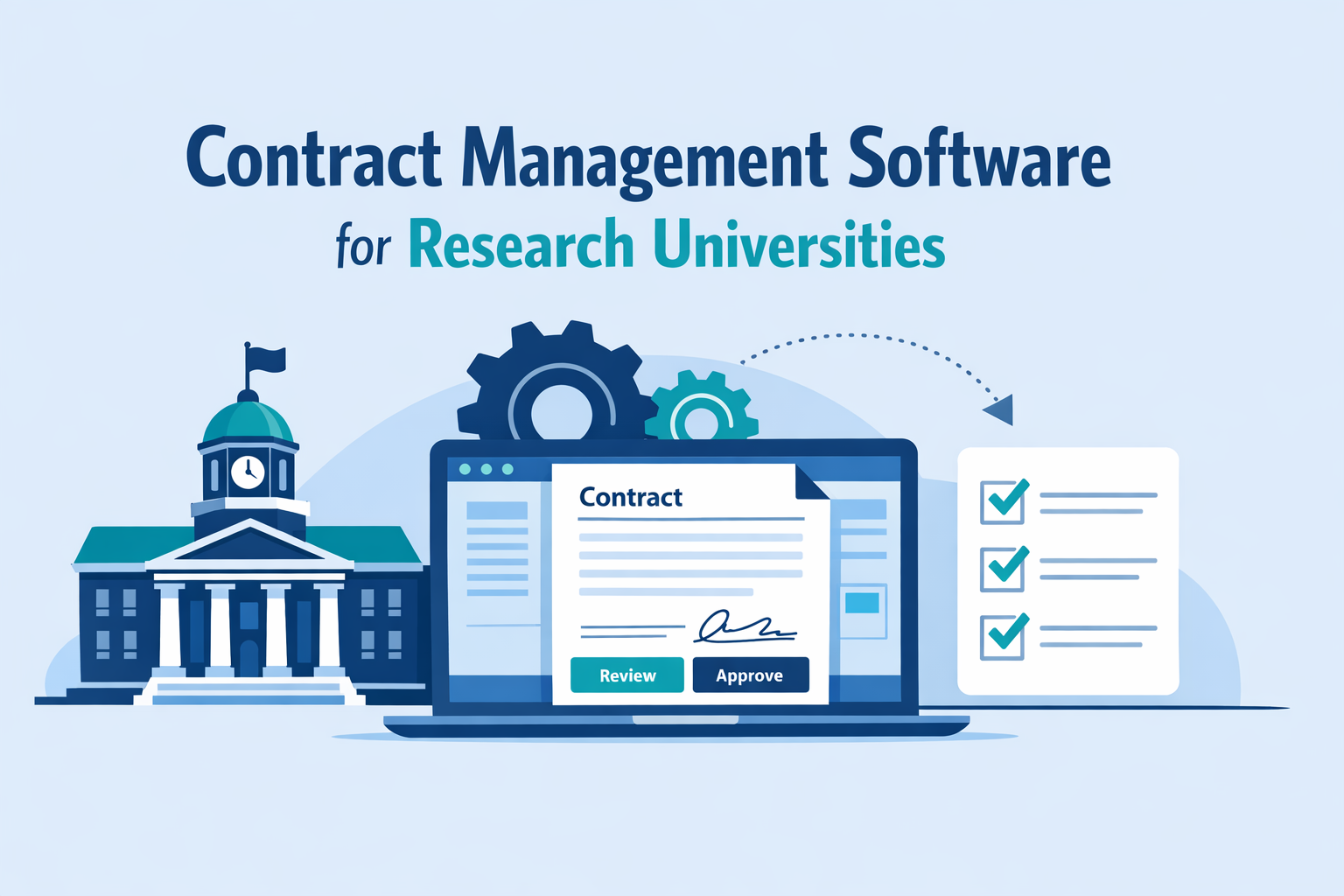
Contract Management Software for Research-Heavy Universities: What to Look For
Most contract management software is built for corporate legal teams managing vendor agreements, sales contracts, and procurement workflows. These tools do that job well. But research universities are not corporate legal departments, and the contract management challenges they face are fundamentally different.
A busy Office of Sponsored Programmes (OSP) might handle dozens of agreement types in a single week: research collaboration agreements, material transfer agreements, clinical trial agreements, data use agreements, NDAs, subawards, and consultancy contracts. Each has its own workflow, approval chain, and compliance requirements. The PI needs sign-off. The department head reviews the budget. The IP office assesses foreground IP provisions. Legal checks indemnification and governing law. Finance confirms the cost allocation.
If you are evaluating contract management software for a research-heavy institution, this guide covers the criteria that matter most and the questions you should be asking in every demo.
Why Generic CLM Falls Short for Research Offices
Contract lifecycle management (CLM) platforms have matured significantly in recent years. But most of that maturation has been driven by the needs of corporate legal, sales, and procurement teams. This creates blind spots when the same tools are applied to a university research environment.
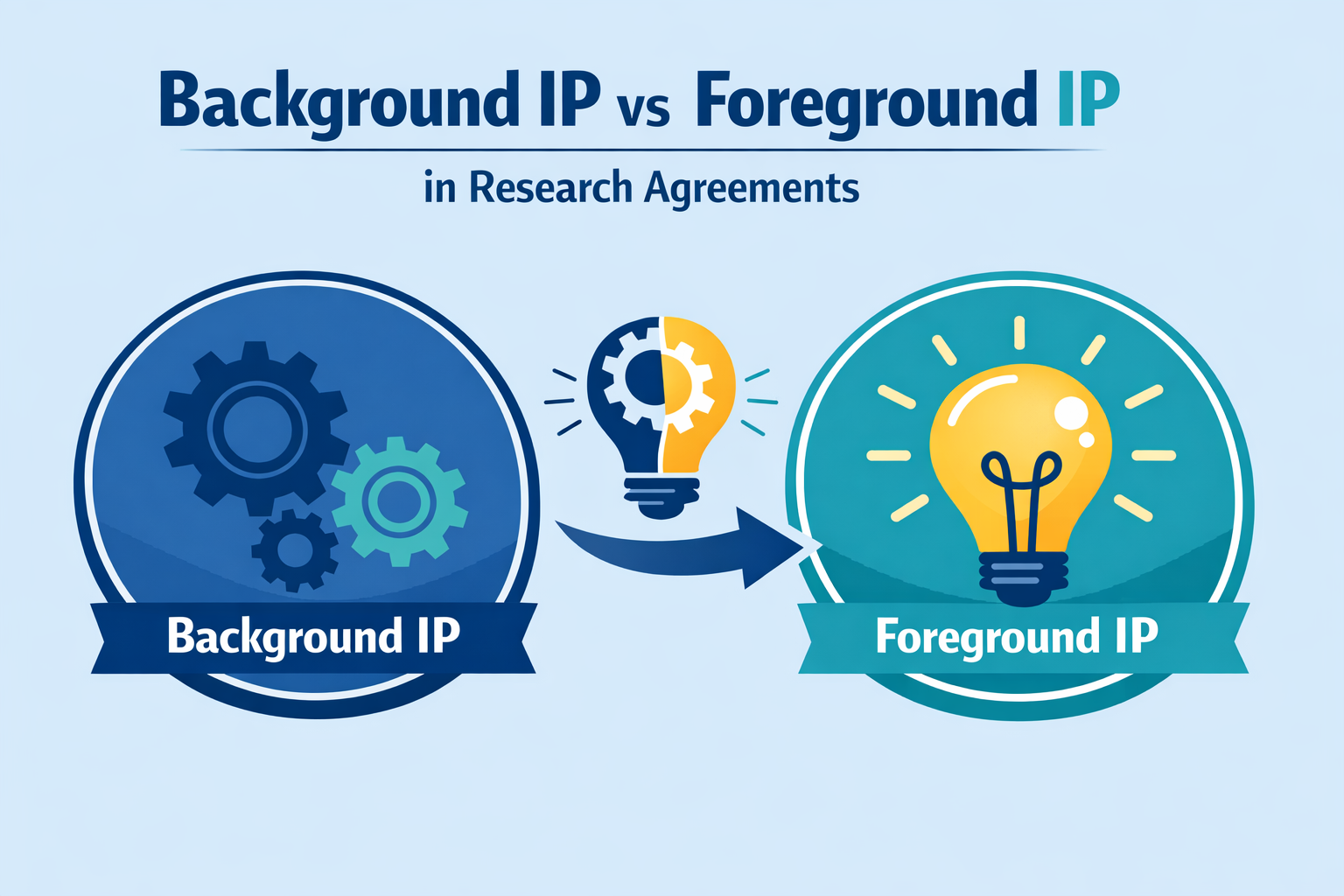
Research contracts are more complex than commercial contracts. A standard vendor agreement has a scope of work, payment terms, and maybe an SLA. A research collaboration agreement has all of that plus background and foreground IP provisions, publication rights, data ownership, and funding body compliance requirements layered on top.
Multiple stakeholders need to be involved, in the right order. Corporate contracts typically go through legal review and then to a signatory. University research contracts can involve six or more stakeholders: the PI, department head, OSP, IP office, legal, and finance. Each reviews different aspects. A system that only supports linear approval routing will slow things down rather than speed them up.
Agreement types are diverse. Research offices work with MTAs, CTAs, DUAs, RCAs, NDAs, subawards, licence agreements, and more, each with different risk profiles, clause libraries, and workflow requirements. A CLM built around sales agreements assumes a uniform contract structure that does not exist in a research office.
Compliance requirements are unique. Research offices must comply with data protection laws like Singapore’s PDPA, funding body terms, export control regulations, and sanctions screening requirements. These obligations differ fundamentally from what corporate CLM tools are designed to handle.
None of this means a research university cannot use commercial CLM software. It means the evaluation criteria need to be different. Here is what to look for.
8 Evaluation Criteria for Research Universities
1. Agreement Type Flexibility
Your institution likely manages a dozen or more agreement types, each with a different risk profile, different required clauses, and different workflows. The software you choose should let you define distinct contract types with their own templates, metadata fields, and approval routing.
An MTA should not follow the same approval chain as a multi-million-dollar industry RCA. An NDA that uses your standard template should be approvable by the OSP alone, while a non-standard NDA with unusual IP carve-outs should route to the IP office. If the system treats all contracts the same, you will end up with either too much process for simple agreements or too little oversight for complex ones.
2. Contract Playbooks
A contract playbook captures your institution’s negotiating positions for every major clause type: the preferred position, acceptable alternatives, and the point at which you walk away or escalate.
For research universities, playbooks are critical for the clauses that generate the most friction: foreground IP ownership, publication review periods, indemnification caps, and governing law. When a contract manager receives a sponsor’s template with non-standard IP language, they should not need to call the IP office for guidance. The playbook should tell them whether the language is within the institution’s acceptable range and, if not, what the approved fallback position is.
Look for a system that supports clause-level playbooks with preferred, acceptable, and fallback positions. This is the single biggest driver of faster turnaround times in research contract negotiation.
3. AI-Assisted Contract Review
When your team reviews an incoming sponsor agreement or a counterparty’s template, they need to identify deviations from your standard terms quickly. AI-assisted contract review can flag clauses that fall outside your institution’s approved positions, highlight missing provisions, and surface risk areas that require human attention.
This matters most for third-party paper. When a multinational sends your OSP their 40-page master research agreement, the system should surface the issues and let your team focus on the negotiations that actually require judgment, not read every clause from scratch.
Evaluate whether the AI review is configurable to your institution’s specific standards. Generic benchmarks are better than nothing, but a system that flags deviations against your own playbook is significantly more useful.
4. Approval Workflows
University research contracts involve multiple stakeholders, and the approval requirements vary by agreement type, value, and risk level. Key capabilities to evaluate:
- Parallel approvals. Can the IP office and the finance team review simultaneously, or must they wait in a sequential queue?
- Conditional routing. Can the system automatically route high-value agreements to the Vice Chancellor’s office while allowing the OSP director to approve agreements below a certain threshold?
- Role-based routing. Can you route based on the reviewer’s role (IP, legal, finance) so that each person sees only the clauses relevant to their area?
- Escalation rules. If a reviewer has not responded within a defined period, does the system escalate automatically?
The goal is to replicate your institution’s existing delegation of authority in the system, not to reshape your governance to fit the software.
5. Counterparty Due Diligence
Universities are under increasing pressure to demonstrate that they have screened research partners against sanctions lists, Politically Exposed Persons (PEP) databases, and adverse media before entering into agreements. This is especially important for cross-border ASEAN collaborations and research involving dual-use technology.
Look for a system that integrates counterparty screening into the contract workflow rather than requiring a separate manual check. The screening should happen automatically when a new counterparty is added, with results logged against the contract record for audit purposes. Pactly’s integration with Dilisense provides automated sanctions and PEP screening covering global watchlists including UN, EU, OFAC, and regional ASEAN lists.
A manual Excel-based screening process works until you have an audit finding that says it does not.
6. Compliance and Audit Trail
Every action on a contract, including creation, editing, review, approval, signature, and amendment, should be logged automatically with timestamps and user attribution. When auditors ask who approved a deviation from your standard IP terms, you should be able to answer in seconds.
An audit trail is not optional for research offices. Funding bodies, accreditation agencies, and government auditors expect it. Evaluate whether the trail is comprehensive (every action logged, not just signatures) and exportable for external audit review.
7. Data Residency and Security
Where is your contract data stored? For ASEAN-based universities, particularly in Singapore, data residency matters. Some institutions have policies requiring that contract data remain within Singapore or within the ASEAN region. Others need to demonstrate that their data is hosted on infrastructure that meets specific security standards.
Key questions to ask:
- Where are the servers physically located? Pactly, for example, runs on AWS infrastructure in Singapore (ap-southeast-1), which addresses data residency requirements for most ASEAN institutions.
- Is the platform ISO 27001 certified? This is the baseline security standard that most institutional procurement teams require.
- Does the platform support role-based access controls, encryption at rest and in transit, and single sign-on (SSO)?
You can review Pactly’s security and compliance posture as an example of what to look for in any vendor’s trust page.
8. Integration Capabilities
Your contract management system does not exist in isolation. It needs to work with your grants management system, your HR system, your procurement platform, and potentially your research information system.
For research universities, the most valuable integrations are typically:
- Grants management. Linking contracts to funded projects so that contract obligations are visible alongside grant milestones.
- HR / personnel systems. Automatically populating PI and co-investigator details into contract records.
- Finance and procurement. Syncing contract values and payment milestones with your financial systems.
- eSignature. Enabling counterparties and internal signatories to execute agreements electronically.
A platform with a well-documented API gives you flexibility. A system with no integration path locks you in.
Questions to Ask in a Demo
When you sit down with a vendor, these are the questions that will tell you whether the system is a good fit for a research university environment.
“Can I create different workflows for different agreement types?” If the answer requires a custom implementation project, that is a red flag.
“How does the playbook handle fallback positions during negotiation?” You want to hear about clause-level playbooks with preferred, acceptable, and fallback tiers, not just a template library.
“What sanctions and PEP databases do you screen against?” Look for global coverage (UN, EU, OFAC at minimum) plus regional lists relevant to your institution’s partnerships.
“Where is my data stored, and can I keep it in Singapore?” For ASEAN institutions, this is not a nice-to-have. Ask about the specific AWS region, data centre certifications, and any data residency guarantees.
“What does implementation look like: days or months?” Enterprise CLM platforms can take 6-12 months to implement. Research offices that are stretched thin cannot wait that long. Ask for a realistic timeline from contract signing to first live agreement.
“Can my business teams self-serve on standard NDAs without involving legal?” A good test of whether the system supports delegation. If the PI’s department can generate a standard NDA using an approved template and route it for signature without the OSP touching it, that is real workload reduction.
“How do you handle third-party paper?” Most CLM demos show their own templates. Ask what happens when a sponsor sends you their agreement. Can you upload it, run a review, and manage the negotiation within the system?
Build vs Buy Considerations
Some institutions consider building a contract tracking system internally, typically on top of SharePoint, a custom database, or an existing enterprise platform. Before going down this path, consider a few realities.
Spreadsheets and shared drives work until they do not. Most research offices start with Excel trackers and shared folders. This is fine for a small portfolio. It breaks down when you have hundreds of active agreements, multiple reviewers, and audit requirements that demand a complete trail.
Building internally means maintaining it forever. An internal tool needs ongoing development, security patching, and support. When the developer who built it moves on, you inherit a system no one fully understands. Purpose-built CLM software transfers that maintenance burden to the vendor.
Look for fast implementation and transparent pricing. Factor in implementation time, training, and the opportunity cost of delayed adoption, not just the subscription fee. A system that can be configured and live within days rather than months delivers value faster and carries less project risk.
Conclusion
Research universities need contract management software that reflects how they actually work: diverse agreement types, complex approval chains, layered compliance requirements, and teams that are already stretched thin.
The criteria above are designed to help you distinguish between tools built for corporate legal departments and tools that can genuinely serve a research office. Not every platform will meet every criterion, but any vendor worth considering should be able to address the majority of them clearly.
Pactly works with research-heavy institutions across ASEAN, including the National University of Singapore (NUS), to manage the full range of research agreements covered in this guide. If you are evaluating contract management software for your research office, we would be happy to walk you through how Pactly handles the requirements above. Book a demo and we will tailor the conversation to your institution’s needs.
You may also find these guides helpful as you evaluate your options:
See it in action
Turn contract chaos into a streamlined workflow
Join legal teams who cut contract turnaround time by 60%. Book a 15-minute demo to see how.