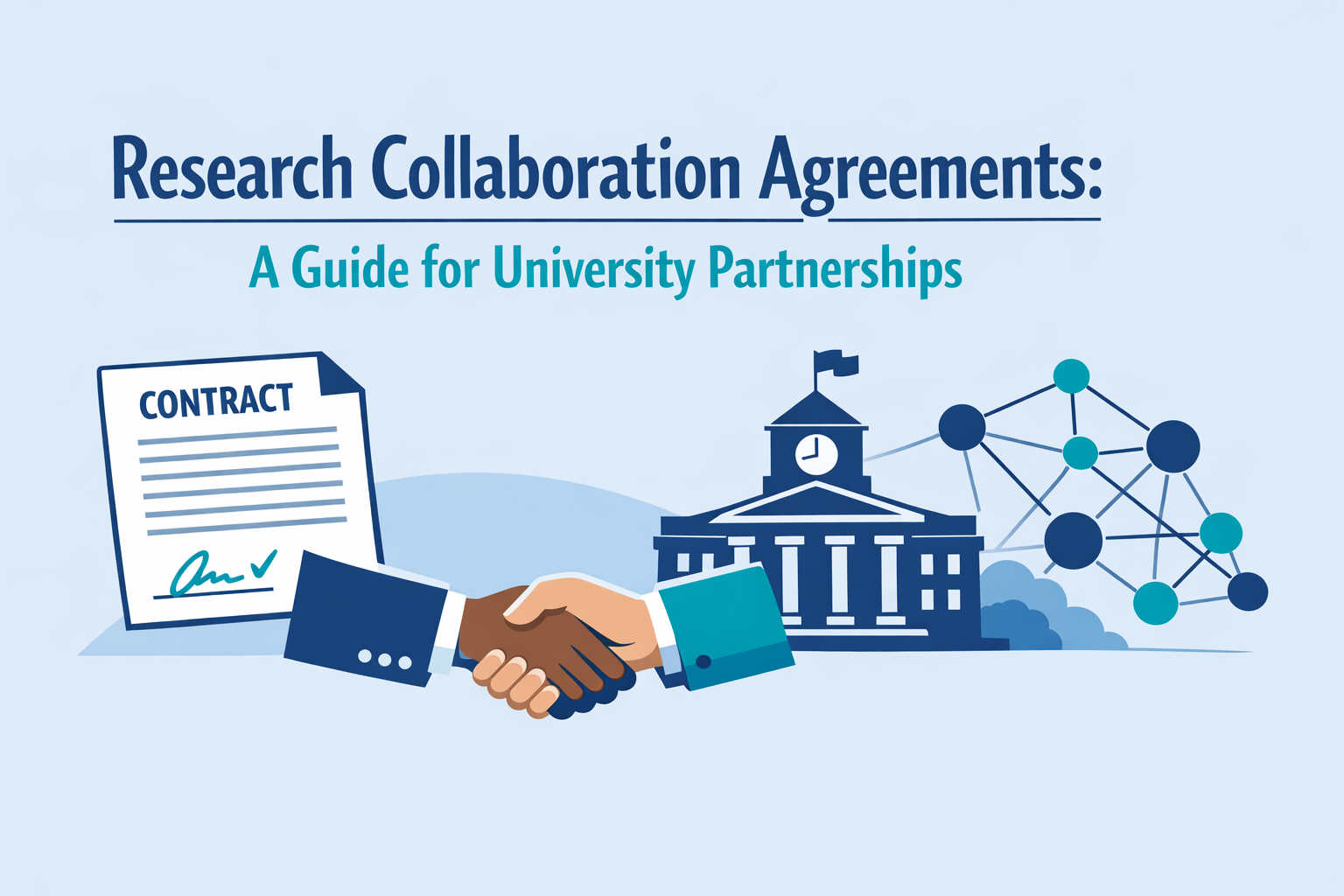
Research Collaboration Agreements: A Guide for University Partnerships
A research collaboration agreement (RCA) is a contract between two or more parties who are actively contributing to a shared research programme. Unlike a simple grant or sponsorship arrangement, every party in an RCA brings resources to the table, whether that is funding, personnel, equipment, or intellectual property.
Terminology varies between institutions. In Singapore and across ASEAN, these contracts are most commonly called RCAs or Collaborative Research Agreements (CRAs). Some offices also use terms like Joint Research Agreement or Contract Research Agreement depending on the nature of the collaboration. Regardless of what your institution calls them, the core purpose is the same: to define who does what, who owns what, and who can publish what.
For Office of Sponsored Programmes (OSP) and contract management teams, RCAs are among the most complex agreements to negotiate. They involve multiple stakeholders, layered IP provisions, and cross-border considerations that simpler agreement types do not. This guide covers what you need to know to manage them well.
When Do You Need an RCA?
Not every research partnership requires an RCA. A sponsor who funds a project but has no involvement in the actual research is better served by a Sponsored Research Agreement. An RCA becomes necessary when there is genuine joint contribution.
Common scenarios include:
- Industry-university joint R&D where a company contributes technical know-how, equipment, or co-investigators alongside university researchers.
- Multi-university collaborations where two or more institutions share research responsibilities under a joint programme.
- Government-funded partnerships such as A*STAR collaborative projects, NRF-funded initiatives in Singapore, or EU Horizon-style frameworks where multiple institutional partners are mandated.
- International research partnerships where a local university partners with an overseas institution, often involving complex governing law and IP jurisdiction questions.
If only one party is performing the research, you likely need an SRA, not an RCA. If both parties are actively contributing to the methodology, design, or execution, an RCA is the right instrument.
RCA vs Other Research Agreements
Research offices manage a web of overlapping agreement types. Here is how an RCA fits alongside the most common ones.
| Agreement | Purpose | Key Difference from RCA |
|---|---|---|
| Sponsored Research Agreement (SRA) | Sponsor funds research performed by the university | Sponsor does not participate in the research itself |
| Material Transfer Agreement (MTA) | Transfer of physical or biological materials between institutions | Covers materials only, not joint research activity |
| Non-Disclosure Agreement (NDA) | Protects confidential information during early discussions | Often a precursor to an RCA, not a substitute |
| Data Use Agreement (DUA) | Governs sharing and use of specific datasets | Scoped to data access, not broader research collaboration |
| MOU / Letter of Intent | Expresses intent to collaborate before formal terms are agreed | Non-binding; sets the stage for the RCA negotiation |
In practice, an RCA negotiation is often preceded by an NDA (to protect the initial exchange of ideas) and an MOU (to outline the broad terms). Once those are in place, the RCA formalises the binding obligations.
Key Clauses in a Research Collaboration Agreement
Every institution has its own template, but most RCAs share a common set of clauses that drive the negotiation. Here are the provisions that matter most.
Scope of Work and Research Objectives
This section defines what the parties are actually doing together. It should be specific enough to prevent scope creep but flexible enough to accommodate the iterative nature of research. Many institutions attach a detailed Research Plan as a schedule to the agreement, allowing updates without amending the main body.
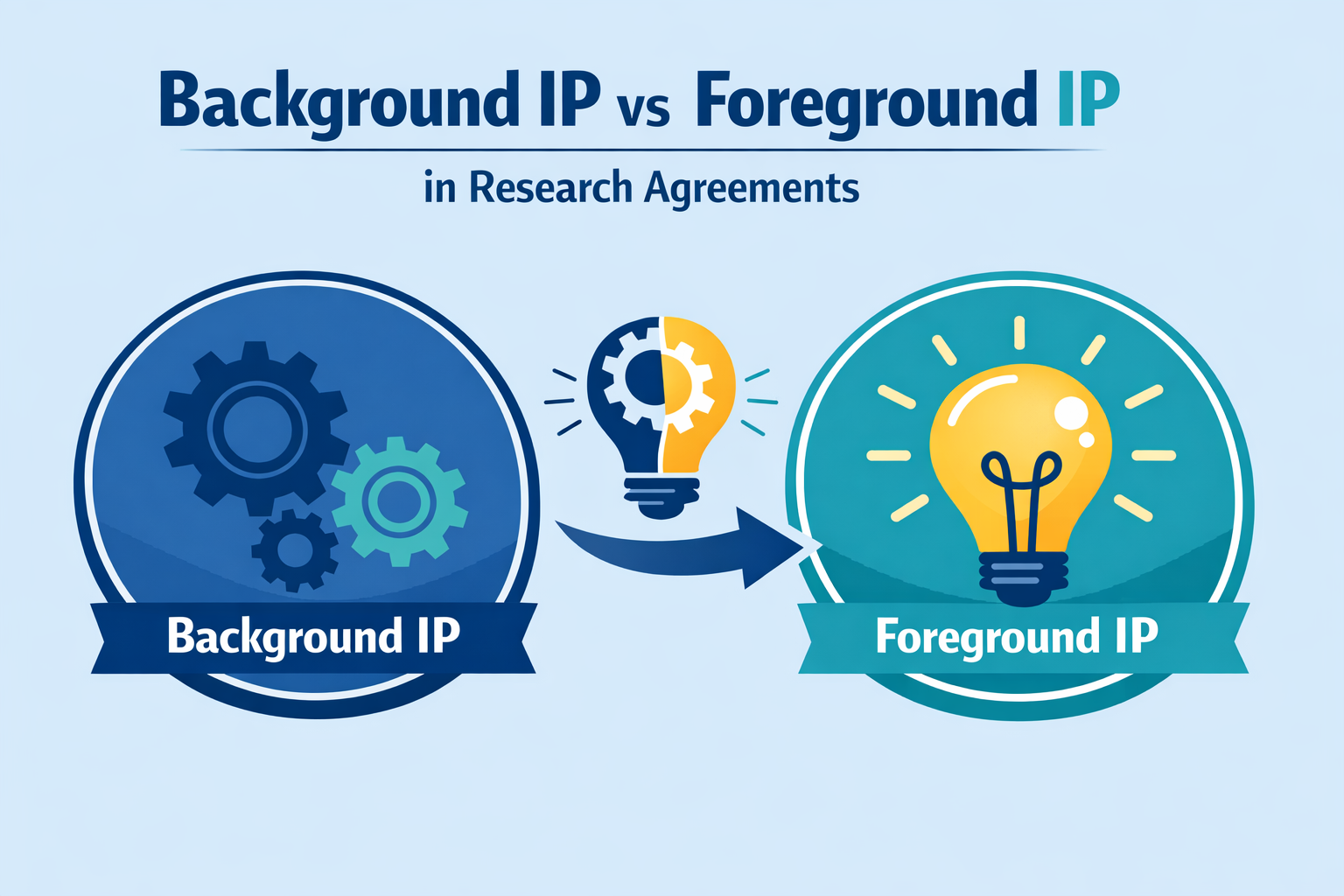
Background IP vs Foreground IP
This is where most negotiations slow down. Background IP refers to the intellectual property each party brings into the collaboration. Foreground IP is what gets created during the project.
The critical questions are: Who owns the foreground IP? Is it jointly owned, or does ownership follow inventorship? Can either party license the foreground IP independently?
Clear definitions here prevent disputes down the line. Many Singapore institutions follow a model where foreground IP ownership follows inventorship, with each party granted a non-exclusive licence for internal research use.
Publication Rights and Review Periods
Academic freedom to publish is non-negotiable for most universities. The standard compromise is to allow the industry partner a review period, typically 30 to 90 days, to identify any confidential information or patentable inventions before a paper is submitted.
Where negotiations stall is on the length of that review period and whether the sponsor can request modifications beyond redacting confidential data. Your institution should have a clear position on this.
Confidentiality Provisions
RCAs need their own confidentiality terms even if an NDA is already in place. The RCA confidentiality clause should address how confidential information generated during the project is handled, not just the pre-existing information covered by the NDA.
Indemnification and Liability
Universities and industry partners typically have very different risk appetites. Most public universities cannot offer uncapped indemnities, and many have statutory limitations. This clause is one where having a pre-approved fallback position ready to go can save weeks of back-and-forth.
Termination and Wind-Down
Research projects can stall for many reasons: loss of funding, departure of key personnel, or a shift in strategic priorities. The termination clause should cover what happens to ongoing work, how costs are settled, and what rights each party retains to foreground IP created before termination.
Data Ownership and Access
With the increasing importance of research data, this clause has become a negotiation item in its own right. It should address who owns the raw data, who can access it during and after the project, and what data retention obligations apply.
Budget and Cost Sharing
Unlike an SRA where the sponsor simply pays, an RCA involves shared costs. This section should specify each party’s financial contribution, how overheads are allocated, and the process for handling cost overruns or underspend.
Governing Law
For domestic collaborations, governing law is straightforward. For cross-border ASEAN partnerships, it becomes a genuine negotiation point. Singapore-based institutions often push for Singapore law and arbitration under the Singapore International Arbitration Centre (SIAC), which is generally well-accepted across the region.
Common Negotiation Challenges
Even with experienced contract managers on both sides, certain provisions consistently take the most time to resolve.
IP Ownership Disputes
The most common sticking point. Industry partners often want to own all foreground IP, while universities need to protect their researchers’ rights and comply with institutional IP policies. In Singapore, the Technology Transfer Offices at NUS, NTU, and SUTD each have established positions on this, but those positions vary. Finding the middle ground, particularly when government funding is involved and agencies like A*STAR have their own IP requirements, can add weeks to the process.
Publication Delays
Industry sponsors sometimes request review periods of 6 to 12 months, which is unacceptable for most universities. A 60-day review window is widely considered reasonable. The negotiation challenge is getting the sponsor to accept this without feeling their commercial interests are unprotected.
Indemnification Mismatches
When a global corporation’s legal team sends their standard indemnification clause to a public university, the two positions are often miles apart. The university cannot indemnify the company for third-party claims, and the company’s template demands exactly that. Resolving this requires both sides to understand each other’s constraints, and it helps to have pre-drafted alternative language ready.
Cross-Border Jurisdiction Issues
ASEAN collaborations bring additional complexity. Which country’s law governs the agreement? Where are disputes resolved? How do data protection regulations (Singapore’s PDPA, Thailand’s PDPA, the Philippines’ DPA) interact? Each of these questions can spawn its own sub-negotiation.
Multiple Stakeholder Approvals
An RCA typically needs sign-off from the PI, the department head, the research office, the IP office, and sometimes the university’s legal counsel and finance team. On the other side, the industry partner has its own approval chain. When you multiply this across a multi-party collaboration, the sequential approval process alone can add months. This is a process problem, not a legal one, and it is solvable with the right approval workflows.
Streamlining RCA Management
If your office is handling dozens or hundreds of RCAs per year, the negotiation challenges above compound quickly. If you are still tracking agreements in spreadsheets, our guide on managing research contracts without spreadsheets explains why that approach breaks down. Here are practical ways to speed things up.
Standardise Your Positions with a Contract Playbook
A playbook captures your institution’s preferred, acceptable, and walk-away positions for every major clause. When a contract manager picks up a new RCA, they should not need to consult legal counsel on whether a particular IP clause is acceptable, the playbook should tell them.
This is especially valuable for RCAs because the same IP and publication debates recur across nearly every deal.
Build a Clause Library
If you haven’t already, build a clause library with pre-approved language for the high-friction provisions: foreground IP ownership, publication review periods, indemnification caps, and governing law. Having two or three approved options for each clause lets your team respond to counterparty redlines in hours instead of days.
Set Up Parallel Approval Workflows
The biggest time-sink in RCA management is rarely the negotiation itself. It is the internal approval chain. If your IP office, finance team, and department head are reviewing sequentially, you are adding weeks of dead time.
Routing reviews to all stakeholders simultaneously, with each reviewer focused on their own area, can cut internal cycle times dramatically.
Use eSignatures for Multi-Party Execution
An RCA with three parties and six signatories should not require anyone to print, sign, scan, and courier a document. Electronic signatures reduce the execution phase from weeks to days, and they create a cleaner audit trail.
Track All Agreements Centrally
Once an RCA is signed, the obligations do not stop. Milestones need to be tracked, reporting deadlines met, and IP disclosures filed. A central contract management system ensures that nothing falls through the cracks, especially when a PI moves on and institutional knowledge walks out the door with them.
Getting Started
Research collaboration agreements sit at the intersection of academic freedom, commercial interest, and regulatory compliance. Getting them right matters. Getting them done quickly matters just as much.
The most effective research offices treat RCA management not as a one-off negotiation exercise, but as a repeatable process with standardised positions, pre-approved language, and workflows that remove unnecessary friction.
Pactly works with research-heavy institutions including the National University of Singapore (NUS) to manage research collaboration agreements at scale. If you are managing RCAs and want to see how Pactly can help standardise and speed up the process, book a demo.
See it in action
Turn contract chaos into a streamlined workflow
Join legal teams who cut contract turnaround time by 60%. Book a 15-minute demo to see how.