
Background IP vs Foreground IP in Research Agreements: What You Need to Know
IP clauses are the most heavily negotiated provisions in university research agreements. Whether you are drafting a Research Collaboration Agreement (RCA), a Sponsored Research Agreement (SRA), a Clinical Trial Agreement (CTA), or a Material Transfer Agreement (MTA), the distinction between background IP and foreground IP shapes everything from commercialisation rights to publication timelines.
Get these definitions wrong, and you risk giving away rights to inventions your institution spent years developing. Get them right, and you create a foundation for productive partnerships that protect both parties.
This article explains what background and foreground IP are, how ownership models differ, and what clauses to include in your agreements. If you are new to structuring research partnerships, our guide to Research Collaboration Agreements provides a broader overview.
What Is Background IP?
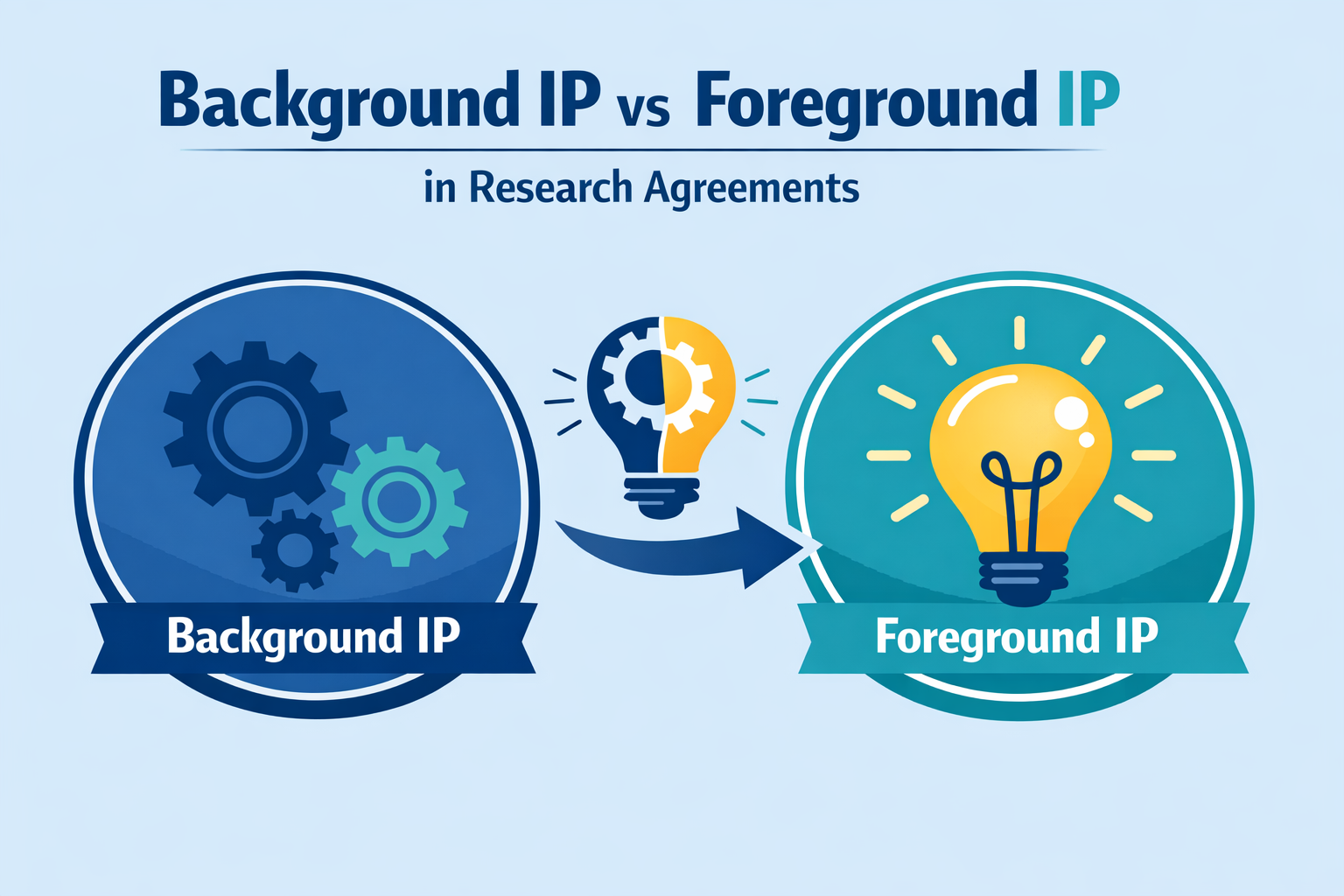
Background IP (sometimes called “pre-existing IP” or “brought IP”) refers to intellectual property that each party owns or controls before the collaboration begins, or that is developed independently of the collaboration during its term.
Examples of background IP include:
- Existing patents and patent applications held by either the university or the industry partner.
- Proprietary software and algorithms that a research group developed under prior funding.
- Datasets and databases compiled before the project started.
- Know-how and methodologies that a PI’s lab has refined over years of prior work.
- Unpublished research results from earlier projects.
The core principle is straightforward: background IP remains owned by the party that brings it in. Neither party should gain ownership of the other’s pre-existing work simply by entering into a collaboration.
However, complications arise when background IP is used in the project. The collaborating party may need a licence to use that background IP during the research, and sometimes after it, to exploit the results. This is why background IP must be carefully defined and, ideally, listed in a schedule attached to the agreement.
What Is Foreground IP?
Foreground IP (also called “project IP” or “arising IP”) refers to new intellectual property created during and as a direct result of the collaboration.
Examples of foreground IP include:
- New inventions and discoveries arising from the joint research.
- Novel datasets generated through the project’s experiments.
- Software and code written specifically for the collaboration.
- Publications and reports produced from the project’s findings.
- New materials or compounds synthesised during the research.
The defining question with foreground IP is: who owns it? Unlike background IP, where ownership is typically uncontested, foreground IP ownership must be explicitly agreed upon before the work begins. The answer depends on the ownership model the parties negotiate.
Why the Distinction Matters
Without clear definitions of background and foreground IP, research agreements become fertile ground for disputes. Here are the most common problems that arise when the boundary is poorly drawn.
Disputes over timing. If the agreement does not clearly define what counts as “pre-existing,” a sponsor may argue that a university invention was created during the project (making it foreground IP) when the university considers it background IP developed independently.
Scope creep on background IP rights. An industry partner may draft broad licence clauses that effectively capture the university’s background IP alongside the foreground IP. This can erode the university’s ability to use its own pre-existing tools and methods in future projects.
Loss of commercialisation rights. If foreground IP ownership defaults to the sponsor, the university may lose the right to commercialise inventions that its own researchers created, often using university facilities and resources.
Multi-party contamination. In collaborations involving multiple universities or industry partners, unclear IP boundaries can create overlapping claims. This is especially problematic in large consortia common in Singapore’s Research, Innovation and Enterprise (RIE) programmes.
IP Ownership Models
There is no single “correct” approach to foreground IP ownership. The right model depends on who funds the research, who performs the inventive work, and what each party intends to do with the results.
| Ownership Model | How It Works | Best For | Key Risk |
|---|---|---|---|
| University owns all foreground IP | University retains full ownership; sponsor receives a licence (exclusive or non-exclusive) | Publicly funded research, collaborations where university contributes most inventive effort | Sponsor may resist if they are funding the bulk of the work |
| Sponsor owns all foreground IP | All foreground IP is assigned to the sponsor | Industry-commissioned contract research | University loses commercialisation rights; may conflict with institutional IP policy |
| Joint ownership | Both parties co-own foreground IP | Genuinely collaborative projects with balanced contributions | Each party can often exploit independently, creating licensing complications (see below) |
| Inventorship-based | Ownership follows inventorship under patent law | Multi-institution collaborations where contributions are separable | Requires clear records of who invented what; can lead to disputes |
| Field-of-use split | Sponsor gets commercial rights in defined fields; university retains academic and research rights | Industry partnerships where commercial and academic interests do not overlap | Boundary disputes over what falls inside vs. outside the defined field |
A Note on Joint Ownership
Joint ownership sounds equitable, but it creates real operational problems. In most common-law jurisdictions, including Singapore under the Patents Act, each co-owner can exploit a patent independently without the other’s consent (unless the agreement states otherwise). This means:
- Either party can grant licences without the other’s approval.
- Neither party can grant an exclusive licence on its own.
- Potential licensees are often reluctant to take a licence from only one co-owner.
If you do agree to joint ownership, the agreement must specify how commercialisation decisions are made, how licensing revenues are shared, and whether either party can assign or sublicence their share.
Key IP Clauses to Include in Research Agreements
The following clauses form the backbone of a well-drafted IP section. Use this as a checklist when reviewing or drafting your agreements.
1. Background IP Definitions and Schedules
Define background IP precisely and attach a schedule listing each party’s relevant background IP at the start of the project. This schedule should be a living document, updated if either party introduces additional background IP during the collaboration.
2. Foreground IP Ownership Assignment
State clearly who will own foreground IP and under what conditions. Avoid ambiguous language like “IP related to the project” and instead use formulations such as “IP conceived or first reduced to practice in the performance of the Research Plan.”
3. Licence-Back Provisions
If the university retains ownership of foreground IP, the sponsor will typically need a licence to use the results. Specify whether the licence is exclusive or non-exclusive, whether it is royalty-bearing, and what field of use and territory it covers.
4. Improvement Clauses
Address who owns improvements to background IP made during the collaboration. This is a frequent point of contention: if a researcher improves upon a sponsor’s proprietary tool, does the improvement belong to the sponsor or the university?
5. Publication Rights and Review Periods
Universities must preserve the right to publish. Standard practice is to allow the sponsor a review period (typically 30 to 90 days) to identify confidential information or patentable subject matter before publication proceeds.
6. IP Disclosure and Reporting Obligations
Require researchers to disclose potentially patentable inventions promptly to the university’s Technology Transfer Office. This obligation should survive the end of the agreement to capture late-stage discoveries.
7. Commercialisation Rights and Revenue Sharing
If the university owns the foreground IP and the sponsor has a commercialisation licence, define how revenues from commercialisation will be shared. Many universities follow a standard formula set by their institutional IP policy.
Common Pitfalls in IP Negotiations
Even experienced negotiators fall into these traps. Knowing them upfront saves time and prevents costly rework. For a broader view of how to identify and mitigate risks in research contracts, see our guide on contract risk assessment for research agreements.
Vague scope language. Phrases like “arising from” and “related to” have very different legal meanings. “Arising from” is narrower and generally safer for the university. “Related to” is broader and can capture IP that was only tangentially connected to the project.
Failing to schedule background IP. If you do not list background IP at the outset, you will spend months arguing about what was pre-existing when a valuable invention emerges. Prepare the schedule during contract negotiation, not after.
Joint ownership without governance. As discussed above, agreeing to joint ownership without specifying commercialisation rights, revenue sharing, and decision-making authority creates more problems than it solves.
Overlooking student IP. In many jurisdictions, including Singapore, students are not employees of the university. This means the university may not automatically own IP created by students under its standard employment IP policy. Research agreements should address student IP assignment explicitly, and students should sign separate IP assignment agreements.
Ignoring existing funding obligations. Government grants frequently include their own IP terms. In Singapore, the National Research Foundation (NRF) and Agency for Science, Technology and Research (A*STAR) grants may require that foreground IP remains in Singapore or is made available for public benefit. Your research agreement’s IP clauses must not conflict with these obligations.
Overlooking sideground IP. Some agreements introduce the concept of “sideground IP,” which is intellectual property created by one party during the collaboration period but outside the scope of the project. Failing to address this can lead to disputes, particularly when a researcher’s broader programme of work overlaps with the collaboration.
How to Standardize Your IP Positions
IP negotiations do not have to start from scratch for every agreement. Building repeatable frameworks saves time and reduces risk.
Build a clause library. Create pre-approved IP clause variants for each agreement type: RCAs, SRAs, MTAs, and consultancy agreements. Include your preferred position, an acceptable fallback, and a “walk-away” position. A well-structured university contract clause library lets contract managers handle routine negotiations without escalating to senior counsel.
Create a contract playbook. Document your institution’s approved, acceptable, and fallback IP positions in a structured playbook. Pactly Playbooks allow you to define these positions and automatically flag deviations when a counterparty’s draft does not match your standards.
Use AI-assisted contract review. When reviewing incoming agreements from sponsors, AI-assisted review can flag IP clauses that deviate from your standard terms, highlight unusual definitions, and surface potential conflicts with your institutional IP policy. This is particularly valuable when your office handles high volumes of agreements.
Document and share your institutional IP policy. Your IP policy should be a practical reference, not a document that sits in a drawer. Make it accessible to Technology Transfer Officers, contract managers, and PIs so that everyone negotiates from the same baseline.
Conclusion
The distinction between background IP and foreground IP is foundational to every research agreement. Clear definitions, explicit ownership assignments, and well-drafted licence-back provisions prevent disputes and protect each party’s ability to use and commercialise the results of collaborative research.
IP negotiations do not need to be adversarial. When both parties understand the framework and have standardized their positions, the conversation shifts from “who gets what” to “how do we structure this so both sides benefit.”
If your research office is looking to streamline how you negotiate and manage IP clauses across agreements, we would be happy to show you how Pactly can help. Book a demo to see how clause libraries, playbooks, and AI-assisted review work in practice.
See it in action
Turn contract chaos into a streamlined workflow
Join legal teams who cut contract turnaround time by 60%. Book a 15-minute demo to see how.