Contract Risk Assessment for Research Agreements: A Framework
When leadership asks “what is our risk exposure across research contracts?” most Offices of Sponsored Programs cannot answer. Not because the risks do not exist, but because there is no systematic way to assess them.
Research agreements carry risks that do not map neatly onto commercial contract risk frameworks. IP disputes can cost more than the contract itself. Collaborating with a sanctioned entity can trigger regulatory consequences that extend far beyond the agreement in question. Data protection breaches can jeopardize an entire research programme. And funding non-compliance can put future grants at risk.
The problem is not a lack of awareness. It is the absence of a structured, repeatable method for identifying, scoring, and managing these risks across a portfolio of active agreements. This article provides a practical framework you can implement.
Why Research Contracts Carry Unique Risks
Commercial contract risk frameworks typically focus on financial exposure: payment terms, liability caps, penalties for non-performance. Research agreements are different in several fundamental ways.
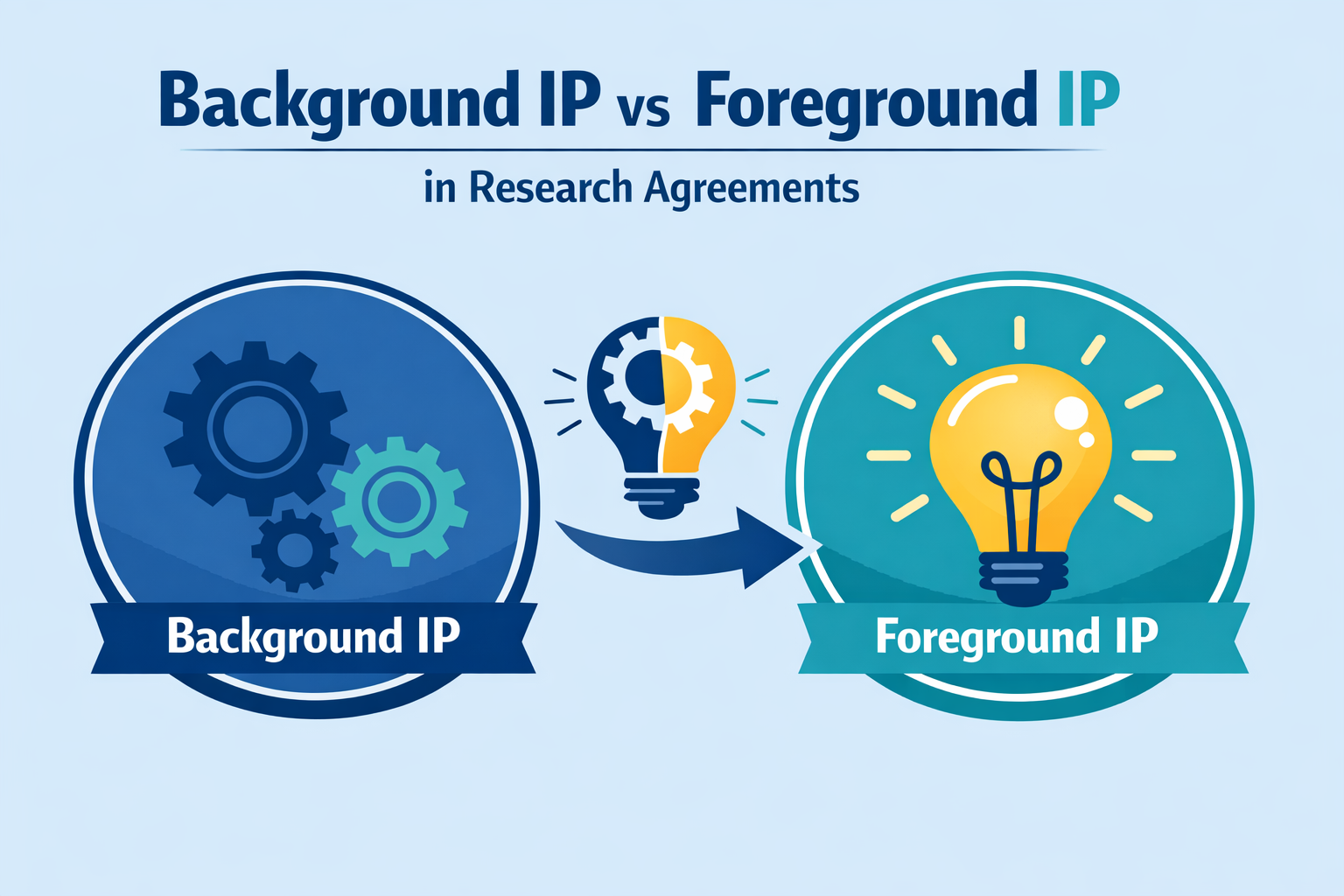
IP is the core asset, not money. In a services contract, the financial value is defined upfront. In a research agreement, the most valuable output (a patentable invention, a novel dataset, a breakthrough methodology) may not exist yet. IP disputes can easily cost more than the contract value, and a poorly drafted IP clause can surrender rights to inventions developed over years of prior work. Our guide on background IP vs foreground IP covers this in detail.
Counterparty risk is different. Universities collaborate with entities worldwide, including in jurisdictions with sanctions exposure. Entering into a research agreement with a sanctioned entity, a Politically Exposed Person, or an organisation with adverse media can trigger regulatory consequences and reputational damage that no indemnity clause can fix.
Compliance is multi-layered. A single research agreement may need to comply with funding body terms, institutional policy, data protection legislation, export control regulations, and ethics approval requirements, all simultaneously. Miss one layer, and the entire agreement is at risk.
Research involves inherent uncertainty. Unlike a construction contract with defined deliverables, research outcomes are unpredictable. Scope evolves, deliverables shift, timelines slip. The contract must accommodate this uncertainty without creating open-ended risk.
Reputational risk is amplified. A university’s brand is built on trust, academic integrity, and public benefit. A single high-profile contract dispute, particularly one involving misuse of research data or controversial research partnerships, can damage that brand in ways that take years to repair.
Risk Categories for Research Agreements
A useful risk framework starts by defining the categories of risk you are assessing. For research agreements, we recommend six categories.
IP Risk
IP risk is the probability that intellectual property rights will be disputed, lost, or inadequately protected.
Key indicators of elevated IP risk:
- Foreground IP ownership is ambiguous or not explicitly assigned.
- Background IP is not scheduled or defined in the agreement.
- Improvement clauses are missing, creating uncertainty about who owns enhancements to pre-existing IP.
- Publication rights are restricted beyond standard review periods.
- The agreement does not address sideground IP.
If your agreements routinely lack these provisions, our article on background IP vs foreground IP in research agreements provides a clause-level checklist.
Financial Risk
Financial risk includes cost overruns, unfunded obligations, and revenue shortfalls.
Key indicators:
- Facilities and Administrative (F&A) rate is capped below institutional standard.
- The budget does not account for cost escalation over multi-year terms.
- The university is accepting unfunded obligations (work required but not covered by the funding).
- Payment milestones are tied to deliverables that may not be achievable on schedule.
- Cost sharing commitments are not tracked or documented.
Compliance Risk
Compliance risk is the probability that the agreement will violate applicable laws, regulations, funding body rules, or institutional policy.
Key indicators:
- Funding body flow-down provisions are missing from sub-awards and sub-contracts.
- Data protection clauses are absent from agreements involving personal data.
- Export control provisions are not addressed for international collaborations.
- Ethics approval requirements are not referenced or are inconsistent with institutional policy.
- The agreement conflicts with existing grant terms.
For a deeper look at compliance exposure, see our guide on preparing for compliance audits.
Counterparty Risk
Counterparty risk is the probability that the other party will cause regulatory, financial, or reputational harm.
Key indicators:
- The counterparty or its principals appear on sanctions lists (OFAC, EU, UN, MAS).
- The counterparty has Politically Exposed Person (PEP) connections.
- Adverse media coverage suggests financial instability, fraud, or ethical concerns.
- The counterparty is in a jurisdiction with high corruption or sanctions risk.
- Undisclosed conflicts of interest exist between the counterparty and university personnel.
We cover counterparty due diligence in more detail below.
Liability Risk
Liability risk concerns the university’s exposure to claims, damages, and costs arising from the agreement.
Key indicators:
- Indemnification obligations are uncapped or disproportionately broad.
- Insurance requirements are not specified or are inadequate for the risk profile.
- The agreement creates product liability exposure for research outputs.
- Limitation of liability clauses exclude key risk categories (IP infringement, data breaches).
- The university is accepting liability for third-party claims it cannot control.
Operational Risk
Operational risk is the probability that the agreement will fail to deliver its intended outcomes due to execution problems.
Key indicators:
- Key person dependency with no succession or substitution provisions.
- No termination wind-down provisions (what happens to IP, data, and materials on termination?).
- Deliverable milestones are vague or unmeasurable.
- Dispute resolution mechanisms are undefined or impractical (e.g., litigation in a distant jurisdiction).
- No provision for force majeure or other extraordinary circumstances.
Building a Risk Matrix
Once you have defined your risk categories, you need a method for scoring individual agreements and comparing risk across your portfolio.
The Scoring Method
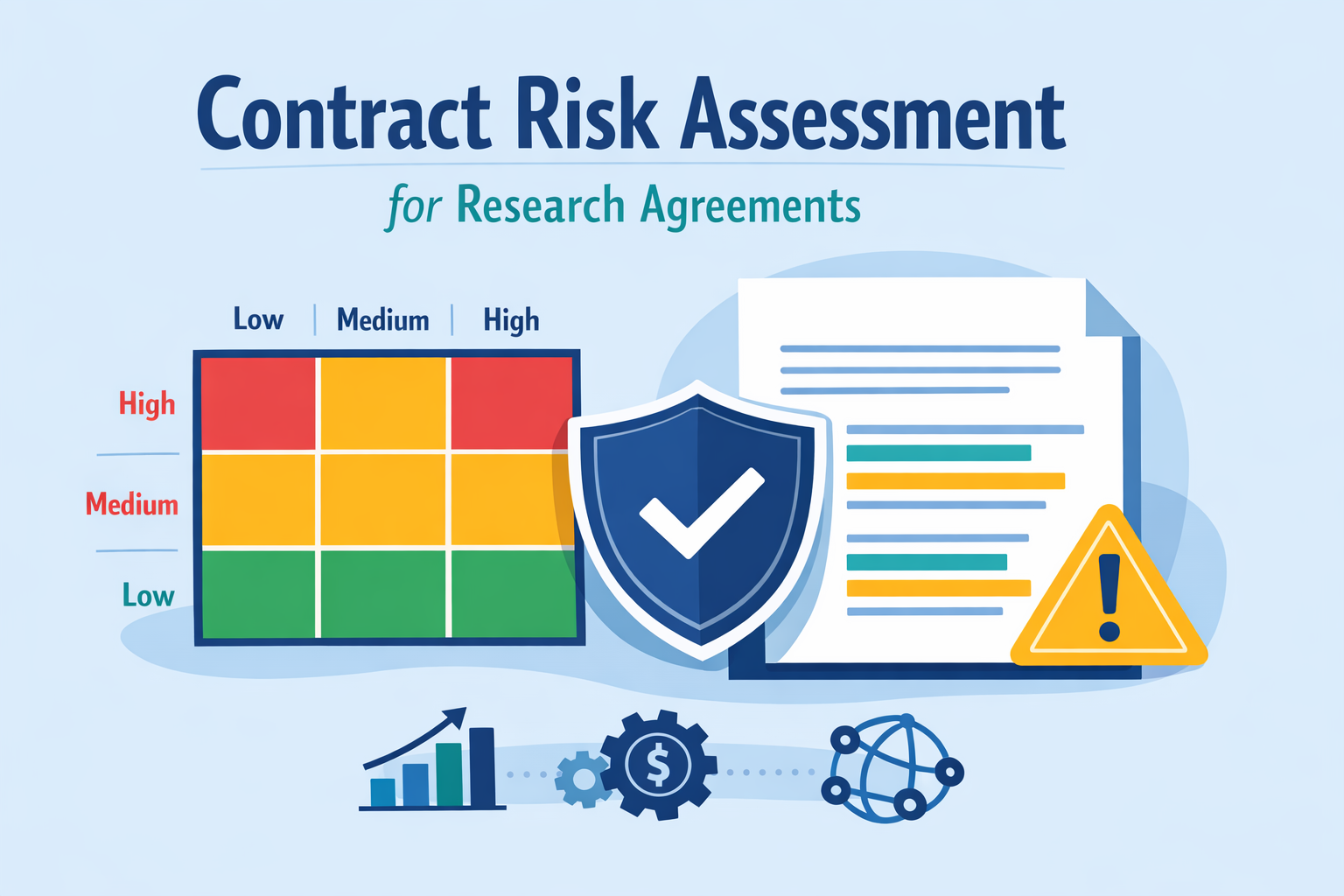
For each agreement, score each risk category on two dimensions:
- Likelihood: How probable is it that this risk will materialise? (Low / Medium / High)
- Impact: If the risk materialises, how severe are the consequences? (Low / Medium / High)
This gives you a simple 3x3 matrix for each category:
| Low Impact | Medium Impact | High Impact | |
|---|---|---|---|
| High Likelihood | Medium | High | Critical |
| Medium Likelihood | Low | Medium | High |
| Low Likelihood | Low | Low | Medium |
Risk Profiles by Agreement Type
Different agreement types carry different inherent risk profiles. Here is a starting point. Adjust based on your institution’s experience.
| Agreement Type | IP Risk | Financial Risk | Compliance Risk | Counterparty Risk | Liability Risk | Operational Risk |
|---|---|---|---|---|---|---|
| NDA / CDA | Low | Low | Low | Medium | Low | Low |
| Material Transfer Agreement | Medium | Low | Medium | Low | Medium | Low |
| Sponsored Research Agreement | High | Medium | High | Medium | Medium | Medium |
| Research Collaboration Agreement (bilateral) | High | Medium | High | Medium | Medium | Medium |
| Multi-party RCA / Consortium | High | High | High | High | High | High |
| Clinical Trial Agreement | High | High | High | Medium | High | High |
| Industry Consultancy | Medium | Low | Low | Medium | Medium | Low |
| Sub-award / Sub-contract | Medium | Medium | High | Medium | Medium | Medium |
Defining Escalation Thresholds
A risk matrix is only useful if it drives action. Define clear thresholds:
- Low risk: Proceed with standard terms. Contract manager handles negotiation.
- Medium risk: Flag for senior review. Apply enhanced clause requirements from your playbook.
- High risk: Escalate to senior counsel. Require additional due diligence and risk mitigation before proceeding.
- Critical risk: Escalate to institutional leadership. Consider whether to proceed at all. Define your walk-away criteria.
These thresholds should be documented in your contract review playbook so that every contract manager applies them consistently.
Counterparty Due Diligence
Counterparty risk deserves special attention because it is both high-impact and frequently overlooked.
Why It Matters
Universities collaborate with entities across the world, including in jurisdictions with sanctions exposure, weak anti-corruption frameworks, or unstable regulatory environments. A single agreement with a sanctioned entity can trigger:
- Regulatory investigations and fines.
- Loss of funding eligibility.
- Reputational damage that affects future partnerships and student recruitment.
- Personal liability for university officers involved in the decision.
The risk extends beyond direct counterparties. If your research partner subcontracts to a sanctioned entity, or if a key individual at the partner organisation is a PEP, the university may still face exposure.
What to Screen For
Effective counterparty due diligence covers multiple dimensions:
Sanctions lists. Check the counterparty against all relevant sanctions lists, including OFAC (US), EU consolidated list, UN Security Council sanctions, and MAS sanctions (Singapore). For multi-jurisdictional collaborations, you may need to screen against all applicable regimes.
Politically Exposed Persons (PEPs). Screen key individuals at the counterparty organisation (directors, beneficial owners, signatories) against PEP databases. PEP connections do not necessarily preclude a partnership, but they require enhanced due diligence and ongoing monitoring.
Adverse media. Search for negative news coverage related to fraud, corruption, sanctions violations, human rights concerns, or financial instability. Adverse media screening provides early warning signs that may not yet be reflected in official sanctions lists.
Corporate registry checks. Verify the counterparty’s legal status, registration, directors, and ownership structure. This confirms you are contracting with the entity you think you are and reveals any undisclosed parent companies, subsidiaries, or beneficial owners.
Conflict of interest. Check whether any university personnel have undisclosed financial or personal relationships with the counterparty or its principals.
Manual vs Automated Screening
The manual approach (searching sanctions lists individually, running news searches, checking corporate registries) is time-consuming and error-prone. Sanctions lists change frequently, and a check that was valid three months ago may not be valid today.
Some CLM platforms integrate sanctions screening directly into the contract workflow, automatically checking counterparties against global sanctions lists and PEP databases before an agreement proceeds. This eliminates the gap between screening and contracting and ensures that no agreement moves forward without a current check.
Pactly’s integration with Dilisense provides automated screening against sanctions lists, PEP databases, and adverse media sources as part of the contract onboarding workflow. The check runs when a counterparty is added to the system and can be configured for ongoing monitoring so that changes to a counterparty’s status are flagged even after the agreement is signed.
One-Time Checks vs Ongoing Monitoring
A common mistake is treating counterparty screening as a one-time gate. Sanctions designations change. Companies are acquired. Directors are replaced. An entity that was clean at the time of contracting may not remain clean for the duration of a multi-year research agreement.
Best practice is to implement ongoing monitoring that automatically alerts your team when a counterparty’s status changes. This is particularly important for long-duration research collaboration agreements and consortia where the risk profile evolves over time.
Operationalizing Contract Risk Management
A framework on paper is a starting point. Making it stick requires embedding risk assessment into your daily operations.
Build Risk Assessment into Your Contract Intake Workflow
Every new agreement should receive a risk score as part of the intake process. This does not need to be elaborate. A contract manager should be able to complete the initial risk assessment in 10 to 15 minutes using the six categories above.
The risk score determines the workflow: low-risk agreements follow the standard path, while high-risk agreements are routed to senior counsel with the specific risk factors flagged. This prevents bottlenecks (not everything needs senior review) while ensuring that genuinely risky agreements receive appropriate attention.
Use Playbooks to Define Acceptable Risk Thresholds
Your contract review playbook should document your institution’s approved, acceptable, and fallback positions for each risk category, broken down by agreement type. When a counterparty’s draft deviates from your standard terms, the playbook tells the contract manager whether to accept the deviation, negotiate a fallback, or escalate.
This is how you scale risk management across a team. Individual judgment is important, but it should be guided by institutional standards, not improvised for each agreement.
Set Up Automated Alerts for High-Risk Provisions
Manual review catches most issues, but it depends on the reviewer knowing what to look for. Automated clause analysis can flag provisions that create elevated risk (uncapped indemnities, broad IP assignments, missing data protection clauses) before the agreement reaches the negotiation table.
This is particularly valuable for incoming agreements drafted on the counterparty’s paper, where non-standard terms may be buried in dense boilerplate.
Track Risk Across Your Portfolio
Risk management is not a contract-by-contract exercise. Leadership wants an aggregate view: how many high-risk agreements do we have? Where is our counterparty risk concentrated? Are we tracking more compliance gaps than last quarter?
This requires a contract lifecycle management platform that captures risk data at the agreement level and surfaces it as portfolio-wide analytics. If your current system cannot produce a risk report across your active agreements, you are operating blind, which is exactly the situation that triggers the leadership question this article opened with.
Review and Update Your Risk Framework Annually
Risk profiles change. New regulations take effect. Institutional risk appetite shifts. Sanctions regimes are updated. Your risk framework should be reviewed at least annually to ensure it reflects current conditions.
During the annual review:
- Update your risk categories and scoring criteria.
- Review escalation thresholds and adjust if they are generating too many (or too few) escalations.
- Refresh your counterparty screening criteria based on new sanctions designations and regulatory guidance.
- Assess whether your playbook positions are still aligned with institutional policy.
- Incorporate lessons learned from any disputes, audit findings, or near-misses during the year.
Conclusion
Contract risk management is not about avoiding all risk. Research is inherently uncertain, and universities that refuse to accept any risk will find themselves unable to collaborate. The goal is knowing where the risk is and making informed decisions about what to accept, what to mitigate, and what to walk away from.
The framework outlined here (six risk categories, a scoring matrix, defined escalation thresholds, and counterparty due diligence) gives your office a structured way to answer the question “what is our risk exposure?” with something more useful than “we are not sure.”
If you are looking to move from ad hoc risk assessment to a systematic approach, get in touch. We can show you how Pactly supports risk-scored intake workflows, automated counterparty screening, and portfolio-wide risk analytics.
For related reading, see our guides on preparing for compliance audits and Research Collaboration Agreements for university partnerships.
See it in action
Turn contract chaos into a streamlined workflow
Join legal teams who cut contract turnaround time by 60%. Book a 15-minute demo to see how.