Why E-Signatures Are Essential for SaaS Contracts
If you’ve ever felt that signing a SaaS contract takes longer than it should despite using a SaaS contract automation tool, you’ve hit on the core problem: execution is often a massive bottleneck.
E-signatures are essential for SaaS contracts because they eliminate this bottleneck, provide immediate legal certainty, and are a non-negotiable component of digital transformation.
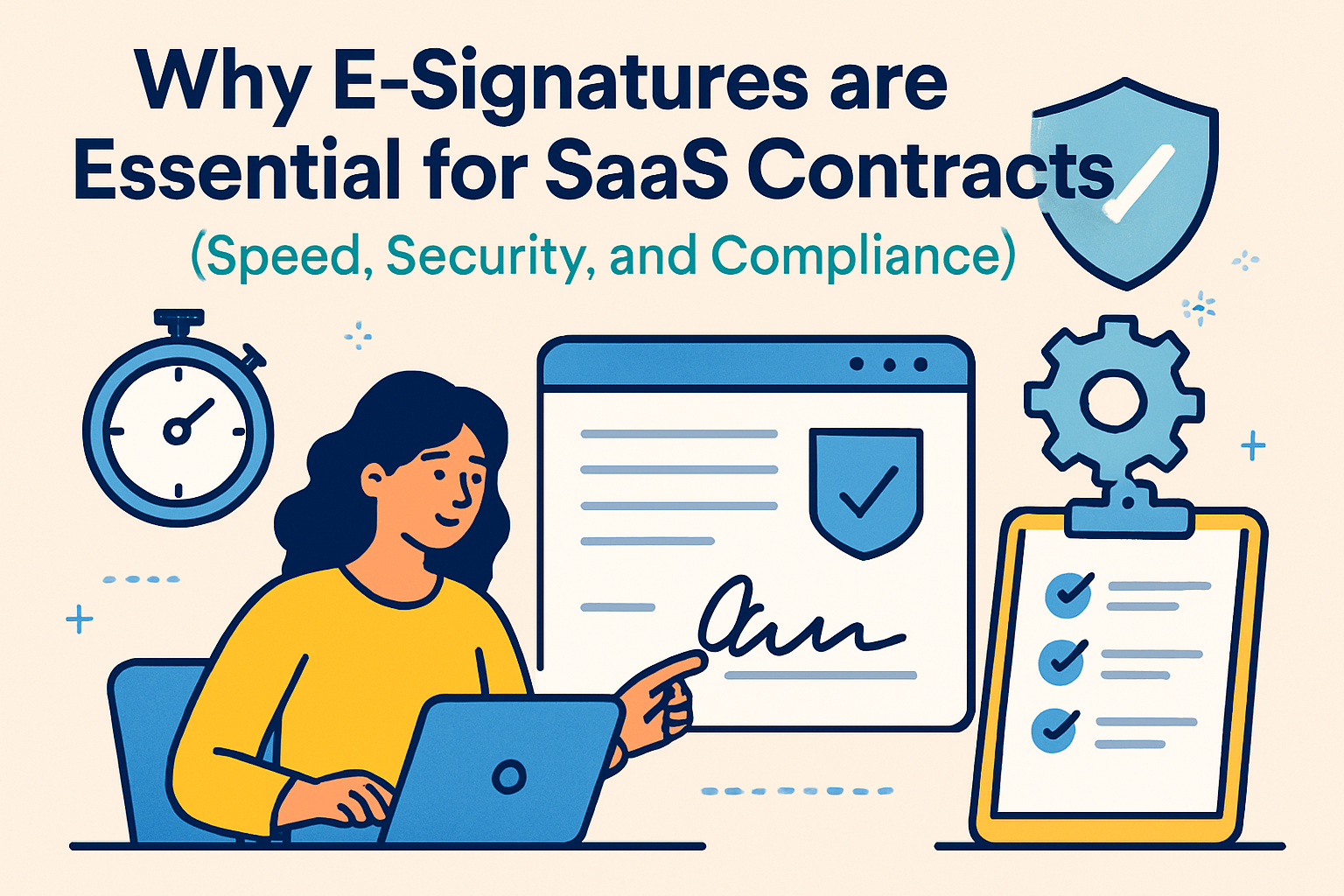
We can break down their essential role into three main drivers:
- Speed & Efficiency: They eliminate the friction and delays of the traditional analog execution process.
- Legal Certainty: They provide irrefutable proof of authenticity, integrity, and signatory authority.
- Digital Integration: They are fundamental to centralized Contract Lifecycle Management (CLM).
Speed & Efficiency: Eliminating the Execution Bottleneck
Let’s start with the most obvious benefit: speed. The traditional “print, sign, scan, and email” process is simply incompatible with how fast the SaaS world moves. It’s a relic that creates unacceptable friction.
A. The Execution Pain Point: Eliminating Friction
Think about the real cost of those delays:
- Delays Time-to-Value: Every day a contract sits waiting for a signature, customer onboarding is postponed, and the vendor waits to recognize revenue. This directly impacts your growth metrics.
- Introduces Risk: Manual processes are prone to errors—a signature missed, a low-resolution scan, or a document lost—any of which can compromise the legal integrity of the final agreement.
B. Core Benefit: Immediate Execution
The solution is immediate execution. E-signatures directly resolve these issues by offering instant speed paired with superior document security.
- Speed: E-signatures eliminate the back-and-forth of paper, allowing sales teams to close deals in minutes, not days. This is crucial for maintaining sales momentum and hitting those quarterly targets.
- Sales Enablement: They streamline agreement processes across your entire supply chain, ensuring fast execution of necessary B2B contracts without administrative delays.
Legal Certainty: Validity, Authority, and Compliance
The next major question is always about legal validity. Do e-signatures truly hold the same weight as a pen on paper?
Absolutely!
For SaaS contracts, Legal Certainty is paramount, and e-signatures achieve this with equal, or often greater, confidence.
A. Equal Treatment Under Law
Across major jurisdictions globally (like the US, UK, and EU), legal frameworks confirm that electronic signatures are treated equally to physical ones. For instance, English law allows e-signatures to be used as the basis for entering into a contract with the same legal treatment as a physical signature.
B. Verifying Authority and Identity
A robust e-signature process provides certainty about who is signing what:
- Ensures Authority: The system verifies that the person signing has the legal authority to commit their organization, making the agreement seamless and legally sound.
- Authenticity and Integrity: E-signatures provide a verifiable digital trail that confirms the signatory’s identity and cryptographically seals the document, guaranteeing that the terms haven’t been altered after execution.
C. Compliance and Proof (Audit Trails)
For your legal and compliance teams, e-signatures are an asset:
- Audit Trails: Every signature event automatically generates a detailed audit trail (timestamps, IP addresses, device data) that provides irrefutable evidence of the signing process for auditing purposes.
- Compliance: Higher-level signatures, such as Qualified Electronic Signatures (QES), can help legal teams easily prove compliance with stringent regulations like GDPR when managing vendor agreements.
Benefits & E-Signature Best practices
Finally, the maximum value of e-signatures comes from treating them as a core component of your digital infrastructure, enabling true digital integration and establishing repeatable best practices across your organization.
A. Integration with Contract Management (CLM)
- Simplified Execution: When integrated directly into a Contract Lifecycle Management (CLM) tool, the entire execution process happens in one place, which vastly streamlines workflows.
- Centralized Access: A good CLM tool makes the signed contracts instantly available on the cloud for all relevant parties to access and store. This eliminates the risk of misfiled or lost documents and vastly improves efficiency during ongoing SaaS contract management.
B. Key E-Signature Best Practices
To maximize the legal validity and efficiency of your e-signature process, focus on these critical practices:
- Audit Trails: Always ensure your system captures detailed audit trails (timestamps, IP addresses, signing methods) to provide irrefutable evidence in case of a legal challenge.
- Signatory Verification: Utilize verification methods (like multi-factor authentication or email verification) to confirm the identity of the person signing, strengthening the authenticity of the signature.
- Final Document Integrity: Ensure the signed document is immediately locked and timestamped to prove that the contents have not been altered after execution.
Conclusion
And there you have it!
We hope this article has clearly explained why e-signatures are fundamental to SaaS contract execution and how it’s able to move your business forward faster, more securely and with greater legal confidence.
If you are currently struggling with manual contract execution or are unsure about the compliance implications of your e-signature provider, book a demo with us today.
See it in action
Turn contract chaos into a streamlined workflow
Join legal teams who cut contract turnaround time by 60%. Book a 15-minute demo to see how.