7 Reasons to Stop Using Excel for Contract Management
If you’ve been hesitant to simplify your contract management system because you’re worried about another failed implementation, you might have fallen back on the “old reliable”: the master spreadsheet.
And why wouldn’t you?
It’s flexible, familiar, and doesn’t require a budget meeting to set up.
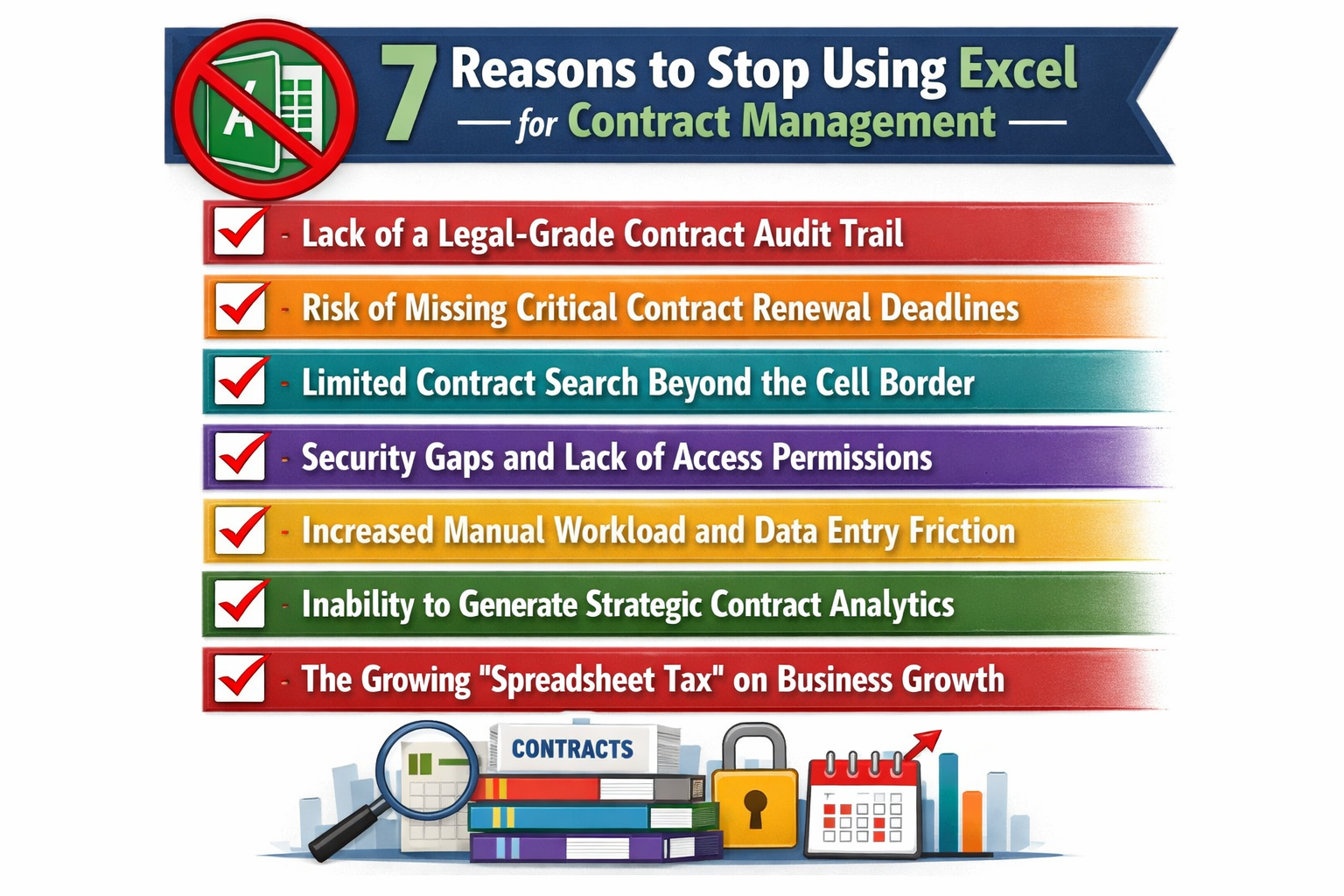
However, before you decide to commit to this fallback for the long haul, consider these 7 reasons to stop using Excel for contract management:
1. Lack of a Legal-Grade Contract Audit Trail
While Excel technically has a version history, it’s a far cry from a legal-grade audit trail. It might tell you who saved the file last, but try finding exactly which cell was changed, by whom, and when. It only takes one person accidentally “fat-fingering” a date or deleting a row to create a massive risk. Unlike a dedicated contract management tool, Excel won’t flag that a critical term was altered, you won’t know it’s broken until a deadline has already passed you by.
2. Risk of Missing Critical Contract Renewal Deadlines
Excel is a static grid; it isn’t going to tap you on the shoulder when a notice period is closing. Relying on a spreadsheet means you’re essentially betting your budget that a human will remember to filter by “Expiration Date” every single morning. We’ve seen teams miss contract renewals simply because a row was hidden behind a filter or the person responsible was out of the office.
3. Limited Contract Search Beyond the Cell Border
Excel is great at searching text within a box, but it can’t “see” inside your PDFs. If you need to find every contract with a specific “Data Privacy” clause, a spreadsheet forces you to manually open and read every single document. A modern contract management system uses OCR to search the actual text of your agreements, turning a three-day manual project into a three-second search.
4. Security Gaps and Lack of Access Permissions
Spreadsheets are notoriously “leaky.” The moment you email the tracker to a colleague, that sensitive data is living in their “Downloads” folder forever, and you can’t revoke access once it’s sent. A dedicated system keeps the data in one place with granular permissions, meaning Sales can see their deals, but your executive contract data stays behind a locked door.
5. Increased Manual Workload and Data Entry Friction
The “flexibility” of Excel comes at the cost of your time. You negotiate the deal, sign it, and then you have to manually type all that info again into your spreadsheet. It’s a high-friction process that almost guarantees your data will be out of date within a week. A connected system pulls this contract metadata automatically from the signed document, so you only do the work once.
6. Inability to Generate Strategic Contract Analytics
When your CFO asks for the total “contractual liability” across your top 20 vendors, an Excel sheet turns that into a manual math project. Because spreadsheets don’t understand the relationship between different contract data points, you’re stuck building pivot tables instead of providing the high-level strategic advice the business actually expects from a GC.
7. The Growing “Spreadsheet Tax” on Business Growth
Excel works fine for 50 contracts, but it’s a disaster at 500. As you scale, the time you spend “fixing the sheet” and double-checking for errors grows exponentially. Eventually, you realize you’re paying a lawyer’s salary for them to act as a data entry clerk. That’s the point where the “free” spreadsheet becomes significantly more expensive than switching to a real contract management system.
Conclusion
Excel is a hall-of-fame tool for finance, but it was never meant to be a contract repository. Sticking with it might feel like the path of least resistance today, but the hidden risks of missed dates and manual errors catch up to every legal team eventually.
The real trick to moving off Excel isn’t just buying a new tool, it’s making sure that tool actually talks to the rest of your company.
Check out our next article on the essential integrations for your contract management system.
See it in action
Turn contract chaos into a streamlined workflow
Join legal teams who cut contract turnaround time by 60%. Book a 15-minute demo to see how.