What Is a Material Transfer Agreement (MTA)?
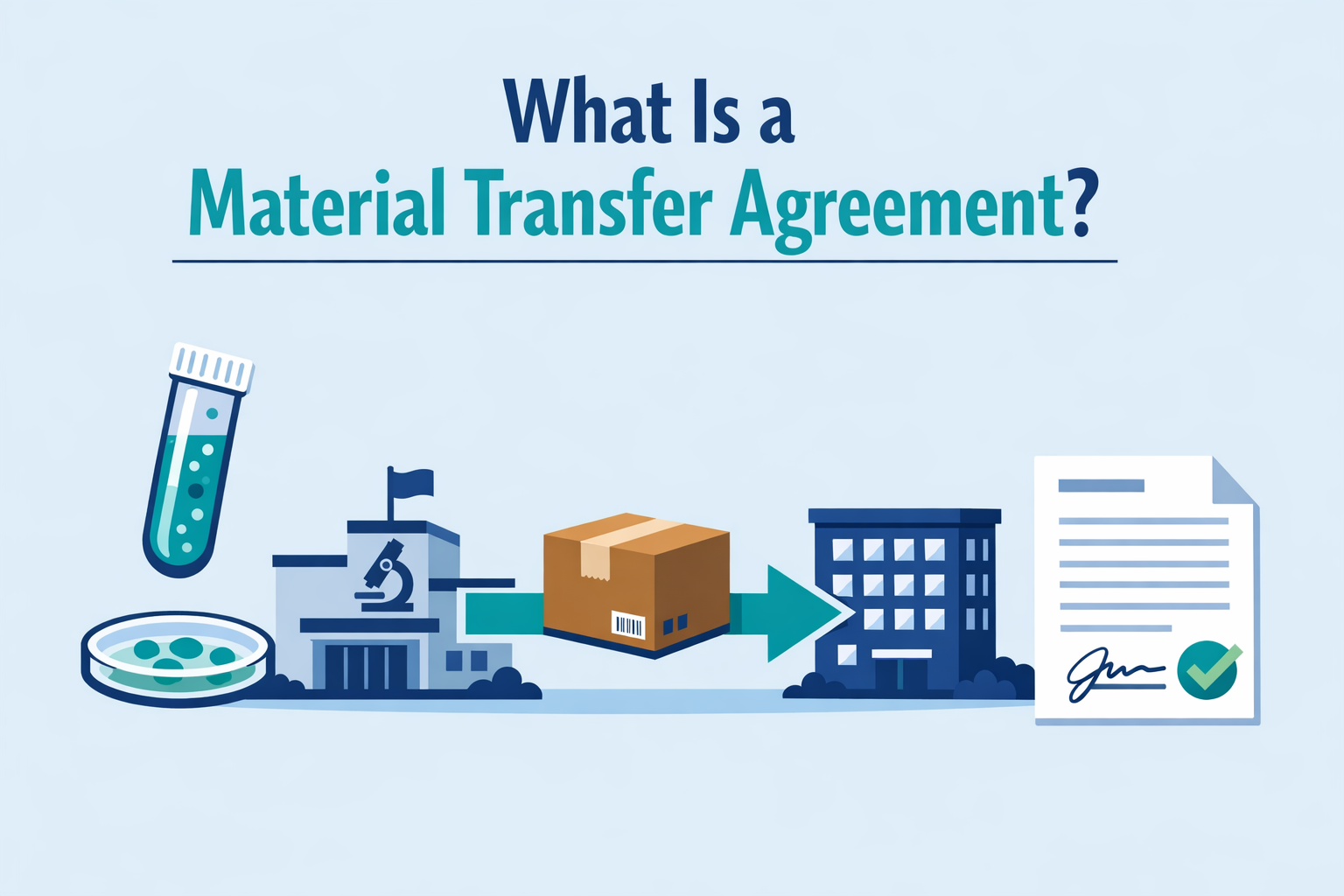
A material transfer agreement (MTA) is a contract that governs the transfer of tangible research materials between organisations. Cell lines, plasmids, chemical compounds, biological samples, proprietary reagents. If it has physical form and intellectual property implications, it should be covered by an MTA before it leaves the building.
The concept is simple. The execution, in many research offices, is anything but. MTAs are among the most common agreements that university Offices of Sponsored Programmes (OSPs) and Technology Transfer Offices (TTOs) process, and one of the most common bottlenecks. What should take days often takes weeks or months, delaying experiments on both sides.
This guide covers when you need an MTA, what to watch for, how the UBMTA framework can help, and what you can do to speed things up.
When Do You Need an MTA?
Not every material exchange requires a formal agreement. An MTA becomes necessary when the materials being transferred carry intellectual property restrictions, were developed under funded research, or belong to a party that needs to control how they are used.
Common scenarios include:
- Biological samples such as cell lines, plasmids, antibodies, and viral vectors shared between laboratories.
- Chemical compounds transferred for testing or validation in another institution’s research programme.
- Proprietary datasets on physical media where the data has IP restrictions.
- Prototype devices or equipment provided for evaluation or collaborative testing.
- Engineered materials such as nanomaterials or proprietary formulations shared for academic research.
The common thread is that the provider has a legitimate interest in controlling what happens to the material after it leaves their hands.
When You Do Not Need One
An MTA is generally not required when:
- The material is commercially available and can be purchased from a catalogue supplier.
- The material carries no IP restrictions and was not developed under funded research.
- Both parties have already signed a broader agreement (such as an RCA) that includes material transfer provisions.
If you are unsure, err on the side of putting an MTA in place. The cost of negotiating a simple MTA is far less than the cost of an IP dispute after the fact.
Incoming vs Outgoing MTAs
The direction of the transfer matters because it changes what your institution should be watching for.
Incoming MTAs
An incoming MTA covers materials your institution is receiving from another university, research institute, or company. The primary concern is what restrictions the provider is placing on your researchers: usage limitations tied to a specific project or PI, publication restrictions, claims of ownership over inventions made using the materials, reach-through rights to downstream discoveries, and any terms that conflict with existing grant obligations.
Outgoing MTAs
An outgoing MTA covers materials your institution is providing to an external party. Here the concerns flip: you are protecting your institution’s IP and managing liability. Key questions include whether the permitted use is narrow enough to prevent unauthorised commercial exploitation, whether return or destruction provisions are adequate, and whether your institution’s liability exposure is appropriately limited.
The UBMTA Framework
The Uniform Biological Material Transfer Agreement (UBMTA) is a standardised MTA framework designed to simplify transfers of biological materials between academic and non-profit institutions.
How It Works
The UBMTA operates through a master agreement model administered by the Association of University Technology Managers (AUTM). Institutions sign the master agreement once, signalling that they accept its standard terms. After that, any transfer between two signatory institutions can be executed using a simple one-page Implementing Letter that identifies the materials, the provider, and the recipient. No clause-by-clause negotiation is required.
When to Use the UBMTA
The UBMTA is appropriate when:
- Both the provider and recipient institutions are signatories to the master agreement.
- The materials being transferred are biological in nature (the UBMTA was specifically designed for biological materials).
- The transfer is for non-commercial, academic research purposes.
- Neither party requires terms that deviate from the UBMTA standard provisions.
Key UBMTA Provisions
The UBMTA includes the following standard terms:
| Provision | UBMTA Position |
|---|---|
| Permitted use | Research and teaching purposes only; no commercial use without a separate licence |
| Modification rights | Recipient may create modifications (derivatives), but the provider retains rights over the original material |
| IP ownership | Recipient owns IP arising from use of the material, but the provider retains ownership of the original material and any unmodified derivatives |
| Reach-through rights | None. The provider does not claim rights to inventions made using the material |
| Publication | No restrictions on publication |
| Distribution | Recipient may not distribute the material to third parties; third parties must obtain the material directly from the provider |
| Liability | Materials provided “as is” with no warranties |
Limitations
The UBMTA does not cover every scenario. It is not suitable when:
- One party is an industry or for-profit entity (the UBMTA is designed for academic-to-academic transfers).
- The materials are not biological in nature (chemicals, devices, and datasets fall outside its scope).
- The materials have significant commercial value and the provider wants to negotiate licensing terms.
- Either party needs non-standard terms such as reach-through royalties or restrictions on modifications.
When the UBMTA does not apply, you will need to negotiate a bespoke MTA.
Key MTA Clauses
Whether you are negotiating from a template or reviewing an incoming draft, these are the provisions that matter most.
Permitted Use
Most academic MTAs restrict use to a specific research project or programme. The critical boundary is between research use and commercial use. If the recipient wants to use the materials commercially, a licence agreement is typically required instead of (or in addition to) an MTA.
Modification Rights
Can the recipient modify or create derivatives of the transferred materials? If so, who owns those modifications? This is particularly important for biological materials, where a recipient lab might create modified cell lines or engineered variants. The provider often retains rights over modifications that incorporate the original material.
Publication Rights
Academic institutions need the freedom to publish. Some MTAs from industry providers include publication review periods or outright restrictions on publishing data generated using the materials. Review periods of 30 to 60 days are generally acceptable; anything beyond that, or any clause that gives the provider a veto over publication, should be flagged.
IP Ownership
This is the clause that causes the most friction, especially in incoming MTAs from industry. If a researcher uses the transferred materials and makes an invention, who owns it?
Most universities take the position that the recipient owns any IP arising from use of the materials. Commercial providers may push for ownership or reach-through rights. Your institution should have a clear position on this, ideally documented in a contract playbook. For a deeper discussion, see our guide to background IP vs foreground IP.
Liability and Indemnification
Materials are typically provided “as is” with no warranties. The provider disclaims liability for any damage caused by the use of the materials. Review indemnification provisions carefully, particularly for incoming MTAs where the provider may seek to shift risk to the recipient institution.
Return or Destruction
Most MTAs require the recipient to return or destroy unused materials (including modifications and derivatives) at the end of the agreed period. Ensure the timeline is realistic and that your researchers understand the obligation.
Confidentiality
If the transferred materials are accompanied by confidential information such as proprietary protocols or unpublished data, the MTA should address how that information is handled, even if a separate NDA is already in place.
Duration and Termination
Specify how long the recipient can use the materials and under what circumstances either party can terminate. Pay attention to what happens on termination: are materials returned? Are modifications destroyed? Do any rights survive?
MTA vs Other Agreements
Knowing which agreement type to reach for saves time and prevents the wrong template from being used.
| Scenario | Agreement Type | Reason |
|---|---|---|
| Sharing physical research materials | MTA | Covers tangible materials and their permitted use |
| Protecting confidential information during discussions | NDA | Covers information, not physical materials |
| Sharing datasets electronically | Data Use Agreement (DUA) | Covers data access, use, and retention obligations |
| Joint research with shared contributions | RCA | Covers the full collaboration; may include MTA-like provisions |
| Transferring materials for commercial evaluation | Licence Agreement | If the purpose is commercial, a licence is more appropriate |
| Material transfer within a broader collaboration | RCA with MTA schedule | The MTA becomes a component of the larger agreement |
A simple decision tree:
- Is tangible material being transferred? If no, consider an NDA (for information) or DUA (for data).
- Is there a broader research collaboration? If yes, consider an RCA with material transfer provisions built in.
- Is the transfer for commercial purposes? If yes, a licence agreement is likely needed.
- Are both parties UBMTA signatories and is the material biological? If yes, use the UBMTA Implementing Letter.
- None of the above? Negotiate a bespoke MTA.
Common MTA Bottlenecks and How to Fix Them
MTAs should be among the fastest agreements to process, yet many research offices report turnaround times of four to eight weeks. Here are the most common bottlenecks and practical solutions.
Non-Standard Terms from Industry Providers
The problem: A company sends its own MTA template with broad IP ownership claims, restrictive publication clauses, and unlimited indemnification demands.
The fix: Maintain pre-approved alternative clauses for the most common problem provisions. A well-structured clause library lets your contract managers respond with pre-vetted language instead of starting a negotiation from scratch each time.
Conflicting Obligations
The problem: The MTA’s IP provisions conflict with the terms of the researcher’s existing grant funding. For example, the MTA grants the provider reach-through rights to inventions, but the grant requires that all foreground IP remain with the university.
The fix: Flag these conflicts early by cross-referencing MTA terms against the PI’s active grant obligations before the agreement is signed. Centralised tracking makes it possible to surface these conflicts before they become problems.
Sequential Review Adding Dead Time
The problem: The MTA sits in the PI’s inbox for a week, then the TTO reviews it for another week, then legal counsel takes a look. Three weeks pass before a single comment reaches the provider.
The fix: Route reviews in parallel. The PI confirms the scientific scope while the TTO reviews IP terms simultaneously. Parallel workflows can cut internal review time by half or more.
Lack of Visibility and Standardisation
The problem: Researchers submit MTA requests and have no idea where they stand. Your office processes hundreds of MTAs per year, but every one is treated as a bespoke negotiation because there is no documented institutional position on key terms.
The fix: Track all MTAs centrally with contract management that gives all stakeholders status visibility. Create a contract playbook that captures your institution’s preferred, acceptable, and walk-away positions for each major MTA clause. With clear guidelines and visibility, contract managers can handle routine MTAs without escalating to senior counsel.
Getting Started
MTAs are, at their core, straightforward agreements. A provider sends materials to a recipient under agreed terms. The provisions are well-understood, and frameworks like the UBMTA exist to make the process even simpler.
The challenge is not complexity. It is volume and process. When your office handles hundreds of MTAs per year without standardised positions, centralised tracking, or parallel review workflows, even simple agreements accumulate unnecessary delay.
The most effective research offices treat MTA management the same way they treat any high-volume, repeatable process: with clear standards, pre-approved language, and workflows designed to eliminate dead time.
If your office is looking for a better way to manage MTAs and other research agreements, get in touch. We would be happy to show you how Pactly can help.
See it in action
Turn contract chaos into a streamlined workflow
Join legal teams who cut contract turnaround time by 60%. Book a 15-minute demo to see how.