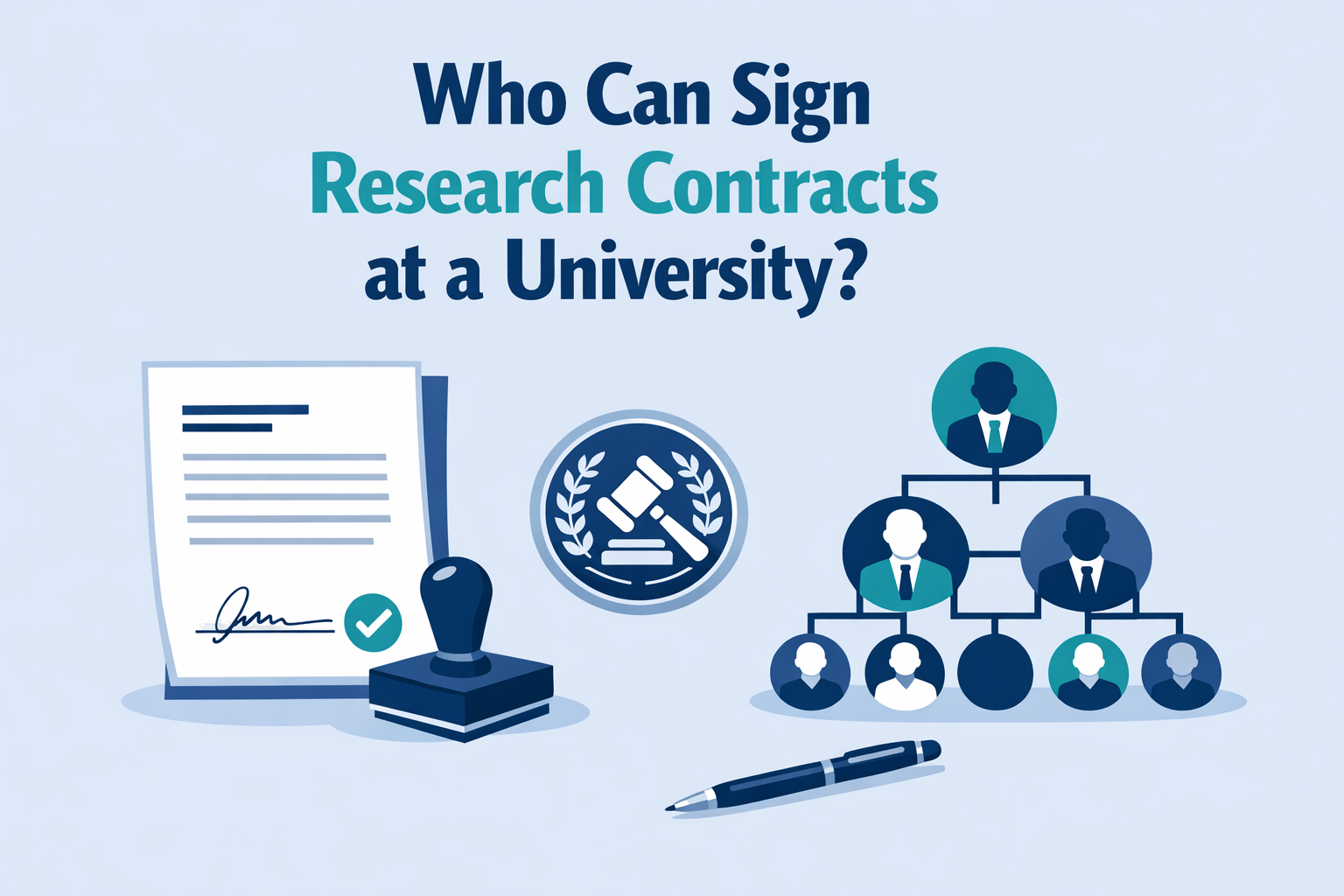
Who Can Sign Research Contracts at a University? A Guide to Signing Authority
A PI signs an NDA at a conference because the industry partner needs it “right now” to keep the conversation going. A department head approves a sponsored research agreement without looping in the legal office because the funder’s deadline is tomorrow. A research assistant agrees to material transfer terms via email because the PI asked them to “sort it out.”
These scenarios happen at every university. Each one creates risk that can take months or years to unwind.
Signing authority, the question of who is authorised to commit the university to contractual obligations, is one of the most important governance questions a research office can get right. Get it wrong, and you end up with contracts that bind the institution to terms no one reviewed. Get it right, and you create a system where researchers can move quickly within clear guardrails.
This guide covers why signing authority matters, the most common governance models, how unauthorised signatures happen, and what you can do to prevent them.
Why Signing Authority Matters
Signing authority is not an administrative formality. It exists to protect the institution, the researcher, and the research itself.
Legal exposure. An unauthorised signature can still bind the institution. Under the doctrine of apparent authority, if a counterparty reasonably believed the person signing had the authority to do so, the contract may be enforceable regardless of whether the signer was actually authorised. Unwinding these agreements is expensive, adversarial, and sometimes impossible.
Financial risk. A contract is a financial commitment. When someone signs without budget approval, the institution may be obligated to fund activities that were never planned, approved, or provisioned. Cost overruns, unfunded commitments, and misallocated resources follow.
IP risk. Research contracts routinely contain intellectual property provisions that determine who owns inventions, who can license them, and who controls publication. When a PI or department head agrees to unfavourable IP terms without the Technology Transfer Office reviewing them, the institution may give away rights to inventions worth millions, often without realising it until much later.
Compliance exposure. Many funding bodies require specific authorised signatories for grant-funded research. Federal grants, government-funded projects, and certain industry agreements may specify that only designated institutional officials can execute the contract. Failure to comply can jeopardise current and future funding.
Audit findings. Auditors routinely check whether contracts were signed by authorised personnel. An unauthorised signature is a finding, and findings accumulate. A pattern of unauthorised signatures signals governance failure and can trigger deeper scrutiny across the entire research portfolio. If you are preparing for a compliance audit, our audit preparation guide covers what auditors look for in detail.
Common Governance Models
Universities typically adopt one of three approaches to signing authority. Most research-intensive institutions end up with some variation of the third.
Centralised Authority
All contracts are routed through the legal office or Office of Sponsored Programs (OSP), and only designated officers sign. No exceptions.
Advantages: Maximum control and consistency. Every agreement is reviewed before execution. The institution speaks with one voice.
Disadvantages: Creates a bottleneck. Researchers experience delays, especially during peak periods. Simple agreements like standard NDAs may take as long to process as complex industry collaborations. Faculty frustration builds, and the temptation to bypass the system increases.
Delegated Authority
Signing authority is delegated to specific roles (deans, department heads, centre directors) up to certain financial thresholds or for certain agreement types. The legal office handles high-value or high-risk agreements.
Advantages: Faster turnaround for routine contracts. Department heads can approve agreements within their area of expertise without waiting for central review.
Disadvantages: Inconsistency. Different departments may apply different standards. Risk of authority creep, where delegated signatories gradually expand what they believe they are authorised to sign. Harder to maintain institutional oversight.
Tiered or Matrix Authority
Different authority levels apply based on agreement type, financial value, and risk profile. This is the model most research universities adopt because it balances speed with control.
A typical signing authority matrix might look like this:
| Agreement Type | Value Threshold | Signing Authority |
|---|---|---|
| Standard NDA (mutual, template) | Any | OSP Director or delegate |
| Material Transfer Agreement (UBMTA) | N/A | TTO Director |
| Research Collaboration Agreement | Under $100K | Head of Department + OSP |
| Research Collaboration Agreement | Over $100K | VP Research or Provost |
| Industry Sponsored Research | Under $250K | OSP Director |
| Industry Sponsored Research | Over $250K | VP Research |
| Clinical Trial Agreement | Any | VP Research + General Counsel |
| Agreements with indemnity or liability caps | Any | General Counsel |
The specific thresholds and roles vary by institution, but the principle is consistent: routine, low-risk agreements can be handled quickly by operational staff, while high-value and high-risk agreements require senior approval.
The Unauthorised Signature Problem
Even universities with clear policies experience unauthorised signatures. Understanding how they happen is the first step to preventing them.
How It Happens
PIs believe they have authority. Many principal investigators assume that because they lead the research, they have the authority to sign contracts related to it. This is a natural assumption. They negotiate the scientific terms, they manage the budget, they interact with the sponsor. The leap from “leading the project” to “signing the contract” feels small, even though it crosses a critical governance boundary.
Sponsors pressure for quick turnaround. Industry partners and funding bodies often operate on tight timelines. When a sponsor says “we need this signed by Friday or the funding lapses,” the pressure to skip internal processes is significant. The PI or department head may sign to avoid losing the opportunity, intending to “sort out the paperwork later.”
Email chains create informal agreements. Not every unauthorised commitment looks like a signed contract. Sometimes it is a PI responding to an email with “yes, we agree to those terms.” Sometimes it is a department administrator confirming scope changes that technically constitute a contract amendment. These informal agreements can be just as binding as a formal signature.
The process feels too slow. When the official process takes weeks for a simple NDA, researchers find workarounds. The problem is often not that researchers are irresponsible. It is that the system does not provide a fast path for genuinely low-risk agreements. When contracts are managed informally through email and spreadsheets, the lack of a clear, fast intake process makes bypassing the system even more tempting.
What Goes Wrong
The consequences of unauthorised signatures range from inconvenient to catastrophic.
Unfavourable IP terms get locked in before the TTO has a chance to review them. The institution agrees to assign foreground IP to a commercial partner or waives the right to publish. By the time anyone notices, the contract is executed and the counterparty has no incentive to renegotiate.
Uncapped liability provisions expose the institution to open-ended financial risk. When a PI signs a contract with unlimited liability, the institution’s risk profile changes in ways that insurance may not cover.
Budget commitments are made without financial approval. The contract commits the university to cost-sharing or matching funds that were never budgeted. The finance office discovers the commitment after the fact.
Conflicts with existing obligations go undetected. The university may already have exclusivity arrangements or competing IP commitments that the new contract violates. Without central review, these conflicts are invisible until they cause a problem.
The Cultural Challenge
The hardest part of enforcing signing authority is cultural, not procedural. Academics are accustomed to a high degree of autonomy. They run their own labs, manage their own research programmes, and make independent decisions about scientific direction every day. Contract governance can feel like bureaucratic interference in work they consider their own.
This is why the most effective signing authority policies are designed to make the right thing easy, not to punish the wrong thing. If the official process is fast and transparent for routine agreements, researchers have less reason to bypass it.
Building a Signing Authority Policy
If your institution does not have a clear signing authority policy, or if the existing policy is outdated, ignored, or inaccessible, here is how to build one that works.
Define authority levels by agreement type, value, and risk. Start with the categories of agreements your institution handles most frequently: NDAs, MTAs, sponsored research agreements, research collaboration agreements, consultancy agreements, clinical trials. For each category, define who can sign, up to what value, and under what conditions.
Document the delegation matrix and make it accessible. A signing authority matrix that lives in a policy manual no one reads is effectively no policy at all. Publish it on your intranet, include it in onboarding materials for new PIs, and reference it in your contract submission forms.
Include escalation paths for edge cases. Your policy needs a clear path for agreements that fall outside the matrix: unusual risk profiles, novel agreement types, or situations where the designated signatory is unavailable. Without an escalation path, people improvise.
Train faculty and department heads. Training does not mean a one-hour presentation during orientation that everyone forgets. It means regular, targeted communication: when new PIs join, when policies change, and when incidents occur that illustrate why the policy exists. The goal is not to make everyone a contract expert but to make sure everyone knows when to stop and ask.
Review annually. Research portfolios change. New funding sources introduce new requirements. Organisational structures shift. A signing authority policy that was appropriate three years ago may no longer reflect how the university operates. Annual review ensures the policy stays current and credible.
How CLM Enforces Signing Authority
Policy is necessary but not sufficient. People forget policies, ignore policies, and work around policies, especially under time pressure. The most effective approach combines clear policy with systems that enforce it automatically.
Approval workflows that prevent contracts from reaching signature without the right approvals. A contract lifecycle management platform routes agreements through the required approval chain based on agreement type, value, and risk profile. A contract cannot be sent for signature until every required approver has signed off. This is not about slowing things down. It is about ensuring that the approval process is structured and predictable rather than ad hoc.
A complete audit trail. Every action on a contract (who created it, who reviewed it, who approved it, who signed it) is logged automatically with timestamps. When an auditor asks “who authorised this agreement,” the answer is immediate and verifiable rather than reconstructed from email archives.
Self-serve intake forms. One of the main reasons PIs bypass the system is that initiating a contract feels like too much friction. Intake forms give researchers a way to submit contract requests quickly and on their own terms, without needing to know who to email or which form to fill out. The system handles the routing based on the information provided.
Role-based access controls. Users can only perform actions appropriate to their role. A PI can initiate a contract request and review terms but cannot execute the agreement. A department head can approve within their delegated authority but not beyond it. The system enforces the boundaries that policy defines.
Automated routing based on agreement type and value. The system evaluates each contract request against the signing authority matrix and routes it to the correct approvers automatically. A standard NDA goes to the OSP Director. A $500K industry collaboration goes to the VP Research. No one needs to manually determine the correct approval path.
Conclusion
Clear signing authority is not bureaucracy for its own sake. It protects the institution from legal and financial exposure. It protects researchers from inadvertently committing the university to obligations they did not fully understand. And it ultimately speeds things up by removing the ambiguity that causes delays, rework, and conflict.
The goal is not to prevent researchers from engaging with industry partners and funding bodies. The goal is to make sure that when the university enters into a contractual commitment, it does so deliberately, with the right terms reviewed by the right people and signed by someone who has the authority to bind the institution.
If you are building or revising your signing authority framework, or if you want to see how workflow-based approvals can enforce your existing policy without adding friction, book a demo and we will walk you through it.
You may also find these guides useful: preparing for a compliance audit of research contracts and research collaboration agreements for university partnerships.
See it in action
Turn contract chaos into a streamlined workflow
Join legal teams who cut contract turnaround time by 60%. Book a 15-minute demo to see how.