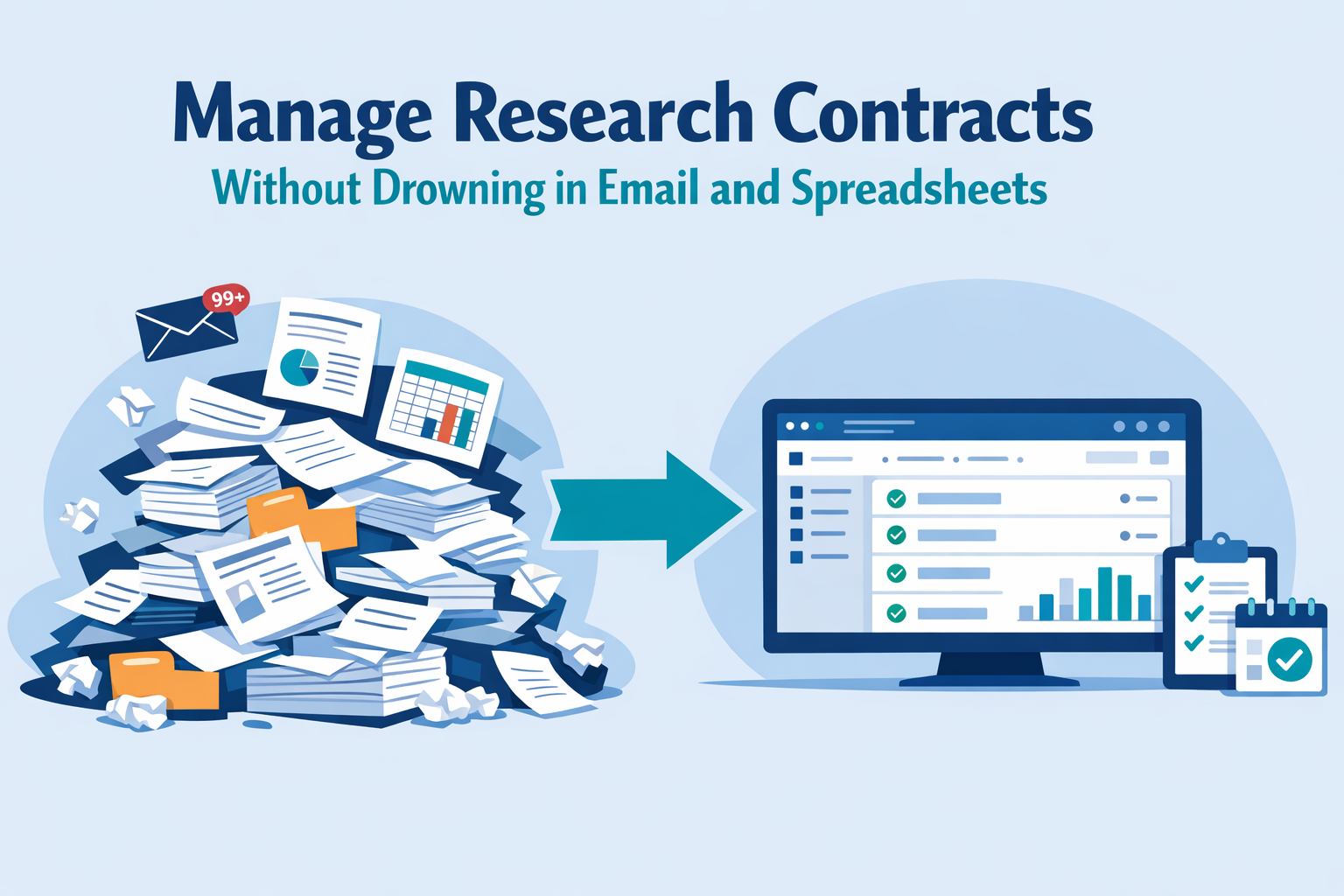
How to Manage Research Contracts Without Drowning in Email and Spreadsheets
You know how it goes. A PI emails asking about the status of a material transfer agreement. You search your inbox. Then the shared drive. Then you message a colleague who was handling it before they went on leave last month. Twenty minutes later, you find a draft, but is it the latest version? Did the sponsor already sign? Is there a redlined copy somewhere else?
This is how most research offices manage contracts. It is not a failure of effort or competence. It is the natural consequence of trying to run a modern research enterprise on tools that were never designed for the job. Spreadsheets, email threads, shared drives, and the occasional sticky note on a monitor have gotten you this far. And for a while, it works well enough.
Until it does not.
The Real Cost of Spreadsheet-Based Contract Management
Nobody sets out to build a fragile contract management system. It happens gradually. One person starts a tracker in Excel. Someone else creates a folder on the shared drive. Email becomes the default approval mechanism. Before long, you have a system. Just not one anyone designed.
Here is what that system actually costs you.
Missed renewals. Agreements lapse without anyone noticing because the spreadsheet does not send reminders. The PI keeps working under an expired agreement. The funding keeps flowing. Nobody raises a flag until a compliance review surfaces the gap. Or worse, until there is a dispute and no valid contract to fall back on.
Version chaos. A negotiation produces six email threads, three Word documents named “Agreement_FINAL”, and a PDF on SharePoint that might or might not be the executed copy. When a question arises about the agreed terms two years later, no one can say with confidence which version was actually signed. You end up re-reading every attachment in every thread, hoping to piece together the history.
No visibility. A simple question, “How many active agreements do we have with this sponsor?”, becomes a research project. If your Vice Chancellor or Provost asks for a report on total contract volume by agreement type, you are looking at hours of manual work pulling data from multiple sources, and the result is only as accurate as the last time someone remembered to update the tracker.
Knowledge loss. When a contract manager leaves, retires, or transfers to another department, their institutional knowledge leaves with them. Their inbox, their mental map of which agreements are in play and where the bodies are buried. All of it goes dark. The team left behind spends weeks reconstructing what was in progress. This is one of the most quietly damaging risks in any research office, and it is almost never addressed until it is too late.
Audit vulnerability. When auditors request a complete contract inventory, you cannot produce one. At least not quickly or confidently. The scramble to locate executed copies, approval records, and amendment histories across email, drives, and filing cabinets is stressful, time-consuming, and rarely ends with a clean result. If this scenario sounds familiar, our guide on preparing for a compliance audit covers how to get ahead of it.
Duplicated effort. Two people in different parts of the office negotiate similar terms with the same sponsor because neither knew the other’s agreement existed. One department signs an NDA with a company while another department is already six months into a research collaboration with the same counterparty under different terms. Without a central view, these overlaps are invisible until they cause a problem.
None of this makes you bad at your job. It makes you someone using the wrong tools for an increasingly complex job.
What “Good” Looks Like
If spreadsheets and email are the floor, what does the ceiling look like? Here is what a well-functioning research contract operation actually looks like in practice.
Every contract is searchable in one place. Not scattered across inboxes, shared drives, departmental file servers, and desk drawers. Every agreement, including drafts, executed copies, and amendments, lives in a single, searchable system. When someone asks “do we have an active agreement with this sponsor?”, the answer takes seconds, not hours. A dedicated contract lifecycle management platform makes this the default state of operations rather than an aspiration.
Automated reminders before renewals and milestones. The system tracks expiry dates, notice periods, deliverable deadlines, and funding milestones, then sends reminders to the right people at the right time. You stop discovering that an agreement expired three months ago and start getting notified 90 days before it happens.
Clear status tracking. Every agreement has a visible status: draft, in review, approved, out for signature, signed, active, expired. At any point, anyone with the right permissions can see exactly where a contract stands in the workflow without sending an email asking for an update.
Analytics that answer real questions. How long does it take your office to turn around an NDA? Which agreement types create the most bottlenecks? How many agreements are expiring in the next quarter? These are not theoretical questions. They are the questions that research leadership, compliance officers, and department heads ask regularly. A proper system makes the answers available at a glance, not after a week of spreadsheet archaeology.
Self-service for standard agreements. A PI needs an NDA for a potential industry collaborator. Instead of emailing the contracts office and waiting in a queue, they submit a request through an intake form. The system routes it through the appropriate approval workflow, generates the agreement from an approved template, and moves it through to execution, with the contracts team overseeing the process rather than manually handling every step.
A complete audit trail. Every version, every approval, every comment, every change is logged automatically with timestamps and user attribution. When an auditor asks “who approved this deviation from standard terms?”, the answer is recorded in the system, not buried in someone’s sent folder.
How to Get There
Knowing what good looks like is one thing. Getting there from where you are now is another. Here is practical advice for making the transition without disrupting the work that cannot stop.
Start small. Do not try to migrate your entire contract portfolio on day one. That path leads to a six-month project that stalls at month three. Instead, draw a line: all new agreements from this date forward go into the new system. Legacy contracts can be migrated in batches later, prioritised by risk and value.
Pick high-volume agreement types first. NDAs, material transfer agreements (MTAs), and data use agreements (DUAs) are ideal starting points. They are high-volume, relatively standardised, and they benefit enormously from templating and workflow automation. Getting these right quickly also builds confidence across the team.
Build playbooks for your top agreement types. A playbook defines how a specific agreement type should be reviewed: which clauses are non-negotiable, which have approved fallback positions, and which require escalation. Starting with playbooks for your top three agreement types gives your team a consistent framework and reduces reliance on individual expertise. Our guide on building a university contract clause library walks through this process in detail.
Get department buy-in by showing them what they get. The fastest way to win adoption is to show department administrators and PIs the self-service intake forms. When a department head sees that their team can request an NDA in two minutes instead of sending an email and waiting a week, you have an advocate. Roll out intake forms early, even before the full workflow is in place.
Do not over-customize. Every institution has unique requirements, but fewer than you might think. Use the system’s defaults wherever they fit. Customise only where your institution genuinely differs from standard practice. Over-customisation is the most common reason contract management implementations stall. The system becomes a bespoke software project instead of a tool people actually use.
Bring your team along. Change is hard, especially for experienced contract professionals who have built effective personal systems over years. Acknowledge that. Involve the team in configuration decisions. Let them see their expertise reflected in the playbooks and templates. The goal is not to replace their judgment. It is to give them better tools to apply it.
What to Look for in a System
This is not the place for a full buyer’s guide. That is a separate conversation. But if you are starting to evaluate options, here are the essentials.
Fast implementation. If the vendor talks about a 12-month implementation timeline, keep looking. Research offices need to be operational quickly. Look for systems that can be configured and live in days or weeks, not months.
Handles diverse agreement types. Research offices do not deal in a single contract type. You need a system that handles research collaboration agreements, MTAs, NDAs, DUAs, consulting agreements, sub-awards, and sponsored research agreements, without requiring you to shoehorn each type into a generic workflow.
Playbook-based review, not just document storage. A contract repository is useful, but it is not enough. You need a system that actively supports the review process: guiding reviewers through clause-level checks, flagging deviations from approved positions, and routing exceptions to the right approver.
Works the way research offices work. Generic enterprise CLM tools are designed for procurement departments and sales teams. They can be adapted for research, but the adaptation is often painful and expensive. Look for a system that understands the research contracting workflow, including multi-party agreements, funder flow-down requirements, and the relationship between grants and contracts.
For a more detailed evaluation framework, see our guide on what to look for in contract management software for research universities.
Conclusion
The spreadsheet is not going to break today. But it will break, and it will break at the worst possible time. During an audit. During a leadership transition. During a dispute with a sponsor when you need to produce the executed agreement and the approval history, and all you can find is a draft in someone’s former inbox.
The research offices that handle contracts well are not doing anything extraordinary. They are doing the same work you do, with a system that was designed for it. The contracts still need to be negotiated. The terms still need to be reviewed. The agreements still need to be signed. The difference is that every step is visible, every version is preserved, and no one has to spend 20 minutes searching for a document they know exists but cannot find.
If you are ready to move beyond the spreadsheet, we would be happy to show you how Pactly works. No pressure, no 90-minute sales pitch. Just a conversation about what your office needs and whether we can help.
See it in action
Turn contract chaos into a streamlined workflow
Join legal teams who cut contract turnaround time by 60%. Book a 15-minute demo to see how.