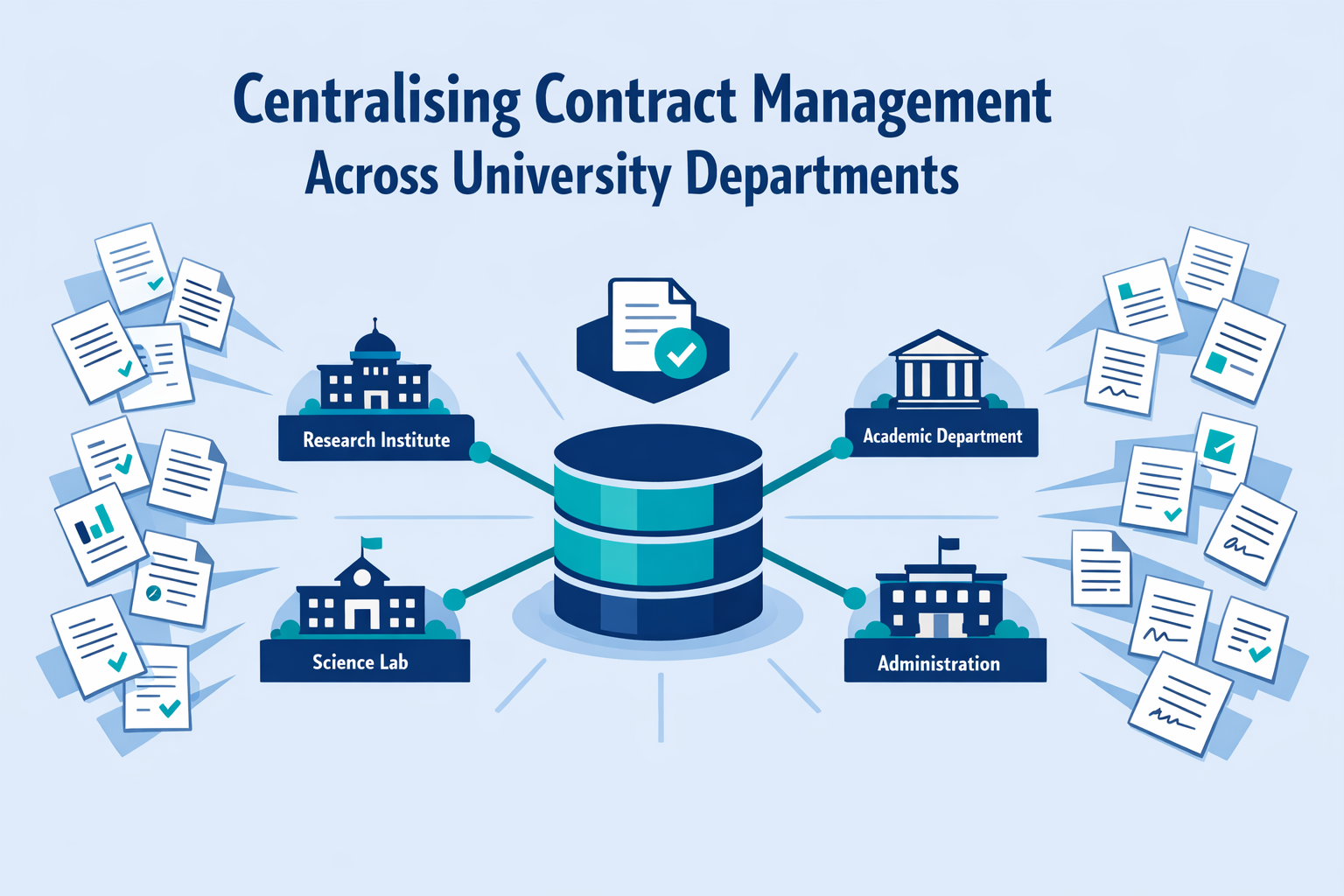
Centralising Contract Management Across University Departments
Most universities do not have one contract management problem. They have seventeen: one per faculty, plus research centres, joint institutes, and administrative departments. Each operates differently. Some use spreadsheets. Some use email folders. Some use nothing at all.
When leadership asks “how many active contracts do we have?” nobody can answer. Not because people are careless, but because there has never been a single system that ties everything together. The contracts exist. The visibility does not.
This article covers how to centralise contract management across university departments without killing the autonomy that faculties need to operate effectively.
The Decentralisation Problem
Decentralised contract management is not an accident. It is the natural result of universities being organised as federations of semi-autonomous units. Faculties have their own research agendas, industry partnerships, and operational needs. Over time, each develops its own approach to managing the agreements that support those activities.
The problem is not that departments manage contracts. The problem is what happens when nobody can see across departments.
No single view of the university’s contract portfolio. The Office of Sponsored Programs knows about research agreements. Procurement knows about vendor contracts. The Faculty of Engineering knows about its industry collaborations. But nobody has the complete picture. When the Provost or VP Administration needs a portfolio-level view, it takes weeks of manual collection to assemble one.
Duplicate agreements with the same counterparty. Two faculties negotiate separate NDAs with the same company. Three departments have independent service agreements with the same software vendor, each at different price points. Without cross-departmental visibility, there is no way to know this is happening.
Inconsistent terms. One faculty routinely accepts IP assignment clauses that another would reject outright. A department agrees to unlimited indemnification that legal counsel would never approve if they saw the contract. When there is no central standard, every department sets its own risk tolerance.
Compliance gaps. Regulatory requirements like data protection, export control, and sanctions screening apply university-wide. But without a central system, there is no way to verify that every department is following the same standards. Gaps only surface when something goes wrong or when auditors come looking.
Audit vulnerability. Auditors expect a complete picture. They do not accept “we think Engineering has those contracts on a shared drive somewhere” as an answer. Decentralised management makes audit preparation an exercise in archaeology rather than reporting.
Knowledge silos. When a department’s contract administrator leaves, their institutional knowledge leaves with them. The filing conventions, the renewal dates tracked in a personal spreadsheet, the verbal agreements with counterparties. All of it disappears. The next person starts from scratch.
Centralisation Models
There is no single correct model for centralising contract management. The right approach depends on your university’s size, structure, and culture. Here are the three most common models.
Full Centralisation
All contracts flow through a central legal or Office of Sponsored Programs team. The central team drafts, reviews, negotiates, and manages every agreement.
Works well for: Smaller institutions with manageable contract volumes and a well-staffed central office.
The trade-off: At scale, full centralisation creates bottlenecks. A central team processing contracts for seventeen faculties will inevitably develop a queue. Faculties that need a fast turnaround on a routine NDA or material transfer agreement end up waiting behind complex industry partnerships. Frustration builds. Departments start going around the system, which defeats the purpose.
Federated Model
A central system and central standards, but departments retain day-to-day management for routine agreements. The central team handles complex, high-value, or high-risk contracts. Think of it as shared infrastructure with distributed execution.
Works well for: Large research universities with diverse faculties and high contract volumes. This is the model that institutions like NUS, with seventeen faculties and schools, tend to gravitate toward.
The trade-off: Requires clear definitions of what is “routine” versus what requires central handling. Without well-defined thresholds, departments may handle agreements that should have been escalated.
Hub-and-Spoke
The central team sets policy, provides tools, and maintains the system. Each department designates a “contract champion,” someone trained in the system and the standards, who handles execution within guidelines. The central team provides oversight, training, and support.
Works well for: Universities that want consistency but need to respect departmental autonomy. The contract champion model builds local capacity while maintaining central visibility.
The trade-off: Success depends on the quality of your contract champions. If the role is treated as an afterthought and assigned to whoever has the lightest workload, standards will drift.
Which Model Fits?
Most research universities land on the federated or hub-and-spoke model. Full centralisation works in theory but struggles with the volume and diversity of contracts that large institutions generate. The federated model gives you the visibility of centralisation with the responsiveness of departmental management.
The key is not which model you choose. It is that you choose one deliberately, rather than letting decentralisation happen by default.
Designing Role-Based Access
One of the most common objections to centralisation is “I don’t want other departments seeing my contracts.” This is a legitimate concern. A centralised system does not mean universal access. It means structured access.
The principle is straightforward: everyone who needs to see a contract can see it. Nobody who does not need to see it can. Role-based access control makes this possible without requiring manual permissions management for every agreement.
Here is an example access matrix for a large university:
| Role | Scope | Access Level |
|---|---|---|
| Legal Counsel | All contracts | Full edit and approval |
| VP Research / Provost | All contracts | View and reporting |
| OSP Director | All research agreements | Full edit and approval |
| Department Head / Dean | Own department’s contracts | View, initiate, approve |
| Principal Investigator | Contracts they are named on | View, comment |
| Finance Officer | Budget and payment terms across all contracts | View financial fields only |
| Contract Champion | Own department’s contracts | Create, edit, submit for approval |
| External Auditor | Designated contract sets | Read-only, time-limited |
The important thing is that the underlying data lives in one place. The access layer determines who sees what. A contract lifecycle management platform handles this through permissions and workspace structures rather than through separate copies of documents scattered across departments.
This also addresses the signing authority question directly. When the system knows who has authority to approve which types of agreements, it can enforce those rules automatically rather than relying on people to remember them.
The Migration Path
The biggest mistake institutions make is trying to migrate everything at once. The “big bang” migration, scanning every historical contract, entering all metadata, training all departments simultaneously, sounds comprehensive. In practice, it stalls. The scope is too large, the data quality is too inconsistent, and the people doing the work burn out before they see results.
A phased approach works better because each phase delivers visible value.
Phase 1: New Contracts From Day One
Set a date. From that date forward, every new contract goes into the system. No exceptions. This is the easiest phase because you control the process from the start. New contracts get proper metadata, proper filing, and proper workflows.
This phase alone solves the “going forward” problem. It stops the bleeding. Every day that passes, your centralised repository becomes more complete relative to your active portfolio.
Phase 2: Active Agreements With Upcoming Events
Migrate active agreements that have upcoming renewals, milestones, or deliverables. These are the contracts you need to act on soon, so there is a natural incentive to get them into the system. Start with agreements expiring in the next 6-12 months.
This phase delivers immediate value because it gives you a working renewal calendar and milestone tracker for the agreements that matter most right now.
Phase 3: Remaining Active Contracts
Bulk import the remaining active contracts. Most systems support spreadsheet import for metadata, with document uploads for the actual agreements. This is the phase where you call on departments to send in their files.
Do not let perfect be the enemy of good here. If a department can provide the contract document and five key metadata fields (parties, type, start date, end date, value), that is enough to get it into the system. You can enrich the records over time.
Phase 4: Historical Archive
Import historical contracts for reference. These are expired or terminated agreements that you may need to refer back to for audit purposes, precedent, or counterparty history. They do not need the same level of metadata as active agreements. A document and basic identification is sufficient.
The critical point: do not wait for Phase 4 to be complete before declaring success. By the end of Phase 2, you already have a working centralised system for everything that matters operationally. Phases 3 and 4 are about completeness, not functionality.
What to Standardise vs. What to Leave Flexible
Centralisation fails when it tries to standardise everything. Faculties are autonomous for good reason. They have different counterparties, different regulatory environments, and different operational rhythms. A one-size-fits-all approach will be resisted, and rightly so.
The goal is consistency in standards, flexibility in execution.
Standardise These
| Area | Why It Matters |
|---|---|
| Naming conventions | So contracts can be found by anyone, not just the person who created them |
| Status tracking stages | So “in review” means the same thing in every department |
| Approval workflows | So the right people review the right contracts, every time |
| Clause library positions | So the university negotiates from consistent positions on key terms like IP, indemnification, and liability |
| Counterparty records | So the institution knows its full relationship with each counterparty |
Leave These Flexible
| Area | Why Flexibility Matters |
|---|---|
| Department-specific templates | A Faculty of Medicine MTA looks different from an Engineering consultancy agreement |
| Local workflow preferences | Some departments want weekly reviews; others prefer ad hoc processing |
| Reporting views and dashboards | Each department head has different priorities and different questions |
| Communication preferences | Some departments want email notifications; others prefer in-system alerts |
The approval workflows are a good example of this balance. The rule that “contracts above $500,000 require VP approval” should be universal. Whether a department reviews contracts on Tuesdays or Thursdays is their business.
Making It Stick
A centralised system only works if people use it. The most common failure mode is not technical. It is adoption. Departments revert to email and spreadsheets because the system feels like overhead rather than an improvement.
Here is how to prevent that.
Self-serve intake forms. Business teams and PIs should be able to initiate a contract request without emailing legal and waiting for a response. A structured intake form captures the information legal needs, routes the request to the right team, and gives the requester a tracking number. Departments love this because it removes the “black hole” feeling of sending a contract request into an inbox and hearing nothing for two weeks. Self-service intake is often the single feature that drives adoption.
Quick wins first. Start with high-volume, low-complexity agreements: NDAs and material transfer agreements. Show departments that a process that used to take two weeks now takes two days. Once they see the speed improvement on routine agreements, they will voluntarily bring more complex contracts into the system.
Executive sponsorship. VP Research or Provost backing makes adoption mandatory, not optional. Without executive sponsorship, centralisation is a suggestion. With it, departments understand that participation is expected. The executive does not need to be involved in the details. They need to communicate that this is institutional priority, not an IT project.
Track adoption metrics. Measure contracts created through the system versus contracts created outside it. If a department is still sending contracts via email, that is a conversation to have early, not a pattern to let calcify. Share adoption dashboards with department heads so they can see their own progress relative to other departments.
Invest in training. Two one-hour sessions, one for contract champions and one for general users, go a long way. Record them for new staff. The most successful rollouts include department-specific training that shows people how the system handles their specific contract types, not just a generic demo.
Conclusion
Centralising contract management is not about control for control’s sake. It is about giving the institution the visibility it needs to manage risk, maintain compliance, and make informed decisions, while preserving the speed and autonomy that faculties depend on.
The universities that do this well do not try to change how departments work. They give departments better tools and a shared framework, then let them operate within it. The result is an institution that can answer “how many active contracts do we have?” in seconds, not weeks.
If you are dealing with scattered contracts across multiple faculties and want to see how a federated model could work at your institution, book a demo and we will walk you through it.
You may also find these related guides useful: preparing for a compliance audit, building a contract clause library, and streamlining internal approvals.
See it in action
Turn contract chaos into a streamlined workflow
Join legal teams who cut contract turnaround time by 60%. Book a 15-minute demo to see how.