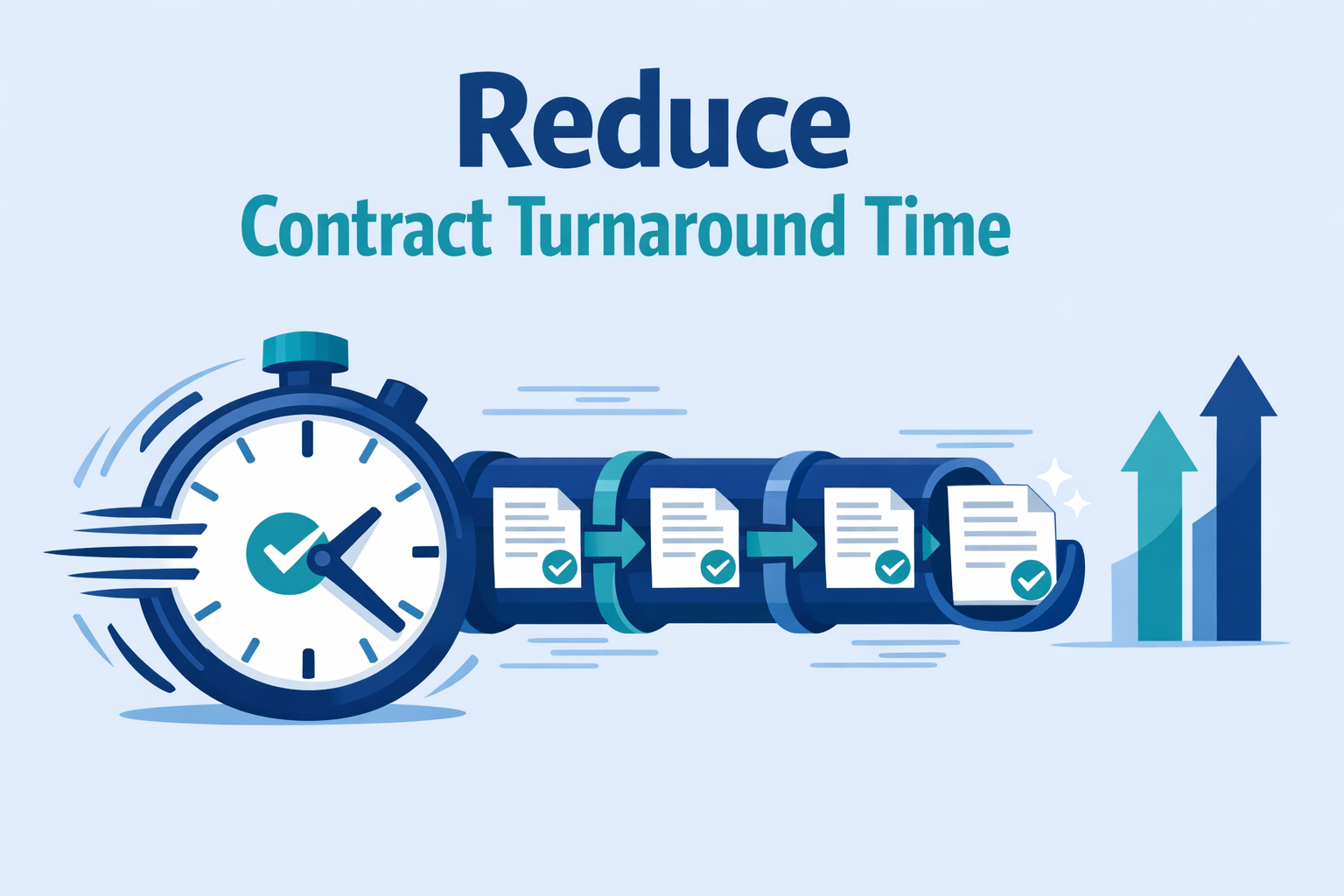
How to Reduce Contract Turnaround Time in Your Research Office
Your PIs think contracts take too long. Your sponsors are pushing for faster execution. And your team is working as hard as it can, but the queue keeps growing.
Before you throw more headcount at the problem, or worse, start skipping steps, you need to understand where the time is actually going. Most research offices have a general sense that “things take too long,” but few can point to the specific stage where days or weeks are being lost.
This article breaks the contract lifecycle into measurable stages, gives you benchmarks to aim for, and identifies five levers that compress cycle time without compromising quality.
If you are looking for a more tactical, step-by-step implementation guide, our companion article on reducing contract cycle times in university research offices covers specific operational changes you can make today.
Where Contract Time Actually Goes
Every research agreement passes through roughly the same stages. The problem is that most offices track only the total elapsed time from request to execution. They know it took 47 days, but not which 47 days went where.
Here is how the lifecycle typically breaks down, along with the time ranges we see across research offices:
Intake and Triage (1-3 days)
This is the time between a PI submitting a contract request and a reviewer picking it up. It includes receiving the request, classifying the agreement type (NDA, MTA, sponsored research, clinical trial agreement), and assigning it to the right person.
In offices without a structured intake process, this stage alone can take a week because requests arrive by email, lack key information, and require back-and-forth before work can begin. If your office is still managing contracts through email and spreadsheets, intake is likely your biggest source of lost time.
Initial Review (3-10 days)
The assigned reviewer reads the agreement, identifies issues, and prepares redlines. The range here depends heavily on agreement complexity, but also on whether the reviewer has to figure out the acceptable positions from scratch every time.
A reviewer who opens a 30-page industry-sponsored research agreement without a contract playbook will spend hours just deciding what to push back on. A reviewer with clear fallback positions and pre-approved language can focus entirely on what deviates from standard.
Internal Routing (5-15 days)
This is the stage most offices underestimate. After the reviewer prepares their analysis, the agreement often needs input or sign-off from the IP office, export control, finance, the department head, and sometimes legal counsel.
When these reviews happen sequentially (IP reviews first, then passes to finance, then to the department), each handoff adds days of queue time. The agreement sits in someone’s inbox waiting for attention.
This is often the biggest hidden time sink in the entire lifecycle. The irony is that these internal reviewers usually need only 30 minutes to an hour of actual work. The delay comes from waiting, not working.
Negotiation (10-60+ days)
The back-and-forth with the counterparty is the most visible stage and the one that gets the most attention. It is also the stage over which your office has the least unilateral control, since you depend on the other party’s responsiveness and flexibility.
Negotiation timelines vary enormously by counterparty. A peer institution might turn redlines in a week. A large pharmaceutical company with 200 active deals might take a month to respond to each round.
Execution (3-10 days)
The agreement is finalized and needs signatures from all parties. In offices still using wet signatures, this stage involves printing, routing for physical signature, scanning, and sometimes couriering documents to the counterparty.
Even with electronic signatures, execution can stall if the signing authority is traveling, if the counterparty uses a different e-signature platform, or if internal policies require physical signatures for certain dollar thresholds.
The Key Insight
Most offices instinctively focus on speeding up negotiation because it is the longest single stage. But internal routing is often where the most recoverable time is hiding. Negotiation depends on the other party. Internal routing depends entirely on you.
How to Measure It
You cannot improve what you do not measure. And measuring total turnaround time is not enough. You need stage-level visibility.
Track Time by Stage
Record timestamps for each transition: when the request was submitted, when review started, when redlines were sent internally, when internal approvals cleared, when the first redline went to the counterparty, and when signatures were collected.
Even a simple spreadsheet with these six timestamps will reveal where your time goes. A contract lifecycle management platform automates this tracking entirely.
Measure by Agreement Type
NDAs, MTAs, sponsored research agreements, and clinical trial agreements should not be lumped together. An NDA that takes three weeks signals a serious process issue. A complex multi-site clinical trial agreement that takes three months may be entirely reasonable.
Set separate benchmarks for each agreement type:
- NDAs: 2-5 business days
- MTAs (standard): 1-2 weeks
- Sponsored research (industry): 4-8 weeks
- Clinical trial agreements: 8-16 weeks
- Sub-awards: 4-6 weeks
If your NDAs are averaging 15 days, that points to a triage or routing problem, not a negotiation problem.
Track by Reviewer
This is not about blame. It is about identifying bottlenecks and capacity issues. If one reviewer consistently has longer cycle times, they may be overloaded, handling more complex agreements, or lacking tools that others have.
Reviewer-level data helps you redistribute work, identify training needs, and make staffing decisions based on evidence rather than gut feel.
Make It Visible
Analytics dashboards that surface these metrics in real time change behavior. When a department head can see that three agreements are waiting on their approval, the queue moves faster. When leadership can see average cycle times trending up, they can allocate resources before the backlog becomes a crisis.
Five Levers to Compress Cycle Time
Once you know where the time goes, you can apply targeted pressure to the stages that matter most.
Lever 1: Playbooks Reduce Review Time
If your reviewer knows the acceptable positions before opening the document, initial review drops from days to hours. A playbook defines your standard position, acceptable fallback, and escalation trigger for each key clause.
Instead of reading every clause and deliberating, the reviewer compares the incoming language against the playbook and flags only what falls outside the acceptable range.
This is especially powerful for high-volume, lower-complexity agreements like NDAs and MTAs. With a well-maintained playbook, contract review becomes a deviation check rather than a fresh analysis.
Lever 2: Parallel Routing Eliminates Dead Time
The biggest gains often come from restructuring internal routing. Instead of sending the agreement sequentially from IP to finance to the department head, send it to all of them simultaneously. Each reviewer focuses on their own area of expertise.
This single change can cut 5-10 days from the internal routing stage. The agreement no longer waits in three queues. It waits in one.
For a deeper dive into how to structure parallel approvals, see our guide on streamlining internal approvals for university research contracts.
Lever 3: Self-Serve for Standard Agreements
If PIs can generate a standard NDA through a guided intake form without involving a reviewer at all, your team handles fewer low-value tasks. The NDA is generated from pre-approved templates, routed directly for signature, and executed without ever entering the review queue.
This does two things: it delivers sub-24-hour turnaround for the PI, and it frees reviewer capacity for the complex agreements that actually need expert attention.
Lever 4: AI-Assisted Review Flags Issues Faster
Contract automation through AI-assisted review does not replace the reviewer. It changes how they spend their time. Instead of reading every clause in a 40-page agreement, the system flags deviations from your standard positions, highlights unusual terms, and surfaces risk.
The reviewer then focuses on the flagged items rather than performing a line-by-line read. For agreements that closely match your standard terms, this can reduce review time from hours to minutes.
Lever 5: E-Signatures Remove the Execution Bottleneck
No more printing, scanning, walking documents between offices, or couriering to the counterparty. Electronic signatures reduce the execution stage from days to hours.
More importantly, they create a clear audit trail and eliminate the ambiguity of “I think I signed that last week.” The agreement is either signed or it is not, and everyone can see the status in real time.
What Not to Do
Speed is important, but not at any cost. Here are the most common mistakes offices make when trying to reduce turnaround time:
Do not skip review steps to go faster. Speed without quality creates risk. A poorly reviewed IP clause in a sponsored research agreement can cost the university millions in lost licensing revenue. Every step in your workflow exists for a reason. The goal is to make each step faster, not to eliminate steps that provide value. Skipping risk assessment to save time can cost the university far more than the days you recover.
Do not set arbitrary deadlines without fixing the underlying process. Telling your team “all NDAs must be done in 5 days” without addressing the intake bottleneck or the sequential routing that adds a week of dead time is setting them up to fail. Fix the process first, then measure against realistic targets.
Do not blame the negotiation phase if the real problem is internal routing. It is tempting to point at the counterparty when a contract takes two months. But if 20 of those 60 days were spent waiting for internal approvals, the counterparty is not your biggest problem.
Conclusion
Speed comes from removing unnecessary waiting, not from rushing necessary work. The offices that achieve consistently fast turnaround times are not cutting corners. They are eliminating dead time between steps, giving reviewers better tools, and routing work in parallel instead of in sequence.
Start by measuring where your time actually goes. The data will tell you exactly which levers to pull.
If you want to see how Pactly helps research offices track cycle times and streamline the contract approval workflow from intake to execution, book a demo and we will walk you through it.
See it in action
Turn contract chaos into a streamlined workflow
Join legal teams who cut contract turnaround time by 60%. Book a 15-minute demo to see how.