Building a Contract Playbook for Your Research Office
A contract playbook tells your team exactly what to accept, what to push back on, and when to escalate. For research offices handling Research Collaboration Agreements, Material Transfer Agreements, Non-Disclosure Agreements, and Data Use Agreements, a good playbook means the difference between resolving a routine NDA in 2 days versus 2 weeks.
If you are new to playbooks, our definitive guide covers the fundamentals: what they contain, how they are structured, and why they matter. This article focuses on building one specifically for a research office, where the agreement types, risk profiles, and stakeholder dynamics are unlike anything in a commercial legal team.
Why Research Offices Need Their Own Playbook
Generic contract playbooks are built around commercial transactions: vendor agreements, SaaS subscriptions, customer MSAs. They cover liability caps and service levels. They do not cover what to do when a sponsor demands ownership of foreground IP, or when a collaborating institution wants to delay publication by 12 months to protect a patent filing.
Research agreements have provisions that commercial contracts simply lack:
- IP ownership. This includes the critical distinction between background IP and foreground IP, which determines who controls the inventions that emerge from the research.
- Publication rights. Sponsors often request review periods before publication. The length and scope of these review periods is one of the most frequently negotiated terms in university agreements.
- Materials use restrictions. MTAs may limit how materials can be used, whether they can be modified, and whether derivatives are covered.
- Data access and ownership. Data Use Agreements introduce questions about who can access research data, for what purpose, and under what security requirements.
Beyond clause-level differences, research offices face a structural challenge: they handle many agreement types simultaneously, each with its own risk profile and regulatory context. A single contract manager might review an NDA in the morning, an MTA after lunch, and an RCA before the end of the day. Without a playbook, each review relies on individual judgment, and that judgment walks out the door when staff turn over.
Staff turnover is a real concern. Research offices at universities and public institutions often experience higher attrition than corporate legal teams. A playbook preserves institutional knowledge so that the next person in the role is not starting from scratch.
Start with Your Top 3 Agreement Types
The most common mistake when building a playbook is trying to cover everything at once. You end up with a 60-page document that nobody reads and nobody maintains.
Instead, start with three agreement types. Pick the ones that consume the most time, generate the most back-and-forth, or create the most risk when handled inconsistently.
For most research offices, the right three are:
NDAs: Highest Volume, Lowest Complexity
NDAs are the quick win. They are high-volume, relatively standardized, and a natural place to delegate review to junior staff once positions are documented.
Your NDA playbook section should cover:
- Mutual vs. unilateral. When do you insist on mutual? When is a one-way NDA acceptable?
- Term length. What is your preferred confidentiality period? What is the minimum you will accept?
- Carve-outs for publication. Research NDAs need specific language protecting the right to publish results. A commercial NDA template will not include this.
- Definition of confidential information. Should oral disclosures be covered? What about research data generated during the collaboration?
For a deeper dive into NDA playbook structure, see our NDA playbook guide.
MTAs: Common and Standardizable
Material Transfer Agreements govern the exchange of biological materials, chemical compounds, software tools, and datasets between institutions. They are common enough to warrant standardization, yet many offices still review them ad hoc.
Key positions to define:
- Permitted use. Is the recipient limited to the specific project described, or can they use materials for broader research purposes?
- Modification rights. Can the recipient modify the materials? Who owns derivatives?
- IP for inventions using the materials. If a researcher uses transferred materials to create something new, who controls that invention?
- Compliance and safety obligations. Biosafety, export controls, and ethical use restrictions.
For more on MTA structure, see our guide to Material Transfer Agreements.
RCAs: Most Complex, Highest Value
Research Collaboration Agreements are the most heavily negotiated agreements in a research office. They involve multiple parties, significant funding, and long timelines. Getting the playbook right here has the biggest impact on negotiation efficiency.
Focus your RCA positions on:
- Foreground IP ownership. This is the single most contested provision. Define your preferred model (university owns, licences to sponsor), your acceptable fallback (inventorship-based ownership with licence-back), and your walk-away position (sponsor owns all foreground IP).
- Publication review periods. How long can a sponsor review a manuscript before publication? 30 days is typical; 90 days is often acceptable; anything beyond that needs escalation.
- Indemnification. Public universities often cannot indemnify. Your playbook should state this clearly and provide alternative language.
- Overhead rates. What is your institutional rate, and under what circumstances can it be negotiated?
Our guide to Research Collaboration Agreements covers the full anatomy of an RCA.
Then Extend
Once your NDA, MTA, and RCA playbook sections are working, meaning your team is actively using them and you have collected some feedback, extend to Data Use Agreements, Clinical Trial Agreements, and subaward agreements. Each new agreement type follows the same structure. The hard part is not writing more positions; it is building the habit of using them.
Playbook Structure: Preferred, Acceptable, Walk-Away
For each key clause in each agreement type, document four things:
Preferred position. This is your ideal language, what you include in your own templates when you are the drafting party. It reflects your institution’s risk tolerance under normal circumstances.
Acceptable fallback. This is what you can live with when the counterparty pushes back. Critically, this position should be pre-approved by senior counsel or the General Counsel’s office. The whole point is that the reviewer can accept this position without escalating.
Walk-away position. This is the line you will not cross. If the counterparty’s position falls below this threshold, the reviewer stops negotiating and escalates.
Guidance notes. This is the context that helps the reviewer understand why the position matters. Without it, positions become arbitrary rules that people work around instead of follow. Good guidance notes explain the institutional risk, reference relevant policies or regulations, and provide talking points for communicating the position to the counterparty.
Here is what this looks like in practice for IP ownership in an RCA:
| Position | Language |
|---|---|
| Preferred | University owns all foreground IP. Sponsor receives a non-exclusive, royalty-free licence for internal research purposes, with an option to negotiate a commercial licence on fair terms. |
| Acceptable | Foreground IP owned based on inventorship. Each party owns IP created solely by its employees. Joint inventions are jointly owned. Sponsor receives a first right to negotiate a commercial licence. |
| Walk-away | Sponsor owns all foreground IP regardless of inventorship. Escalate to Associate Director or General Counsel. |
| Guidance | University policy requires retention of IP ownership to protect academic freedom and future research use. Inventorship-based models are acceptable because they align with patent law defaults. Full assignment to sponsor undermines the university’s ability to build on its own research and should only be approved in exceptional circumstances with VP Research sign-off. |
This structure works because it gives the reviewer clear boundaries and the authority to act within them. The reviewer does not need to call senior counsel for every redline, only when the negotiation moves beyond the pre-approved positions.
Key Clauses to Cover in a Research Playbook
Regardless of which agreement types you start with, certain clause categories appear across nearly all research agreements. Here is a practical checklist:
- IP ownership (background and foreground). Define what each party brings in and what happens to new IP. See our background IP vs foreground IP guide for detailed guidance.
- Publication rights and review periods. Protect the right to publish while giving sponsors reasonable time to review for confidential information or patentable inventions.
- Indemnification and liability caps. Public institutions often have statutory limitations on indemnification. Your playbook should flag this and provide alternative risk allocation language.
- Confidentiality scope and duration. Research confidentiality provisions need to accommodate academic norms around open science and data sharing.
- Data ownership and access. Especially important for DUAs and multi-site studies. Define who owns generated data, who can access it, and under what conditions.
- Governing law and dispute resolution. Many universities have policies requiring their home jurisdiction. Document this clearly.
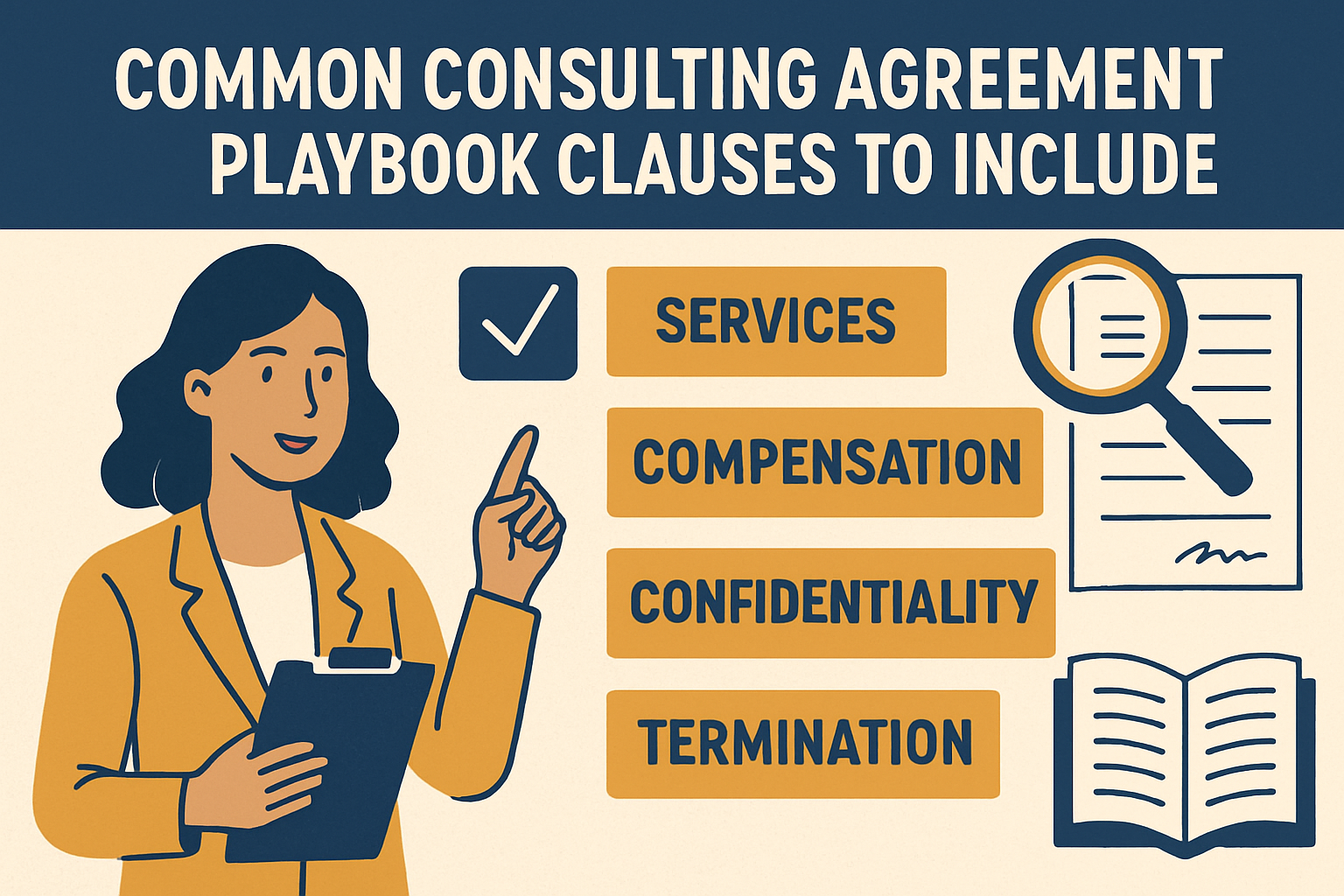
- Termination and wind-down. Research projects cannot be stopped overnight. Playbook positions should address what happens to ongoing experiments, graduate students, and unpublished results.
- Cost sharing and overhead rates. Institutional overhead rates are often set by policy. Your playbook should specify when and how they can be negotiated.
You do not need to have fully developed preferred/acceptable/walk-away positions for every clause on day one. Start with the clauses that generate the most negotiation friction and build out from there.
From Document to System
A playbook in a Word document or a shared drive is better than nothing. It captures institutional knowledge, gives reviewers a reference point, and creates consistency.
But document-based playbooks have a shelf life. They get duplicated. They go stale. The version on the shared drive is not the version the new hire downloaded three months ago. And when a reviewer is deep in a negotiation, they are unlikely to switch to a separate document to look up the acceptable fallback position for indemnification.
The real value of a playbook comes when it is embedded in your review workflow, when the guidance appears alongside the contract you are reviewing, not in a separate file.
This is what operationalizing a playbook means:
- Define positions once, apply them automatically. With Pactly Playbooks, you define your preferred, acceptable, and walk-away positions for each clause type. When a contract is reviewed, whether manually or with AI assistance, the system flags deviations from your positions automatically.
- Build a clause library with pre-approved language. Instead of rewriting acceptable fallback language from memory, reviewers can pull from a centralized clause library with pre-approved alternatives available in one click.
- Track which positions you are actually using. Analytics reveal which fallback positions your team reaches most frequently. If you are always falling back on the same clause, that tells you something: either your preferred position is unrealistic, or you need to renegotiate your standard template.
None of this replaces the intellectual work of deciding what your positions should be. But it eliminates the friction between having positions and actually using them.
Getting Started
A playbook will not eliminate negotiation. Counterparties will still push back. Sponsors will still request IP terms you do not like. Collaborating institutions will still have their own templates and their own preferences.
What a playbook eliminates is the unnecessary parts of negotiation: the time spent figuring out whether a position is acceptable when someone already made that decision six months ago, the inconsistency between what one reviewer accepts and another rejects, the institutional knowledge that disappears when an experienced contract manager moves on.
Start with your top three agreement types. Define positions for the clauses that generate the most friction. Get it in front of your team and start collecting feedback. The first version will not be perfect, and that is fine. A playbook that is 80% right and actively used will outperform a comprehensive document that sits untouched on a shared drive.
If you are ready to move your playbook from a static document to an operational tool, get in touch. We can show you how other research offices have set this up.
See it in action
Turn contract chaos into a streamlined workflow
Join legal teams who cut contract turnaround time by 60%. Book a 15-minute demo to see how.